Overview
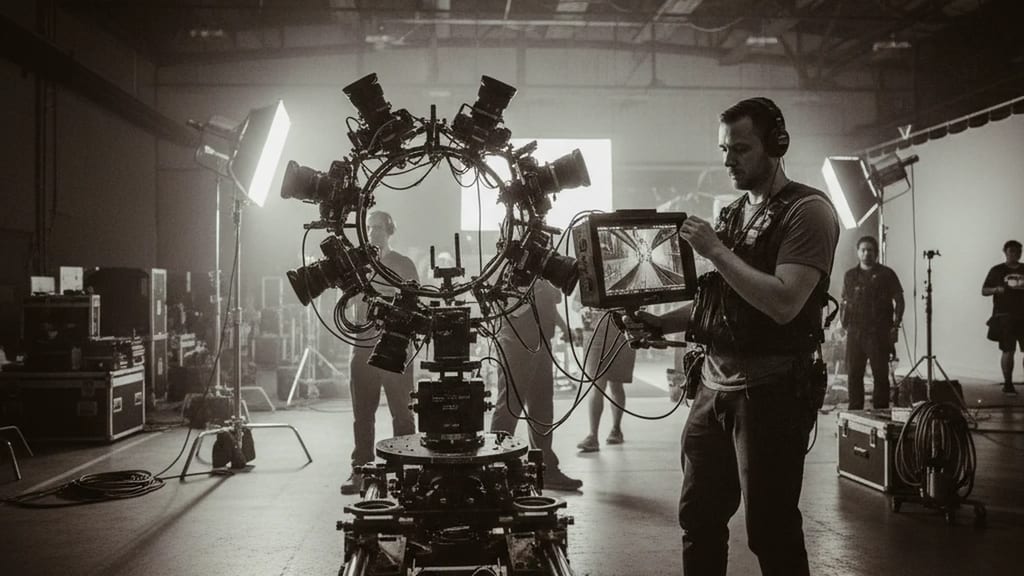
A 360 camera (also known as an omnidirectional or 360-degree camera) captures the entire scene around the camera's viewpoint simultaneously. Instead of a limited image frame, it records a complete spherical panorama: 360 degrees horizontally and 180 degrees vertically, from the ground (nadir) to the zenith. This is achieved either by a compact camera with multiple fixed lenses (typically two opposing wide-angle or fisheye lenses) or by a rig of several individual cameras whose images are composited into a seamless spherical image.
The individual images are combined through stitching: the color and contrast of the overlapping shots are matched and calculated into a continuous panorama. Stitching is done either in-camera or downstream in specialized software. The result is usually saved in equirectangular projection and can be interactively explored in VR headsets or via mouse/touch.
Technology
360 cameras are operated monoscopically or stereoscopically. Monoscopic delivers the same image to both eyes, while stereoscopic creates a spatial 3D impression through separate images per eye. Well-known devices and rigs from production practice include, among others, Ricoh Theta, Insta360, GoPro Omni, Samsung Gear 360, and the Nokia OZO.
- Recording Principle: multiple lenses/sensors, simultaneous capture of overlapping areas
- Image Compositing: stitching in-camera or in post-production
- Storage Format: equirectangular projection (360 degrees azimuth, 180 degrees nadir to zenith)
- Modes: monoscopic or stereoscopic (VR/3D)
On-Set Usage
For lighting and grip, the 360 camera presents a fundamental challenge: since it records almost everything around it, there is no classic "off-screen" area. Lamps, tripods, cables, and the crew are potentially visible; only the area directly beneath the camera support remains hidden.
Techniques used in practice to hide light sources and equipment:
- Practicals: utilizing existing lights in the set (lamps, windows), possibly equipping them with stronger bulbs
- Clean Plate: shooting the scene once with, and once without, lamps, and compositing them in post to mask visible light sources
- Hiding behind furniture or the camera tripod, followed by digital retouching (e.g., nadir/ground replacement)
- Exposure Plates: combining multiple takes with different exposures to compensate for the high dynamic range of the sphere