Overview
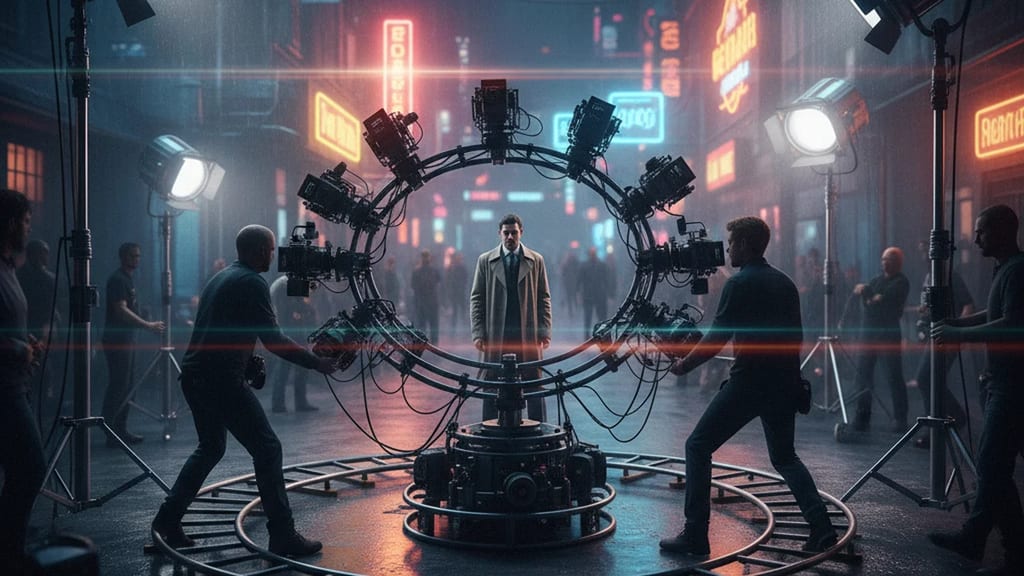
The 360 Shot (also known as a 360-degree move, 360 tracking shot, or more fully, an arc shot) is a camera movement where the camera circles the subject in a complete 360-degree circular motion. The subject typically remains stationary and in the center of the frame, while the camera moves completely around it. The term derives from the arc shot (from English arc = bow): while a classic arc shot describes only a partial arc, the 360 shot completes the circle entirely.
This movement is used to heroically elevate a subject, build tension in confrontations, establish the surrounding space, or create disorientation, dizziness, and emotional intensity in the viewer. By isolating the subject from the changing background, the continuous movement draws attention to the central figure.
Technique and Equipment
For a clean execution, one of the following methods is typically employed:
- Circular Dolly / Curved Track System: The camera runs on a circular track around the subject, keeping the image plane steady.
- Steadicam: On locations without tracks, the movement is executed handheld with a stabilized support system.
- Gimbal: Electronically stabilized mounts allow for fluid circling without a fixed setup.
The camera height can be varied during the move to enhance the disorienting effect; similarly, the direction of rotation can be reversed mid-movement. A well-known special technical form is the Bullet Time effect from The Matrix, where around 120 still cameras were arranged in a circle around the subject, and the individual frames were interpolated to create a fluid circling.
On-Set Usage
A proven approach divides the circling into four quadrants: by filling each quadrant creatively, the circular movement is emphasized. If the camera and subject move simultaneously, the execution requires precise coordination between the camera team and the actor. Due to the complete circling, the lighting must be consistent all around, and the set must be illuminated 360 degrees without stands, lights, or crew entering the frame.
Notable Examples
- The Avengers (2012): Circling the assembled heroes as a moment of unity.
- The Dark Knight: Complete circling to heighten the sense of threat.
- Moonlight: Opening scene reflecting a character's troubled state of mind.