Cinematographer
From a DoP's perspective, this element is essential for the visual design. It allows me to consistently implement the desired color mood and aesthetic image.
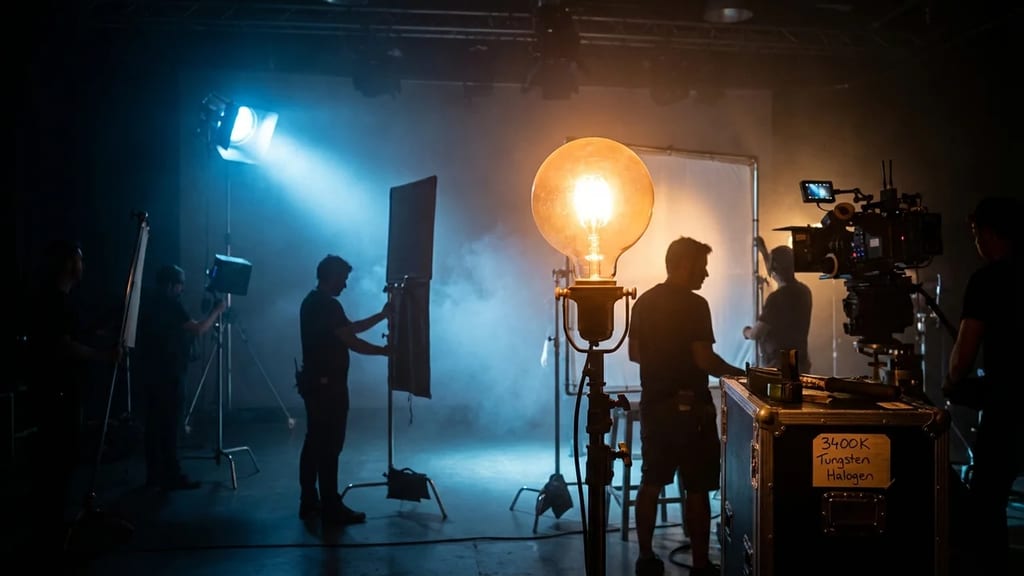
3400K: A photographic color temperature standard (Kelvin) historically associated with photoflood lamps and Type-A film balanced for 3400K lighting.
3400K (read "3400 Kelvin") refers to a standardized color temperature in photo and film lighting. It lies between the classic studio artificial light of 3200K and significantly cooler daylight (around 5500–6500K). The light at 3400K therefore appears slightly whiter and less warm-orange than the 3200K commonly used in film production, but remains clearly within the warm artificial light spectrum.
Historically, 3400K is closely linked to two things: Photoflood lamps (overdriven incandescent lamps for high light output) and Type A color film, which was precisely calibrated for 3400K. Compared to the currently dominant 3200K standard (Type B film or the "Tungsten" preset on cameras), 3400K is the less common of the two classic artificial light reference values.
In photographic and film technology, two reference color temperatures for artificial light have become established. They determine which light source a color film or a camera white balance setting is calibrated for:
| Color Temperature | Film Type | Typical Light Source |
|---|---|---|
| 3200K | Type B (Tungsten) | Studio Halogen/Tungsten Spotlights |
| 3400K | Type A | Photoflood Lamps |
Since the difference of 200K is small, it can be bridged with slight correction filters. An 81A filter is used to correctly expose Type B (3200K balanced) film under 3400K Photofloods. Conversely, if daylight film (approx. 5500K) is to be used under 3400K Photofloods, a Wratten 80B filter is employed, which raises the color temperature from 3400K to around 5500K.
Photoflood lamps are incandescent lamps that are deliberately operated above their rated voltage or designed with a higher filament temperature to deliver high light output at 3400K – at the cost of a very short lifespan.
The most common type bears the ANSI lamp code BBA (also "Photoflood No. 1"):
The extremely short lifespan is characteristic of Photofloods: they trade longevity for maximum brightness and the defined color temperature.
On modern sets, 3400K is less relevant as its own lighting standard – 3200K dominates for Tungsten sources, with which the camera's "Tungsten" white balance setting also corresponds. Today, 3400K is primarily encountered as a specification on Photoflood lamps, in analog film practice (Type A film), and as a reference value in color temperature and filter charts. Anyone working with Photofloods or Type A material must consider the 200K difference to 3200K when mixing with other Tungsten sources and during white balancing or filter selection to avoid color casts.
From a DoP's perspective, this element is essential for the visual design. It allows me to consistently implement the desired color mood and aesthetic image.
This professional solution increases production efficiency and reduces post-production requirements. It allows for flexible, rapid adjustments during the shoot.
As a gaffer, this is an indispensable tool in my daily toolkit. It allows me professional light control and quick adjustments on set, which saves time and ensures quality.
1. Zu welchem Department gehört „3400K (Fotolicht)"?
2. Wie viele verschiedene Fachperspektiven bietet dieser Eintrag?
The Lexikon is part of the Filmfarm ecosystem — alongside budgeting (FilmBalance), an industry magazine (FilmCircus) and crew networking (FilmCall, CrewMesh). One shared vocabulary for the whole production.