Cinematographer
From a DoP's perspective, this element is essential for the visual design. It allows me to consistently implement the desired color mood and aesthetic image.
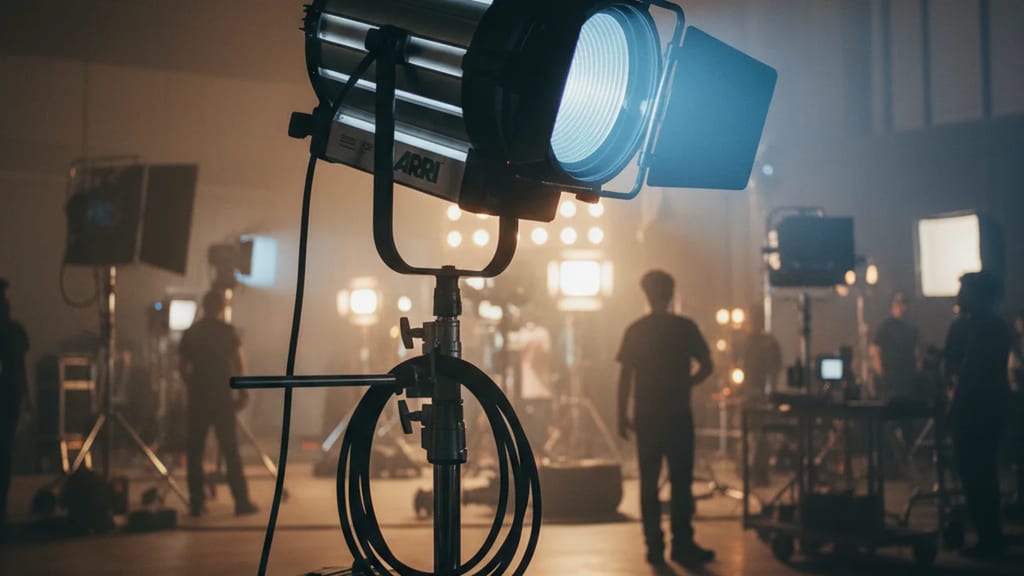
4000W HMI spotlight: daylight-balanced discharge lamp unit in the 4-kilowatt class, operated via separate electronic ballast.
"4000W HMI" does not refer to a single fixture, but rather a power class of daylight-balanced fixtures utilizing a 4-kilowatt HMI lamp. HMI stands for Hydrargyrum Medium-arc Iodide – a metal halide gas-discharge lamp that generates light via an arc between two electrodes, rather than a filament. Unlike Tungsten sources, HMIs inherently provide daylight color temperature and are significantly more efficient, producing a light output from a 4kW lamp suitable for exterior and large interior shots.
The 4kW class is a common "workhorse" standard on set: large enough to simulate windows, fill shadows, or push through diffusion, but without the logistical overhead of 6kW, 12kW, or 18kW heads. The lamp is housed within the fixture head; it must be operated via a separate electronic ballast, which ignites and stabilizes the arc.
The 4kW lamp is used in various head types:
Many 4kW heads are designed as dual-wattage, accepting either a 2500W or a 4000W lamp, which is often reflected in the model name (e.g., "40/25").
Values refer to the single-ended Osram/Sylvania lamp (model 54321); other manufacturers and designs may vary.
| Characteristic | Value |
|---|---|
| Power | 4000 W |
| Color Temperature | 6000 K (Daylight) |
| Color Rendering Index (CRI) | approx. 90 |
| Luminous Flux | approx. 380,000 lm |
| Base | GX38 |
| Type | single-ended (SE) |
| Average Lifespan | approx. 500 h |
HMI lamps are also manufactured as double-ended (e.g., Osram HMI 4000 W/DXS). The daylight characteristic is specified by manufacturers in the range of approximately 5600–6000 K.
The 4kW HMI always requires a compatible electronic ballast, typically configured as a 2500/4000W ballast. Modern electronic ballasts operate flicker-free and offer switchable high-frequency modes (e.g., 300 Hz or 1000 Hz) for slow-motion shooting. HMIs are only dimmed to a limited extent – typically down to about 50% – as heavy dimming affects color temperature and arc stability; for finer adjustments, diffusion, nets (scrims), or distance are usually employed.
Practical notes: HMI lamps ignite with high voltage and require a cool-down period after being switched off before they can be reignited (unless equipped with hot-restart). Due to UV emission and the lamp's burst pressure, the protective front glass is a safety feature and must not be removed during operation.
From a DoP's perspective, this element is essential for the visual design. It allows me to consistently implement the desired color mood and aesthetic image.
This professional solution boosts production efficiency and cuts down post-production demands. It allows for flexible, rapid adjustments during the shoot.
As a gaffer, this is an indispensable tool in my daily toolkit. It allows me professional light control and quick adjustments on set, which saves time and ensures quality.
1. Zu welchem Department gehört „4000W HMI"?
2. Wie viele verschiedene Fachperspektiven bietet dieser Eintrag?
The Lexikon is part of the Filmfarm ecosystem — alongside budgeting (FilmBalance), an industry magazine (FilmCircus) and crew networking (FilmCall, CrewMesh). One shared vocabulary for the whole production.