तकनीकी विवरण
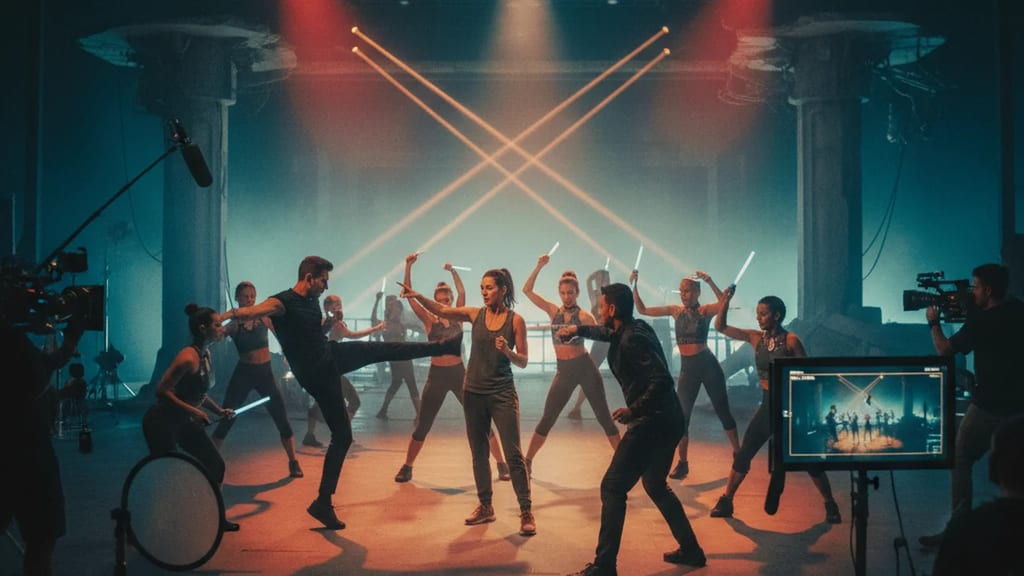
the choreographic notation is done via ground plans with grid measurements (usually 1:50 scale), in which movement lines, stop points, and gaze directions are drawn. for fight scenes, the standard safety distance between actors is at least 15 cm for simulated blows. dance choreographies are organized in 8-count structures (32 beats per phrase), while action sequences are often rhythmized in 4/4 time. the paths are fixed using markings (tape marks) on the floor, with t-shaped markings used for stop positions and arrows for movement directions.
इतिहास और विकास
the first documented film choreography originated in 1895 in the lumière shots, where workers were consciously positioned for the camera. busby berkeley revolutionized camera choreography in 1933 with "42nd street" through geometric formations of up to 200 dancers. stanley kubrick established in 1975 with "barry lyndon" the precise notation of camera movements in relation to actor movements over scene times of up to 3 minutes without cuts. digitization since the 1990s enables pre-visualization software like maya or frameforge for three-dimensional movement planning.
फिल्म में व्यावहारिक उपयोग
in "goodfellas" (1990), scorsese choreographed the famous copacabana shot over 184 seconds with 47 different actor positions. action films like "john wick" (2014) use fight choreography with an average of 15 movements per 10-second sequence. in musical film adaptations, playback speeds of 23.976 fps are precisely matched to the choreography rhythm. the workflow includes: blocking rehearsals (2-3 days), marking runs (1 day), full-intensity rehearsals before shooting begins.
तुलना और विकल्प
choreography differs from blocking by its rhythmic component and precise timing structure. while blocking defines basic positions, choreography defines the exact movement dynamics. stunt coordination focuses on safety aspects for risky movements. motion capture has replaced traditional choreography notation in vfx-intensive productions since the 2000s, but still requires basic choreographic planning for the reference performance of the actors.