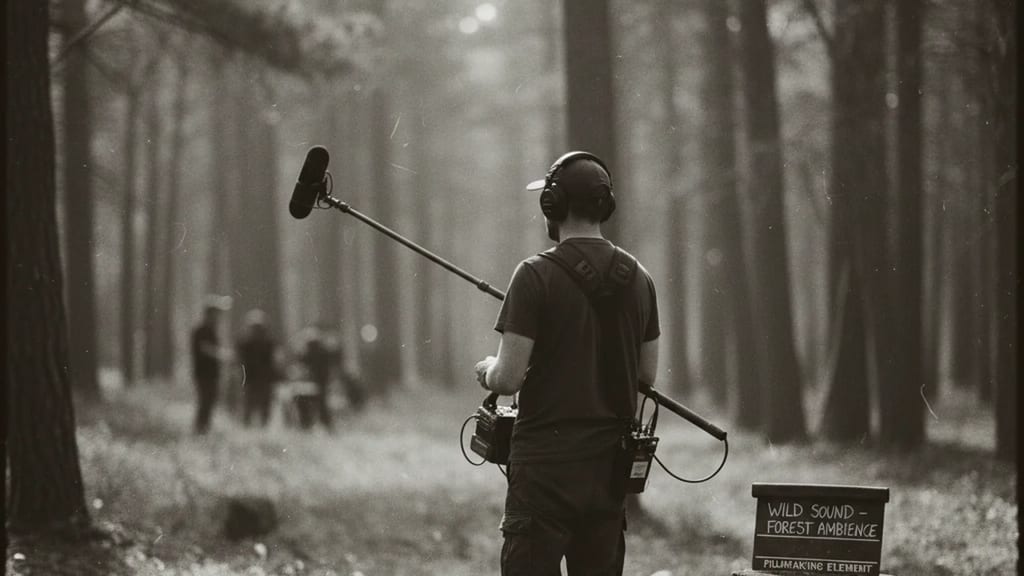
Technical Details
Wild sound is recorded by default at 48 kHz/24 bit in uncompressed WAV or BWF files. Recording duration varies between 30 seconds and 5 minutes, depending on the required material. Sound recordists use identical microphone positions and preamp settings as for dialogue recording to ensure acoustic consistency. Modern field recorders like the Sound Devices 833 automatically tag wild sound recordings with corresponding metadata and timecode references.
Three main types exist: Room Tone (pure atmosphere without activity), Ambiance with specific sounds (traffic, machinery), and Wild Lines (dialogue repetitions without camera operation). Each type receives its own channel configurations and folder structures in post-production.
History & Development
Wild sound recording originated in 1929 with the introduction of sound film, when technicians realized that purely studio atmospheres did not harmonize with original locations. In 1932, RCA developed the first standardized procedures for "wild recording" in Hollywood productions.
The breakthrough came in 1958 with Robert Altman's experiments in "The Delinquents," where systematic wild sound recordings were used for dramatic effect for the first time. Digital Audio Workstations since the 1990s have significantly simplified integration and editing. Modern AI-based tools like iZotope RX have been able to automatically analyze wild sound and seamlessly integrate it into scenes since 2018.
Practical Use in Film
Christopher Nolan used extensive wild sound recordings from the original beach for "Dunkirk" (2017) to create an authentic sea atmosphere. Sound recordist Mark Weingarten recorded 20-30 minutes of wild sound daily, which ended up in the final mix at 40%.
Standard workflow: After each scene, actors remain still on set for 2-3 minutes while wild sound is recorded. This "sound pole" (tone matching) allows for seamless cuts and dialogue editing. For exterior shoots, wild sound compensates for changing weather conditions between different takes.
Disadvantages arise with impatient actors or time-critical shooting schedules, as high-quality wild sound recordings cannot be rushed.
Comparison & Alternatives
Wild sound differs from Foley sounds through its connection to the original location and from sound libraries through its set-specific acoustics. Room Tone describes only the silent atmosphere of a room, while wild sound also includes active soundscapes.
Modern alternatives such as Ambisonics recordings with the Sennheiser Ambeo VR Mic capture 360° spatial sound, but require specialized post-production software. Artificial reverb plugins like Altiverb simulate original locations but do not achieve the natural microphone characteristics of real wild sound. Low-budget productions often resort to stock audio, but lose the acoustic authenticity of the shooting location.