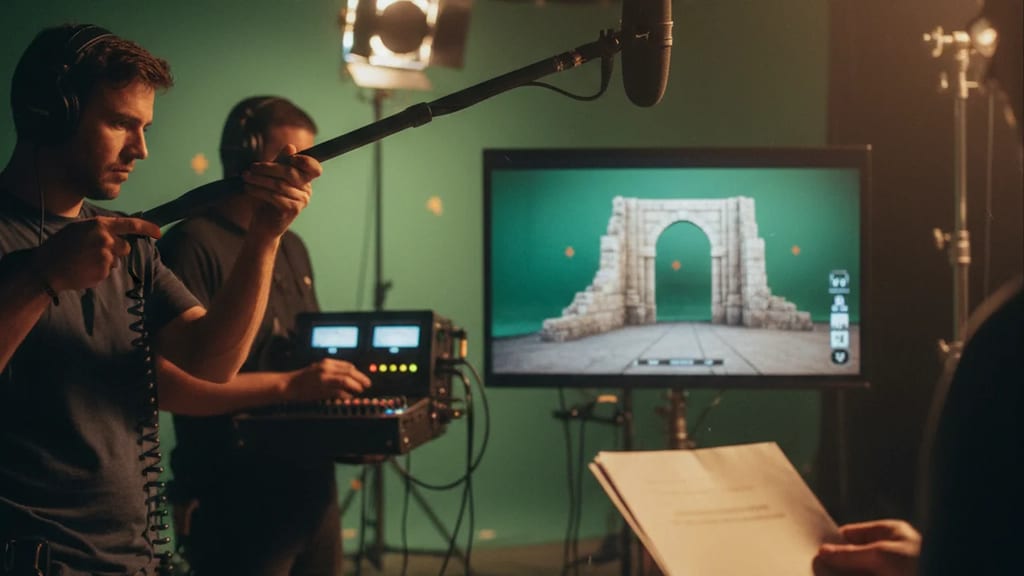
Spoken voice originating off-screen — laid over images to narrate, explain, or comment. Cuts to rhythm and scene, never to lip-sync.
You lay a voice over images whose mouths are not moving — that is voice-over. The voice comes from off-screen, working completely independently of lip movements in the image. That is the crucial difference to dubbing: with voice-over, you don't concern yourself with mouth movements; you cut against the editing rhythm, against the image logic, not against rows of teeth.
On set or in the edit, you use voice-over for narrative voices — an invisible first-person narrator reporting from the past while we see scenes. Or for commentary: a documentary film where an objective voice explains what we are currently seeing. Or for inner monologues — the thoughts of a character that we hear while their face remains silently in the frame. Voice-over also works for telephones: a person is on the line, we only hear the other side off-screen — that is then voice-over, not dubbing, because no lip is visible.
Practically, this means: you don't write the voice simultaneously with mouth movements, but lay it freely over the edited film. This gives you flexibility — you can place the voice where it fits dramatically, not where a mouth is whispering. A long voice-over passage across multiple shots creates continuity and reflection. You can edit while the voice is running because there is no sync requirement. This fundamentally distinguishes voice-over from dubbing, where every word is coupled to mouth movement.
In the edit, you ensure that voice-over doesn't become a crutch — it only works if the images themselves have content. A weak sequence of shots with a strong voice-over doesn't get better; it becomes dependent. Work against the visual direction, not with it: if the image shows, the voice should interpret or contradict. Voice-over is a tool of narration, not decoration. Pay attention to the balance between image and voice in the mix — voice-over needs space but doesn't have to dominate. It accompanies.
Related terms
Quiz
1. Zu welchem Department gehört „Off-Ton"?