Filmlexikon.
Support
Omnidirectional
Sound · Terms

Omnidirectional

Murnau AI illustration
omnidirectional microphone sound perspective hypercardioid direct sound on set sound omnies original sound sync sound

Omnidirectional microphone with spherical pickup pattern capturing sound equally from all 360° directions. Used for room ambience recording and concealed placement in props.

Technical Details

Omnidirectional microphones typically operate with a pressure transducer, where only one side of the diaphragm is exposed to sound pressure. The frequency response remains omnidirectionally stable up to approximately 10 kHz, beyond which the characteristic becomes increasingly directional. Condenser microphones achieve a frequency range of 20 Hz to 20 kHz with a sensitivity of -37 dBV/Pa. Dynamic omnidirectional microphones often exhibit a more limited frequency response from 50 Hz to 15 kHz, but higher robustness at a maximum sound pressure level of 134 dB SPL.

History & Development

The first practical omnidirectional microphone was developed by Western Electric in 1916 as a carbon microphone for telephony. Georg Neumann introduced the first tube condenser microphone, the CMV3, in 1928. The breakthrough came in 1962 with Neumann's U67, which offered switchable polar patterns for the first time. Modern digital signal processing has enabled omnidirectional condenser microphones with extremely linear frequency response and low self-noise of 7 dB-A since the 2000s.

Practical Use in Film

Omnidirectional microphones are used as ambient microphones for ambience recordings and as fill microphones in multi-track setups. In "Apocalypse Now" (1979), Walter Murch used omnidirectional microphones for the complex jungle atmospheres. In dialogue scenes, they are placed as hidden microphones in props, as their non-directional nature compensates for positioning errors. Disadvantages: higher susceptibility to feedback and poorer separation in multi-microphone setups compared to directional microphones.

Comparison & Alternatives

Unlike the cardioid with its heart-shaped polar pattern or the shotgun with its extreme directionality, the omnidirectional microphone captures sound equally from 360°. Modern alternatives include adaptive microphone arrays that simulate various polar patterns via DSP. In stereophony, the omnidirectional microphone is used for AB stereo, while XY technique requires cardioid microphones. Lavalier microphones mostly use an omnidirectional polar pattern due to the unpredictable body movements of the speakers.
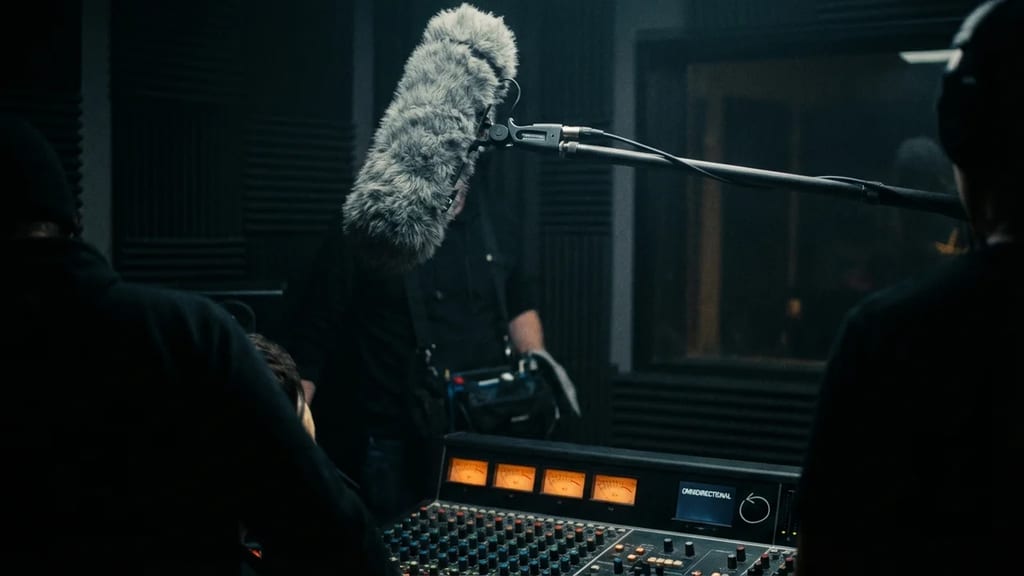
From the crafts

Perspectives

Cinematographer

Ich muss bei Kugelmikrofonen im Bild besonders auf Wind- und Trittschallschutz achten, da sie jeden Störschall aus allen Richtungen aufnehmen. Wenn ich sie als versteckte Mikrofone in Szenenbildern platziere, kann ich flexibler mit Kamerabewegungen arbeiten, weil die Tonqualität nicht von der exakten Ausrichtung abhängt. Bei Steadicam-Fahrten sind sie als Backup ideal, falls das Richtmikrofon durch Erschütterungen unbrauchbar wird.

Director

Kugelmikrofone helfen mir, authentische Raumatmosphären zu schaffen, die das Publikum mitten ins Geschehen ziehen – besonders in Thriller- oder Kriegsszenen. Ich setze sie ein, um natürliche Gespräche einzufangen, bei denen sich Darsteller frei bewegen sollen, ohne dass der Boom ständig nachjustiert werden muss. In Improvisationsszenen geben sie mir die Sicherheit, dass spontane Wendungen trotzdem sauber aufgezeichnet werden.

Producer

Kugelmikrofone reduzieren meine Personalkosten, weil weniger präzise Tonangel-Führung nötig ist und ich dadurch mit weniger erfahrenen Tonassistenten arbeiten kann. Bei Location-Drehs spare ich Zeit, da weniger Setup und Neujustierung zwischen den Takes erforderlich ist. Allerdings muss ich höhere Postproduktionskosten für die Tonmischung einkalkulieren, da die geringere Separation mehr Nachbearbeitung erfordert.

More in the lexikon

Related terms

Test your knowledge

Quiz

1. Was beschreibt „Kugel" am besten?

2. Zu welchem Department gehört „Kugel"?

3. Wie viele verschiedene Fachperspektiven bietet dieser Eintrag?

Report an error
From the Filmfarm ecosystem

Understand visual language, budget productions, connect crew.

The Lexikon is part of the Filmfarm ecosystem — alongside budgeting (FilmBalance), an industry magazine (FilmCircus) and crew networking (FilmCall, CrewMesh). One shared vocabulary for the whole production.

FilmFarm FilmRadarComing soonFilmPulseComing soonFilmNumbersComing soonFilmCapitalComing soonFilmLabComing soonFilmBalanceComing soonFilmCircusComing soon