Filmlexikon.
Support
Unbleached Muslin
Lighting · Terms

Unbleached Muslin

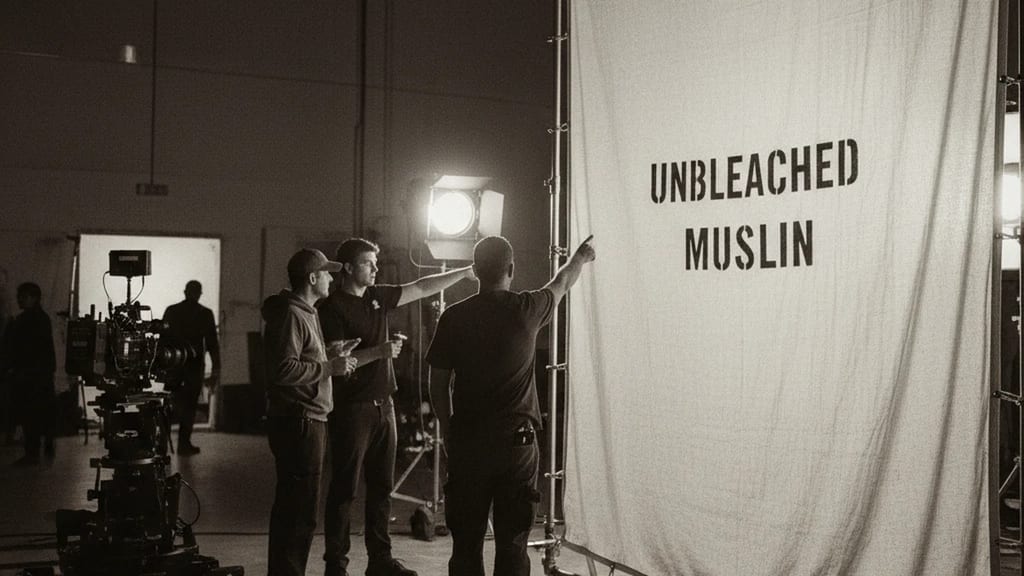
Murnau AI illustration
bleached muslin color temperature flow muslin roll take

Natural cotton fabric for light diffusion with 40–70% transmission, cream tone, and 98–99 CRI. Standard widths 3–6 m, heat-resistant to 180°C.

Technical Details

Standard film muslin is supplied in widths from 3.05m (10 feet) to 6.10m (20 feet). Transmission ranges from 40-70% depending on the weave density, with color temperature neutrality of ±50K between 3200K and 5600K. Unbleached muslin has a slight cream tone with a Color Rendering Index (CRI) of 98-99. The material is heat-resistant up to 180°C and weighs between 120-180g/m². Commonly used variants are 1/4, 1/2, and Full Muslin, which differ in density and corresponding light reduction.

History & Development

The use of muslin as a diffusion material became established in Hollywood studios in the 1930s as a cost-effective alternative to tissue paper. Cinematographer Gregg Toland already used large-scale muslin setups in 1941 for "Citizen Kane" for his characteristic deep-focus lighting. In the 1960s, manufacturers like Matthews Studio Equipment introduced standardized muslin qualities. Since the 1980s, synthetic diffusion materials like Opal Frost have complemented the offering, but muslin remains standard due to its natural properties and cost-effectiveness.

Practical Application in Film

Unbleached muslin is used for large-scale diffusion of daylight through windows or to soften hard artificial light sources. In "The Revenant" (2015), Emmanuel Lubezki used extensive muslin constructions to control natural light without losing the organic lighting mood. Typical setups include 12x12-foot frames for wide-angle shots or 6x6-foot frames for portrait lighting. The advantage lies in uniform diffusion without hotspots, the disadvantage in susceptibility to wind and the space required for the necessary frame constructions.

Comparison & Alternatives

Unlike bleached muslin, the unbleached variant retains a minimally warmer tone, which appears more natural in daylight shots. Modern alternatives like Ultrabounce also reflect light, while Grid Cloth offers stronger light reduction. Lee 250 Half White Diffusion or Rosco 3006 Tough White Diffusion are synthetic films with more precise transmission, but are more expensive and less environmentally friendly. Silk remains the premium alternative with even finer diffusion, but costs three to four times as much.
From the crafts

Perspectives

Cinematographer

Ich setze ungebleichten Musselin hauptsächlich für große Diffusion-Setups ein, wenn ich hartes Sonnenlicht durch Fenster mildern oder HMI-Scheinwerfer großflächig ausleuchten muss. Der leichte Cremeton des ungebleichten Materials harmoniert perfekt mit warmen Hauttönen und gibt mir die Kontrolle über Kontrast, ohne die Natürlichkeit des Lichts zu zerstören. Bei Wind brauche ich allerdings zusätzliche Sandsäcke und Spanngurte.

Director

Musselin ermöglicht mir subtile Stimmungsmodulation, ohne dass das Licht künstlich wirkt - perfekt für intime Szenen oder wenn ich natürliche Tageszeit-Atmosphäre erhalten will. Der warme Unterton des ungebleichten Materials verstärkt emotionale Momente und schafft organische Übergänge zwischen verschiedenen Lichtquellen. Ich kann damit die Zuschauer visuell "einlullen" ohne dass sie die technische Manipulation bemerken.

Producer

Musselin ist kostengünstig in der Anschaffung (ca. 3-5€/m²), aber die notwendigen Rahmen und Stative treiben die Tagesmiete auf 150-300€ pro Setup. Dafür ist das Material wiederverwendbar und reduziert Stromkosten, da weniger elektrisches Licht benötigt wird. Bei Außendrehs muss ich Wetter-Backups einplanen - Wind über 25 km/h macht große Musselin-Setups unmöglich.

More in the lexikon

Related terms

Test your knowledge

Quiz

1. Was beschreibt „Ungebleichter Musselin" am besten?

2. Zu welchem Department gehört „Ungebleichter Musselin"?

3. Wie viele verschiedene Fachperspektiven bietet dieser Eintrag?

Report an error
From the Filmfarm ecosystem

Understand visual language, budget productions, connect crew.

The Lexikon is part of the Filmfarm ecosystem — alongside budgeting (FilmBalance), an industry magazine (FilmCircus) and crew networking (FilmCall, CrewMesh). One shared vocabulary for the whole production.

FilmFarm FilmRadarComing soonFilmPulseComing soonFilmNumbersComing soonFilmCapitalComing soonFilmLabComing soonFilmBalanceComing soonFilmCircusComing soon