Filmlexikon.
Support
Ultrasonic Distance Measure
Camera · Terms

Ultrasonic Distance Measure

Murnau AI illustration
flow para roll take

Non-contact distance measurement using 40 kHz ultrasound (10–50 ms), range 30 cm to 6 m. Operates in low light below 1 Lux; fails on glass and underwater.

Technical Details

The sensor operates at a frequency of 40 kHz and achieves a measurement time of 10-50 milliseconds per cycle. The speed of sound of 343 m/s at 20°C forms the basis for distance calculation. Two main variants exist: monostatic systems with a combined transmitter/receiver and bistatic systems with separate components spaced 2-4 cm apart. The range varies between 30 cm and 6 meters depending on object size and surface texture, with hard, smooth surfaces exhibiting better reflection properties than soft or textured materials.

History & Development

Polaroid introduced the first ultrasonic autofocus in the SX-70 Sonar OneStep in 1978. The technology reached professional film cameras in the early 1980s through Nikon (F3AF, 1983) and Canon (T80, 1985). The breakthrough for motion picture cameras occurred in 1987 with the Sony CCD-V8, the first consumer video camera with ultrasonic AF. By the mid-1990s, this technology dominated the autofocus market before phase-detection and contrast-detection systems took the lead.

Practical Application in Film

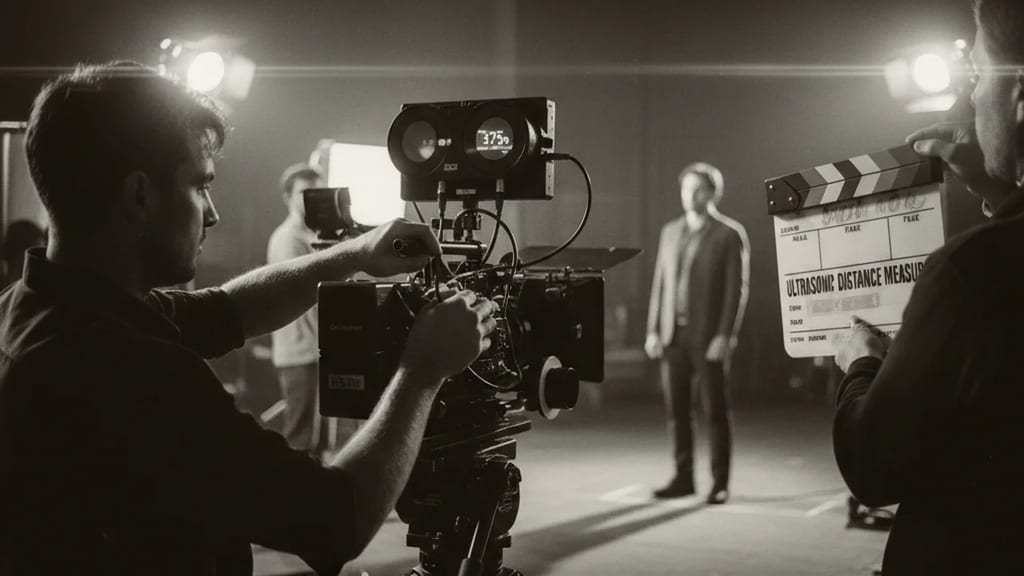
Ultrasonic distance measures prove effective in low-light conditions below 1 lux, where optical systems fail. Documentary filmmakers utilize the technology for discreet shots as it operates without visible AF assist light. The system fails during underwater shots due to the altered speed of sound in water (1500 m/s), leading to measurement errors by a factor of 4.4. Reflective surfaces like windows or mirrors cause false readings, as the ultrasound captures objects behind the intended subject rather than the subject itself.

Comparison & Alternatives

Compared to infrared distance measures, ultrasonic systems work more precisely at short distances but are more susceptible to wind noise and acoustic interference. Modern Dual Pixel CMOS sensors and laser AF systems have largely replaced ultrasonic technology, as they measure 10-20x faster and are not affected by sound reflections. Time-of-Flight (ToF) sensors offer similar non-contact measurement but use infrared light instead of sound waves, achieving measurement times under 1 millisecond.
From the crafts

Perspectives

Cinematographer

Ich schätze Ultraschall-AF bei Available-Light-Drehs in Clubs oder Konzerthallen, wo andere AF-Systeme durch Nebel oder Stroboskop-Effekte versagen. Die konstante Messgeschwindigkeit gibt mir planbare 50ms Reaktionszeit für Fokus-Pulls, allerdings muss ich bei Windaufnahmen oder in der Nähe von Klimaanlagen mit Fehlauslösungen rechnen.

Director

Ultraschall-Entfernungsmesser ermöglichen mir diskrete Dokumentaraufnahmen ohne störende AF-Hilfslichter, die Protagonisten ablenken könnten. Bei Szenen mit Glasscheiben oder Spiegeln plane ich bewusst manuelle Fokussierung ein, da das System zuverlässig das falsche Motiv anmisst und dramaturgisch wichtige Schärfeverlagerungen verhindert.

Producer

Die Wartungskosten für Ultraschall-Systeme sind 30% niedriger als bei Laser-AF, da keine optischen Komponenten verschmutzen können, jedoch begrenzt die 6-Meter-Reichweite den Einsatz bei Weitwinkel-Setups. In staubigen Umgebungen oder bei Außendrehs spare ich durchschnittlich 2 Stunden täglich für AF-Kalibrierung gegenüber optischen Systemen. PRODUZENT: Die Wartungskosten für Ultraschall-Systeme sind 30% niedriger als bei Laser-AF, da keine optischen Komponenten verschmutzen können, jedoch begrenzt die 6-Meter-Reichweite den Einsatz bei Weitwinkel-Setups. In staubigen Umgebungen oder bei Außendrehs spare ich durchschnittlich 2 Stunden täglich für AF-Kalibrierung gegenüber optischen Systemen.

More in the lexikon

Related terms

Test your knowledge

Quiz

1. Zu welchem Department gehört „Ultraschall-Entfernungsmesser"?

2. Wie viele verschiedene Fachperspektiven bietet dieser Eintrag?

Report an error
From the Filmfarm ecosystem

Understand visual language, budget productions, connect crew.

The Lexikon is part of the Filmfarm ecosystem — alongside budgeting (FilmBalance), an industry magazine (FilmCircus) and crew networking (FilmCall, CrewMesh). One shared vocabulary for the whole production.

FilmFarm FilmRadarComing soonFilmPulseComing soonFilmNumbersComing soonFilmCapitalComing soonFilmLabComing soonFilmBalanceComing soonFilmCircusComing soon