Filmlexikon.
Support
Cinetape
Camera · Terms

Cinetape

Murnau AI illustration
flow para roll take

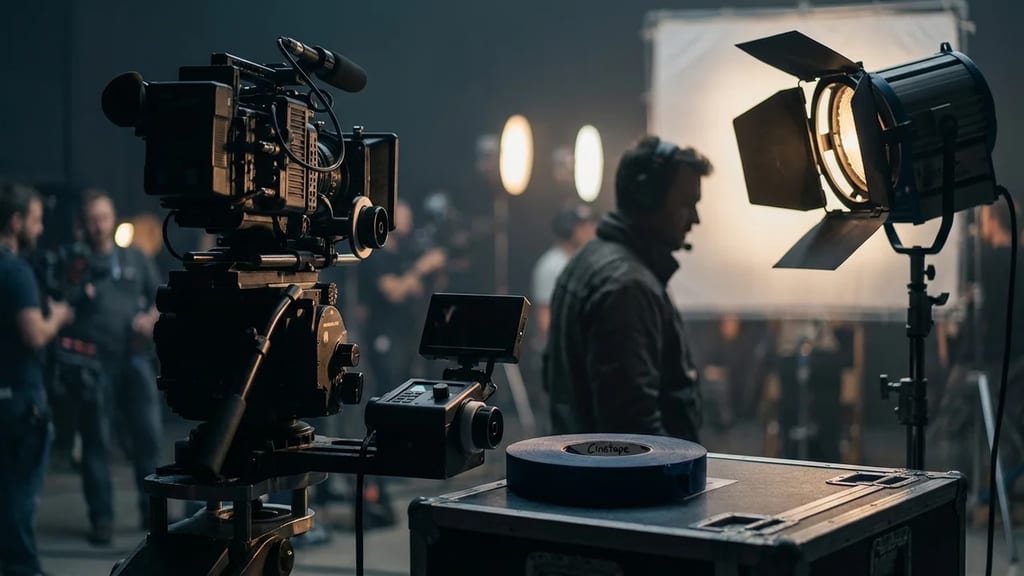
Professional gaffers tape for film sets—marks focus points, secures cables, protects equipment, leaves no residue.

Technical Details

Standard Cinetape has a tensile strength of 180 N/cm at 25mm width and is available in standard widths of 12mm, 19mm, 25mm, 38mm, and 50mm. The adhesive strength is 12-15 N/25mm according to FINAT standards, while the peel adhesion is a maximum of 6 N. Fluorescent Cinetape reflects UV light with a luminance of 300-400 mcd/m² for nighttime shoots. Black Cinetape absorbs 98% of visible light and prevents unwanted reflections on camera equipment.

History & Development

Permacel developed the first professional gaffer tape in 1936, but it wasn't until 1973 that Shurtape released variants specifically optimized for Hollywood studios. In 1981, 3M introduced the P-665 series, which became an industry standard. The development of digital cameras from 2005 onwards necessitated anti-static variants, as conventional tapes caused electrostatic charges that interfered with sensors.

Practical Use in Film

Cinematographers mark focus points on the follow-focus with colored Cinetape – on "Blade Runner 2049," Roger Deakins used red tape for close-ups and blue for wide shots. Gaffers secure cables to tripods with black Cinetape or mark actors' paths on the floor. During exterior shoots, transparent Cinetape protects lenses from spray without compromising image quality. The tape adheres reliably to metal, plastic, glass, and wood alike.

Comparison & Alternatives

Household adhesive tape leaves residue and fails under temperature fluctuations, while duct tape adheres too strongly and damages surfaces. Console tape offers lower adhesion for sensitive surfaces, while spike tape, with its low thickness of 0.13mm, is optimized for floor marking. Modern LED Cinetapes with integrated LEDs are increasingly replacing fluorescent variants, as they are battery-powered and function for 12 hours without recharging.
From the crafts

Perspectives

Cinematographer

Ich verwende täglich verschiedene Cinetape-Farben für mein Schärfeziehen - rot für Protagonist, blau für Hintergrund, gelb für kritische Punkte. Das Band muss sich nach 14-Stunden-Drehtagen noch problemlos ablösen lassen, ohne mein teures Zeiss-Objektiv zu beschädigen. Schwarzes Cinetape an der Mattebox eliminiert Streulicht zuverlässiger als teure Flaggen.

Director

Ich nutze Cinetape-Markierungen am Boden, um Schauspielern diskrete Positionshilfen zu geben, ohne dass sie im Bild sichtbar werden. Bei emotionalen Szenen klebe ich kleine Farbpunkte an die Kamera, damit die Darsteller einen festen Blickpunkt haben. Das schafft authentischere Verbindungen als abstrakte "Kamera anschauen"-Anweisungen.

Producer

Qualitäts-Cinetape kostet 8-12 Euro pro Rolle, aber billige Alternativen für 2 Euro verursachen Folgekosten durch Equipment-Schäden oder Verzögerungen beim Abbau. Pro Drehtag kalkuliere ich 15-20 Rollen verschiedener Breiten ein, bei 60-Tage-Produktionen also 1.200-1.600 Euro reine Tape-Kosten. Die Investition amortisiert sich durch gesparte Reinigungskosten und intaktes Leihequipment.

More in the lexikon

Related terms

Test your knowledge

Quiz

1. Zu welchem Department gehört „Cinetape"?

2. Wie viele verschiedene Fachperspektiven bietet dieser Eintrag?

Report an error
From the Filmfarm ecosystem

Understand visual language, budget productions, connect crew.

The Lexikon is part of the Filmfarm ecosystem — alongside budgeting (FilmBalance), an industry magazine (FilmCircus) and crew networking (FilmCall, CrewMesh). One shared vocabulary for the whole production.

FilmFarm FilmRadarComing soonFilmPulseComing soonFilmNumbersComing soonFilmCapitalComing soonFilmLabComing soonFilmBalanceComing soonFilmCircusComing soon