Filmlexikon.
Support
Ultra Panavision 70
Camera · Equipment

Ultra Panavision 70

Murnau AI illustration
arri skypanel astera hydrapanel company move cooke panchro cooke speed panchro led panel litepanels astra litepanels gemini

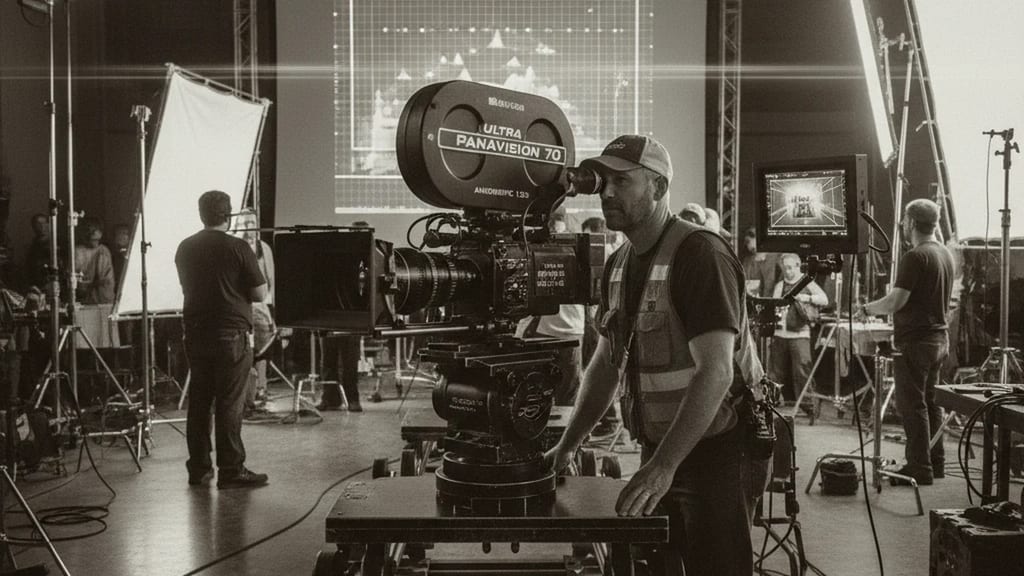
Panavision's 1957 65mm anamorphic system using 1.25× lenses to achieve 2.76:1 ultra-widescreen. Featured in Ben-Hur and The Hateful Eight.

Technical Details

The system uses 65mm negative film with five perforations per frame, producing an image area of 52.6 × 23.0mm. Ultra Panavision lenses compress the image horizontally by a factor of 1.25:1, significantly less than standard anamorphic lenses with 2:1 compression. For projection, 70mm prints with six-channel magnetic soundtracks are used. The focal lengths of the available Ultra Panavision lenses range from 40mm to 200mm, with each lens specifically designed for minimal anamorphic distortion.

History & Development

Panavision introduced Ultra Panavision 70 in 1957 to achieve an even wider aspect ratio than the already established Super Panavision 70 (2.2:1). The first film in this format was "Raintree County" (1957) starring Elizabeth Taylor and Montgomery Clift. MGM utilized the system for prestigious large-scale productions such as "Ben-Hur" (1959) and "Mutiny on the Bounty" (1962). After the decline of the roadshow era, Ultra Panavision 70 largely disappeared by the late 1960s, until Quentin Tarantino revived the format in 2015 for "The Hateful Eight."

Practical Use in Film

Ultra Panavision 70 was particularly suited for epic historical films and Westerns, as the extreme widescreen format spectacularly showcased landscapes and crowd scenes. The chariot race sequence in "Ben-Hur" demonstrated the format's advantages for action-packed widescreen compositions. The workflow required special projection equipment in cinemas, as standard 70mm projectors had to be modified for the 2.76:1 aspect ratio. The disadvantages included the high cost of specialized equipment and the limited number of cinemas equipped to handle it.

Comparison & Alternatives

Ultra Panavision 70 differs from Super Panavision 70 through its anamorphic compression and wider aspect ratio (2.76:1 vs. 2.2:1). While standard anamorphic formats like Panavision rely on 35mm film, Ultra Panavision utilizes the higher resolution of 65mm negative. Modern IMAX formats achieve larger image areas but with different aspect ratios. As a contemporary alternative, filmmakers use digital intermediate processes to achieve similar widescreen effects with conventional equipment, without replicating the authenticity of the analog Ultra Panavision look.
From the crafts

Perspectives

Cinematographer

Als DoP schätze ich Ultra Panavision 70 für die außergewöhnliche Bildqualität und das cineastische 2,76:1-Format, das horizontale Kompositionen begünstigt und vertikale Bewegungen herausfordert. Die speziellen anamorphotischen Objektive erzeugen charakteristische Lens Flares und eine einzigartige Tiefenwirkung, die sich deutlich von digitalen Formaten unterscheidet. Allerdings erfordert das Format präzise Belichtung und Fokussierung, da 65mm-Film weniger Fehlertoleranz bietet als kleinere Formate.

Director

Für mich eröffnet Ultra Panavision 70 narrative Möglichkeiten durch das extreme Breitformat, das perfekt für epische Erzählungen und Ensemble-Szenen geeignet ist. Das 2,76:1-Verhältnis zwingt mich, Szenen horizontal zu komponieren und schafft eine theatrale Distanz, die besonders bei Western und Historienfilmen die gewünschte monumentale Wirkung erzeugt. Die Seltenheit des Formats verleiht dem Film automatisch einen Event-Charakter, der das Kinoerlebnis vom Streaming-Konsum abhebt.

Producer

Ultra Panavision 70 bedeutet erhebliche Mehrkosten durch spezielles Equipment, teure 65mm-Filmrollen und aufwendige Postproduktion. Die Anzahl der Kinos, die das Format korrekt projizieren können, ist extrem begrenzt, was die Auswertungsstrategie auf Premium-Roadshow-Aufführungen beschränkt. Dafür generiert die Einzigartigkeit des Formats hohe Medienaufmerksamkeit und rechtfertigt Premium-Ticketpreise für die authentische 70mm-Projektion.

More in the lexikon

Related terms

Test your knowledge

Quiz

1. Was beschreibt „Ultra Panavision 70" am besten?

2. Zu welchem Department gehört „Ultra Panavision 70"?

3. Wie viele verschiedene Fachperspektiven bietet dieser Eintrag?

Report an error
From the Filmfarm ecosystem

Understand visual language, budget productions, connect crew.

The Lexikon is part of the Filmfarm ecosystem — alongside budgeting (FilmBalance), an industry magazine (FilmCircus) and crew networking (FilmCall, CrewMesh). One shared vocabulary for the whole production.

FilmFarm FilmRadarComing soonFilmPulseComing soonFilmNumbersComing soonFilmCapitalComing soonFilmLabComing soonFilmBalanceComing soonFilmCircusComing soon