Technical Details
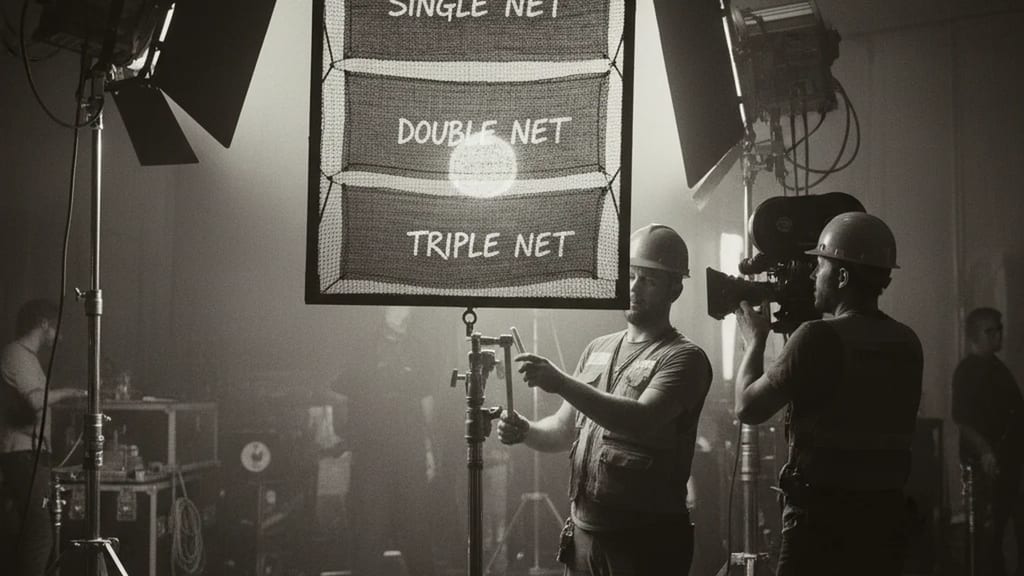
The net structure consists of 40-denier nylon threads with a mesh size of 0.8 mm per layer. The three layers are thermally welded and mounted in an aluminum frame with spring tension of 12-15 Newtons per square centimeter. Standard formats are 12"×18", 18"×24", and 24"×36" for flag mounting, as well as 4'×4' and 6'×6' for butterfly frames. The color temperature is shifted by a maximum of 50 Kelvin towards warm tones. Special variants like Triple Net Silver use metallized threads for more neutral color reproduction.
History & Development
In 1974, gaffer Conrad Hall, together with Matthews Studio Equipment, developed the first Triple Net construction for "The Day of the Locust." Hall's requirement was for greater light reduction than Double Net (0.8 stops), but softer shadows than solid ND filters. In 1978, Rosco introduced industrial production, followed by Lee Filters in 1985 with the European Net series. Since 2010, modern versions have used UV-stabilized polyester fabrics and computer-optimized weave patterns for more uniform light distribution.
Practical Use in Film
Gordon Willis extensively used Triple Net in "Manhattan" (1979) for night park scenes to dim streetlights without creating harsh shadows. Typical workflow: positioning 1-2 meters in front of the light source at a 45-degree angle to the camera axis. For daylight balancing, Triple Net is mounted in front of an HMI fixture to simulate sunlight through windows. Advantage over ND filters: preservation of light direction. Disadvantage: moiré effects with certain camera angles to textured surfaces.
Comparison & Alternatives
Single Net reduces 0.3 stops, Double Net 0.8 stops – Triple Net sits between them with 1.5 stops, followed by the 2-stop Quad Net. Lavender Net combines diffusion with a magenta filter effect. Modern LED panels with stepless dimming are increasingly replacing mechanical net filters but do not achieve the characteristic shadow quality. Silk diffusers offer softer scattering but not precise light reduction. Triple Net remains the standard for traditional tungsten and HMI lighting, especially for period pieces with authentic lighting moods.