Filmlexikon.
Support
Top Lighting
Lighting · Terms

Top Lighting

Murnau AI illustration
color temperature flow roll take

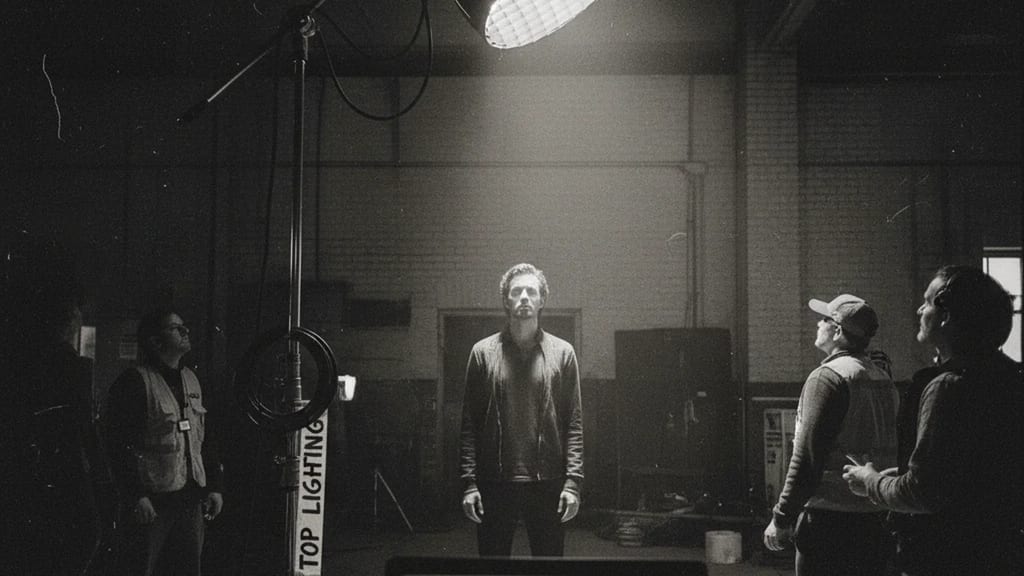
Lighting from above at 70–90° elevation that emphasizes facial contours and creates mystery through hard shadows beneath eyes and jawline.

Technical Details

Typical lamp positioning is at 70-90 degree elevation above the subject with light intensities between 2,000-10,000 Lux. Commonly used fixtures are 2K/5K Fresnel spots, HMI lamps (575W-2.5kW), or LED panels from 100W. The Key-Light to Fill-Light ratio is usually 4:1 to 8:1 for dramatic effects. Softboxes (60x90cm to 120x180cm) soften harsh shadows, while honeycombs or barndoors control light spill.

History & Development

Top lighting established itself in the 1920s within Hollywood's studio system as a standard technique for portraits. Cinematographer Gregg Toland perfected the method in "Citizen Kane" (1941) with specially constructed ceiling sets. In the 1960s, European filmmakers like Sven Nykvist developed subtler variations with diffused top lighting. Modern LED technology since 2010 enables precisely controllable top lighting systems with variable color temperature (2700K-6500K).

Practical Application in Film

"Apocalypse Now" (1979) uses harsh top lighting for Colonel Kurtz's ghostly appearance in the jungle temple. Stanley Kubrick employed cool top lighting in "2001: A Space Odyssey" (1968) for a sterile spaceship atmosphere. Roger Deakins used LED top lighting systems in "Blade Runner 2049" (2017) for futuristic interiors. The technique enhances facial contours, creates a mysterious atmosphere, and simulates natural daylight indoors.

Comparison & Alternatives

Top lighting differs from Rembrandt lighting by its steeper angle (over 60 degrees instead of 45 degrees) and the absence of a triangle on the shadow side. Butterfly lighting positions the light more frontally at a 45-degree elevation. Side lighting (90 degrees horizontally) creates split-light effects. Modern alternatives include tube lights on trusses, programmable LED matrices, and hybrid systems with motorized positioning for dynamic lighting control during shooting.

From the crafts

Perspectives

Cinematographer

Ich setze Oberlicht gezielt ein, um Gesichtskonturen zu modellieren und dramatische Schatten zu schaffen - besonders bei Verhörszenen oder Mystery-Atmosphäre funktioniert der steile Winkel perfekt. Die Herausforderung liegt im präzisen Fill-Light-Verhältnis, damit die Augen nicht zu dunkel werden, weshalb ich meist mit 2K Fresnel von oben und 650W Redhead als Fill arbeite.

Director

Oberlicht nutze ich für psychologische Charakterisierung - es macht Figuren mysteriöser, bedrohlicher oder übernatürlich, da es unsere Sehgewohnheiten von natürlichem Sonnenlicht durchbricht. Bei Antagonisten oder in Thriller-Szenen verstärkt diese Lichtführung die emotionale Distanz zum Publikum und schafft visuell eine Art "göttliche" oder "richtende" Perspektive von oben.

Producer

Oberlicht-Setups erfordern robuste Deckenkonstruktionen oder Traversen, was Standmiete und Aufbauzeit um 20-30% erhöht - besonders in bestehenden Locations ohne ausreichende Deckenhöhe. Ich plane zusätzliche Grip-Trucks und Sicherheitstechnik ein, da hängende schwere Leuchten strengere Abnahmen benötigen und bei 2,5K HMI-Lampen die Stromversorgung kritisch wird.

More in the lexikon

Related terms

Test your knowledge

Quiz

1. Zu welchem Department gehört „Oberlicht"?

2. Wie viele verschiedene Fachperspektiven bietet dieser Eintrag?

Report an error
From the Filmfarm ecosystem

Understand visual language, budget productions, connect crew.

The Lexikon is part of the Filmfarm ecosystem — alongside budgeting (FilmBalance), an industry magazine (FilmCircus) and crew networking (FilmCall, CrewMesh). One shared vocabulary for the whole production.

FilmFarm FilmRadarComing soonFilmPulseComing soonFilmNumbersComing soonFilmCapitalComing soonFilmLabComing soonFilmBalanceComing soonFilmCircusComing soon