Filmlexikon.
Support
Tokina Vista Prime
Camera · Lenses

Tokina Vista Prime

Murnau AI illustration
anamorphic lens anamorphic projection lens angenieux optimo prime arri master prime arri signature prime arri ultra prime arri zeiss variable prime atlas lens co

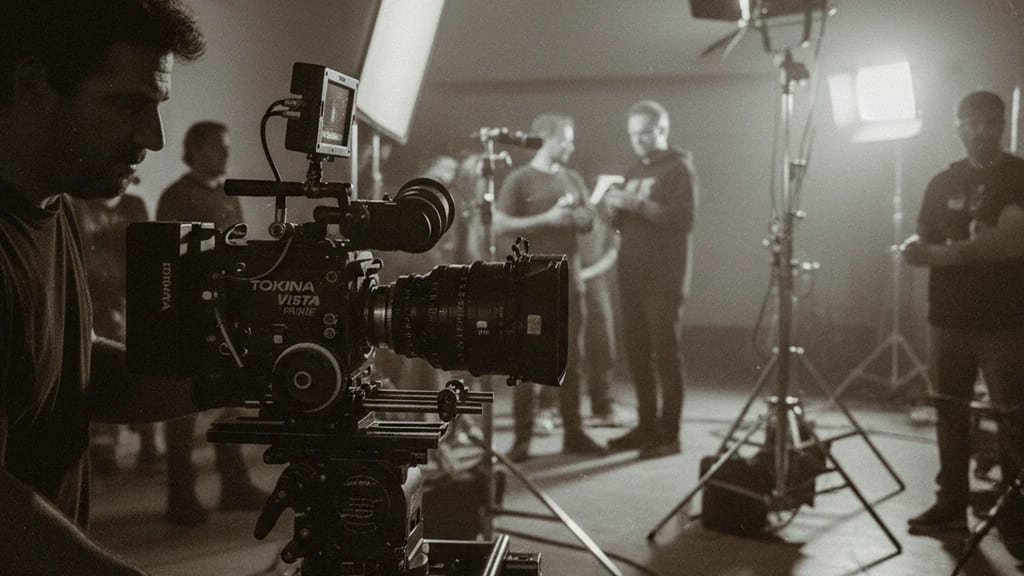
Tokina cine lens series with unified T1.5 aperture across eight focal lengths (18–135mm), designed for affordable full-frame cinematography with 95mm front diameter and 300° focus throw.

Technical Details

Focal Lengths

182535405085105135
T1.5T1.5T1.5T1.5T1.5T1.5T1.5T1.5
0.28m0.30m0.35m0.40m0.45m0.60m0.70m0.80m
1.50kg1.60kg1.70kg1.80kg1.80kg1.90kg2.00kg2.10kg
9595959595959595
84°64°48°43°35°21°17°13°
◀━━━━▶◀━━━▶◀━━▶◀━━▶◀━▶◀▶◀▶◀▶

PL · 95mm Front · 300° Focus · FF

History & Development

Tokina announced the Vista Prime series at NAB 2019, after the company had primarily produced still photography lenses. The first shipments began in late 2019 with the 25mm, 35mm, and 85mm focal lengths. The remaining focal lengths followed in 2020, with the 135mm version becoming available last in spring 2021. The development was a direct response to the growing demand for affordable full-frame cine lenses.

Practical Use in Film

Vista Primes are primarily used in independent productions, commercials, and streaming content. The consistent T1.5 aperture allows for consistent exposure when changing focal lengths, while the wide aperture opening creates shallow depth of field for subject isolation. The 95mm front diameter allows for uniform matte box filters without adapters. Focus pullers appreciate the smooth, precise focus ring with a 300° rotation angle. The lenses exhibit minimal focus breathing and consistent bokeh characteristics across all focal lengths.

Comparison & Alternatives

Vista Primes directly compete with ZEISS CP.3, Canon CN-E, and Rokinon Xeen series in the mid-price segment. Compared to more expensive optics like ZEISS Master Primes or Cooke S4/i, they lack the extreme T-stops and premium build quality. Canon RF Mount variants expand compatibility to mirrorless cameras like the C70. Rokinon Cine DS lenses offer a more affordable alternative, but they exhibit less consistent optical properties.

From the crafts

Perspectives

Cinematographer

Ich nutze Vista Primes hauptsächlich für Low-Light-Szenen, wo die T1.5 Lichtstärke entscheidend ist. Die einheitlichen Frontdurchmesser sparen mir Zeit beim Filterwechsel, und die minimale Fokus-Atmung macht Schärfeverlagerungen sauber. Allerdings erreichen sie nicht die Schärfeleistung von Master Primes, was bei 4K-Close-ups auffällt.

Director

Die Vista Primes geben mir die kreative Flexibilität für intensive Nahaufnahmen mit extremer Unschärfe im Hintergrund. Besonders die 85mm und 135mm erzeugen diese cinematische Isolation der Charaktere, die ich für emotionale Szenen brauche. Der weiche Bokeh-Look unterstützt meine Bildsprache ohne das Budget zu sprengen.

Producer

Vista Primes kosten etwa 60% weniger als vergleichbare ZEISS CP.3, bei 90% der Bildqualität – eine klare Rechnung für mittlere Budgets. Der einheitliche Objektivsatz reduziert Kamera-Prep-Zeit und Transportkosten. Für Netflix-Deliverables reicht die technische Qualität völlig aus, während ich Budget für andere Departments freihalte.

More in the lexikon

Related terms

Test your knowledge

Quiz

1. Was beschreibt „Tokina Vista Prime" am besten?

2. Zu welchem Department gehört „Tokina Vista Prime"?

3. Wie viele verschiedene Fachperspektiven bietet dieser Eintrag?

Report an error
From the Filmfarm ecosystem

Understand visual language, budget productions, connect crew.

The Lexikon is part of the Filmfarm ecosystem — alongside budgeting (FilmBalance), an industry magazine (FilmCircus) and crew networking (FilmCall, CrewMesh). One shared vocabulary for the whole production.

FilmFarm FilmRadarComing soonFilmPulseComing soonFilmNumbersComing soonFilmCapitalComing soonFilmLabComing soonFilmBalanceComing soonFilmCircusComing soon