Filmlexikon.
Support
Tetradic Colors
Art Department · Terms

Tetradic Colors

Murnau AI illustration
triadic colors color scheme monochromatic warm colors cool colors analogous colors

Color scheme using four hues at 90° intervals on the color wheel (e.g., red-yellow-green-cyan-violet). Enables complex visual storytelling through deliberate color assignment to narrative layers.

Technical Details

A tetradic scheme precisely comprises four colors with 90° spacing on the HSV color wheel: for example, red (0°), yellow-green (90°), cyan (180°), and violet (270°). Saturation typically ranges between 60-80%, while brightness varies between 40-70% to achieve optimal image depth. Subtractive variants use CMYK values with Delta E distances of at least 40 units between adjacent colors. The scheme works in RGB workflows (Rec. 709) and in extended color spaces like DCI-P3.

History & Development

In 1968, Vittorio Storaro systematically introduced tetradic color concepts in "Il conformista." Technicolor developed special LUTs (Look-Up Tables) in 1975 for tetradic grading in post-production. The digital revolution around 2005 enabled precise control through DaVinci Resolve and similar systems. Modern HDR workflows since 2018 expand tetradic schemes to the Rec. 2020 color space with 12-bit depth.

Practical Use in Film

Wes Anderson consistently utilizes tetradic palettes: "The Grand Budapest Hotel" (2014) combines pink, turquoise, orange, and violet for narrative layers. Christopher Nolan employs a blue-orange-red-green tetradic scheme in "Tenet" (2020) for time layers. Grading is usually done via primary correction in four separate nodes, with each color specifically placed in highlights, midtones, or shadows. Onset monitoring requires calibrated reference monitors with at least 95% Rec. 709 coverage.

Comparison & Alternatives

Tetradic schemes offer more flexibility than triadic (three colors, 120° spacing) or split-complementary approaches. While monochromatic palettes save 15-20% of post-production time, tetradic concepts require 40-60% longer color correction. Analogous color schemes are suitable for naturalistic looks, while tetradic schemes are for stylized narrative forms. Modern AI-based tools like DaVinci Neural Engine have been automatically analyzing tetradic balance in real-time since 2022.
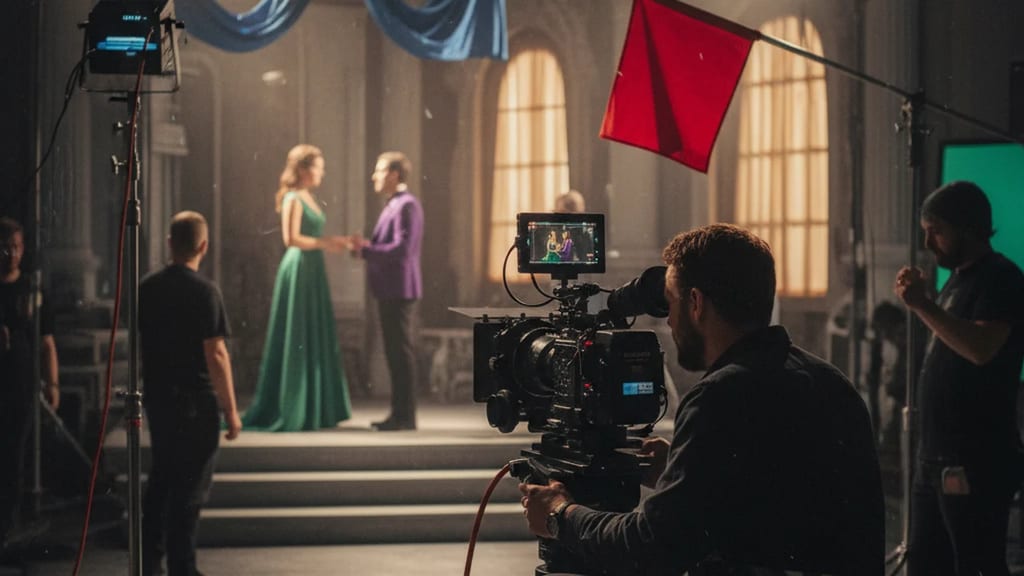
From the crafts

Perspectives

Cinematographer

Ich plane tetradische Schemata bereits bei der Beleuchtung mit entsprechenden Gel-Kombinationen – Rosco 202/200 für warme Töne, CTB für Kälte. Meine LUT-Vorschau am Set zeigt mir sofort, ob die vier Grundfarben in der gewünschten Balance stehen, bevor ich die Szene freigebe.

Director

Tetradische Paletten geben mir vier emotionale Register für komplexe Charakterentwicklung – jede Farbe trägt eine andere psychologische Ebene meiner Geschichte. Bei Zeitsprüngen oder parallelen Handlungssträngen kann ich das Publikum subtil durch Farbwechsel führen, ohne exposition-lastige Dialoge zu benötigen.

Producer

Tetradische Farbkonzepte erhöhen meine Postproduktionskosten um etwa 30%, da der Colorist deutlich mehr Zeit für die Balance von vier Farbebenen benötigt. Dafür spare ich aber bei aufwendigem Production Design, da Farbraumkorrekturen nachträglich kostengünstiger sind als komplette Set-Umbauten.

More in the lexikon

Related terms

Test your knowledge

Quiz

1. Was beschreibt „Tetradische Farben" am besten?

2. Zu welchem Department gehört „Tetradische Farben"?

3. Wie viele verschiedene Fachperspektiven bietet dieser Eintrag?

Report an error
From the Filmfarm ecosystem

Understand visual language, budget productions, connect crew.

The Lexikon is part of the Filmfarm ecosystem — alongside budgeting (FilmBalance), an industry magazine (FilmCircus) and crew networking (FilmCall, CrewMesh). One shared vocabulary for the whole production.

FilmFarm FilmRadarComing soonFilmPulseComing soonFilmNumbersComing soonFilmCapitalComing soonFilmLabComing soonFilmBalanceComing soonFilmCircusComing soon