Filmlexikon.
Support
Super Telephoto
Camera · Terms

Super Telephoto

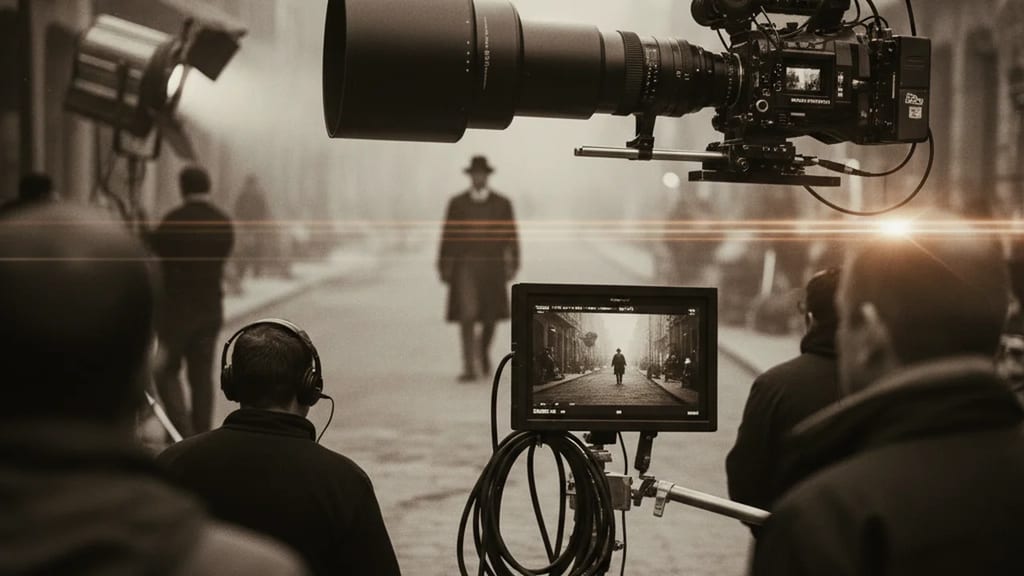
Murnau AI illustration
flow para roll take

Lens with focal lengths from 300mm to 2000mm for extreme close-ups from safe distance with strong background compression.

Technical Details

Professional cine super telephoto lenses achieve focal lengths from 300mm to 2000mm with apertures between T2.8 and T8. The Cooke Anamorphic/i 300mm T2.3 weighs 8.2kg, while the Canon CN20 50-1000mm T5.0-8.9 Cine-Servo is 3.8kg. Internal Focusing (IF) prevents changes in length during focusing, and floating elements compensate for spherical aberrations. Modern designs utilize ED (Extra-low Dispersion) glass and fluorite lenses to reduce chromatic aberration. Cinema optics offer standardized 114mm front diameters for matte box systems and 0.8 module gears for follow focus systems.

History & Development

Nikon introduced the first commercial 1000mm mirror lens in 1959, followed by Zeiss in 1963 with the Mirotar 500mm. The film industry initially adapted super telephotos from sports photography – the iconic Canon FD 600mm F4.5 was used in "Rocky" in 1976. In 2008, Cooke developed the S4/i 300mm T2.8 specifically for cinema applications, and Fujinon followed in 2012 with the Cabrio series of variable cine zooms up to 850mm. In 2019, RED integrated crop modes for the first time with the Komodo, turning standard telephotos into super telephoto equivalents.

Practical Use in Film

Roger Deakins used an 800mm lens for the Istanbul chase sequence in "Skyfall" (2012) to isolate motorcycles against compressed cityscapes. "The Revenant" utilized 600mm lenses for wildlife documentary scenes without disturbing the bears. Super telephotos enable extreme close-ups from a safe distance from pyrotechnics or dangerous stunts. The strong background compression dramatically isolates subjects from their surroundings, while the shallow depth of field at wide apertures creates cinematic isolation. Disadvantages: Camera shake is exponentially amplified, and gimbal systems reach their weight limits.

Comparison & Alternatives

Standard telephoto lenses (85-200mm) still offer a natural perspective, whereas super telephotos from 300mm onwards significantly distort spatial perception. Crop sensors like the ALEXA Super35 extend effective focal lengths by a factor of 1.3-1.5. Modern alternatives include digital zoom functions in 8K cameras or extender systems that increase existing focal lengths by a factor of 1.4x or 2x. Mirror lenses (catadioptric) achieve extreme focal lengths in a compact design but produce characteristic ring bokehs and fixed apertures.
From the crafts

Perspectives

Cinematographer

Superteles verlangen absolute Stabilität - ab 400mm arbeite ich ausschließlich mit Studio-Stativen oder Remote-Heads. Die extreme Kompression macht präzise Fokusarbeit kritisch, da bereits minimale Abweichungen das Subjekt vollständig unscharf werden lassen. Gleichzeitig eröffnen mir diese Optiken völlig neue Bildsprachen durch die Isolation von Details in komplexen Umgebungen.

Director

Ein 600mm-Objektiv verwandelt Schauspieler in intime Portraits, selbst wenn sie 20 Meter entfernt stehen - perfekt für emotionale Nahaufnahmen ohne physische Nähe der Crew. Die Hintergrundkompression lässt mich Charaktere gegen grafische, abstrahierte Kulissen inszenieren. Allerdings schränkt der enge Bildwinkel die spontane Regie-Arbeit ein, jede Einstellung muss präzise geplant werden.

Producer

Supertele-Setups verdoppeln die Rigging-Zeit durch schwere Stative und Extended-Remote-Systeme - kalkuliere 45 Minuten zusätzlich pro Setup. Die Optiken kosten 800-1200 Euro Tagesmiete, benötigen spezielle Transport-Cases und erfahrene 1st ACs. Dafür ermöglichen sie Aufnahmen aus unmöglichen Positionen und reduzieren Sicherheitsrisiken bei Action-Szenen erheblich.

More in the lexikon

Related terms

Test your knowledge

Quiz

1. Zu welchem Department gehört „Superteleobjektiv"?

2. Wie viele verschiedene Fachperspektiven bietet dieser Eintrag?

Report an error
From the Filmfarm ecosystem

Understand visual language, budget productions, connect crew.

The Lexikon is part of the Filmfarm ecosystem — alongside budgeting (FilmBalance), an industry magazine (FilmCircus) and crew networking (FilmCall, CrewMesh). One shared vocabulary for the whole production.

FilmFarm FilmRadarComing soonFilmPulseComing soonFilmNumbersComing soonFilmCapitalComing soonFilmLabComing soonFilmBalanceComing soonFilmCircusComing soon