Filmlexikon.
Support
Target
Lighting · Terms

Target

Murnau AI illustration
color temperature flow roll take

The point in frame that establishes visual hierarchy and directs viewer attention, independent of the camera's focal plane.

Technical Details

Professional targets are made of aluminum or fire-resistant plastic with a reflection tolerance of ±2% between segments. The white surface reflects 90% of incident light, the black absorbs 95%. Common variants include the Siemens star target with 36 radial segments for sharpness testing, gray wedge targets with 10 brightness levels (0.3 f-stop gradation), and color temperature targets with defined color fields for white balance at 3200K and 5600K.

History & Development

Eastman Kodak developed the first standardized film targets for Technicolor production in 1952. The breakthrough came in 1967 with Osram's heat-resistant ceramic targets for 10kW spotlights. Arri introduced the modular target system in 1981, allowing various test patterns to be combined. Since 2010, digital LED targets with programmable patterns and brightness levels up to 50,000 lux have dominated.

Practical Use in Film

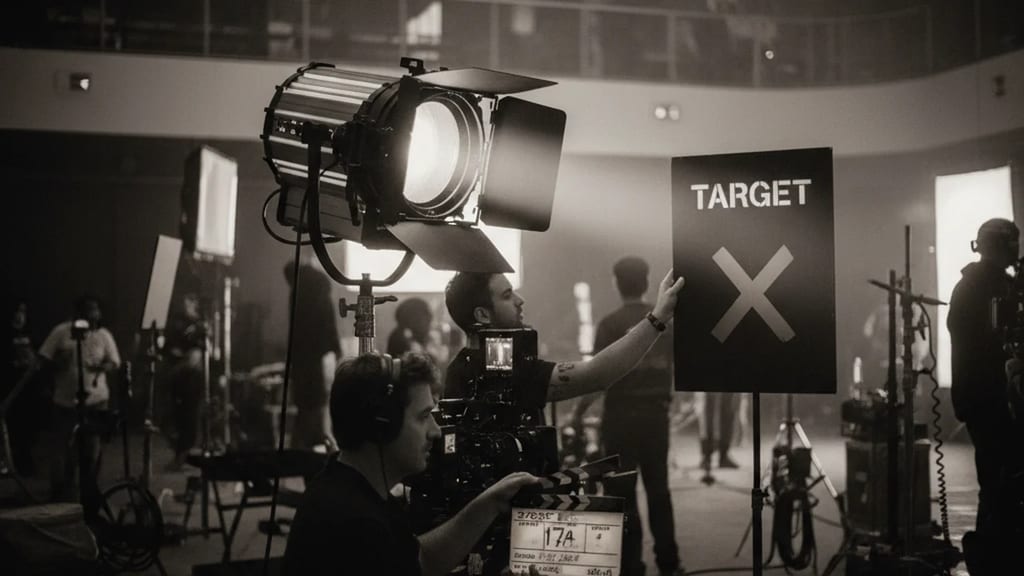
Camera crews use targets for precise focusing of Fresnel spotlights: The target is positioned at the desired distance, and the spotlight is adjusted until the circular lines are rendered razor-sharp. In "Blade Runner 2049," Roger Deakins calibrated all 18K ARRI spotlights daily with targets for the precise light shaping in the interior scenes. Gaffers systematically use targets in multi-camera setups to ensure identical light distribution across all camera positions.

Comparison & Alternatives

Unlike gray cards, which only measure exposure, targets check sharpness and light distribution simultaneously. Modern alternatives include digital light meters with target projection or laser alignment systems that do not require physical objects. However, targets remain standard for daylight shoots, as electronic devices fail under direct sunlight (up to 100,000 lux).
From the crafts

Perspectives

Cinematographer

Ich positioniere Targets systematisch in verschiedenen Distanzen, um die exakte Fokussierung meiner Key-Lights zu kontrollieren - besonders kritisch bei 85mm-Objektiven mit offener Blende, wo bereits 10cm Unschärfe im Licht die Gesichtsmodellierung ruinieren. Die konzentrischen Ringe zeigen mir sofort Abbildungsfehler oder ungleichmäßige Lichtverteilung, die mit bloßem Auge nicht erkennbar wären.

Director

Targets nutze ich als präzises Werkzeug zur Lichtdramaturgie - wenn ich harte Schatten für Thriller-Atmosphäre brauche, verlange ich messerscharfe Target-Abbildung von meinem Gaffer, für romantische Szenen bewusst weiche Target-Konturen. Die geometrischen Muster helfen mir, komplexe Lichtformen wie Fensterschatten oder Jalousie-Effekte millimetergenau zu platzieren.

Producer

Ein Target-Set für 150 Euro spart mir täglich 2-3 Stunden Setup-Zeit, weil mein Kamerateam die Beleuchtung ohne langwierige Tests justiert - das entspricht 800 Euro Personalkosten pro Drehtag. Bei Multi-Location-Produktionen reduzieren standardisierte Target-Workflows die Kontinuitätsfehler erheblich und minimieren teure Nachdreh-Termine.

More in the lexikon

Related terms

Test your knowledge

Quiz

1. Zu welchem Department gehört „Target"?

2. Wie viele verschiedene Fachperspektiven bietet dieser Eintrag?

Report an error
From the Filmfarm ecosystem

Understand visual language, budget productions, connect crew.

The Lexikon is part of the Filmfarm ecosystem — alongside budgeting (FilmBalance), an industry magazine (FilmCircus) and crew networking (FilmCall, CrewMesh). One shared vocabulary for the whole production.

FilmFarm FilmRadarComing soonFilmPulseComing soonFilmNumbersComing soonFilmCapitalComing soonFilmLabComing soonFilmBalanceComing soonFilmCircusComing soon