Cinematographer
Aus DoP-Perspektive ist dieses Element essentiell für die visuelle Gestaltung. Es ermöglicht mir die gewünschte Farbstimmung und das ästhetische Bild konsistent umzusetzen.
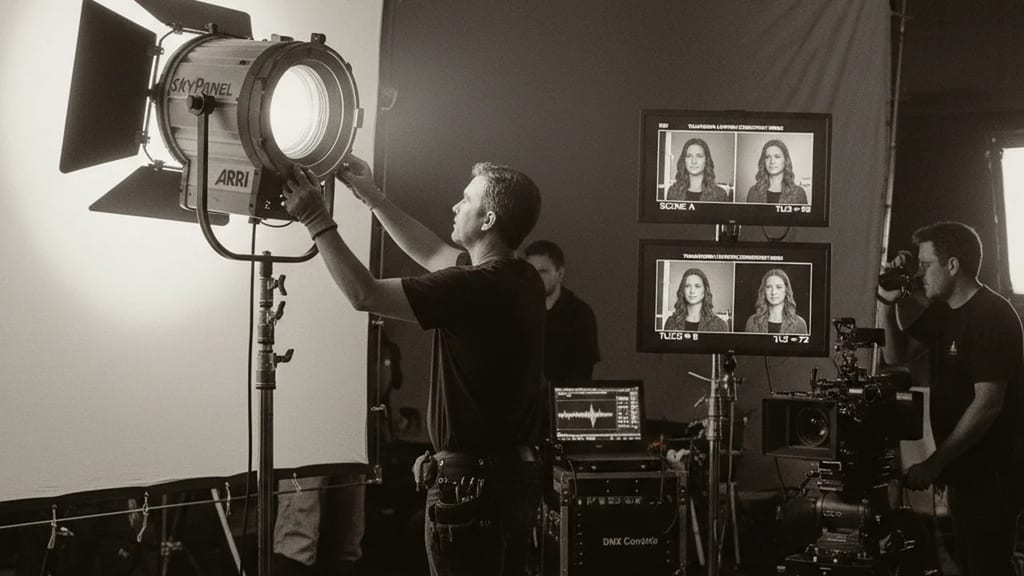
EBU-developed metric (0–100) measuring how accurately a light source reproduces colors on camera for television, ensuring consistent color fidelity.
The Television Lighting Consistency Index (TLCI) is a metric developed by the European Broadcasting Union (EBU) to evaluate the color rendering of light sources in film and television production. Unlike the older Color Rendering Index (CRI), which describes color rendering for the human eye, the TLCI models a complete television signal chain, including a typical camera and display, thus reflecting how a light source actually appears to the camera. The current version, TLCI-2012, was adopted by the EBU in November 2012.
The TLCI is particularly relevant for assessing LED lights. LEDs with discontinuous spectra can achieve a high CRI but still produce color errors (e.g., in skin tones or saturated colors) in front of the camera. The TLCI specifically highlights these camera-specific errors.
For calculation, color patches from a standard color test chart (based on the Macbeth/X-Rite ColorChecker, which includes skin tones, foliage, primary colors, and neutral values) are mathematically passed through the camera and monitor model and compared with a reference light source of the same color temperature. The deviations result in a value on a scale from 0 to 100, where 100 represents near-flawless reproduction.
The EBU interprets the values based on the expected correction effort for a colorist:
| TLCI Value | Meaning |
|---|---|
| 85-100 | Errors so minor that a colorist would not correct them |
| 75-85 | Correction desired, but easy and possible with good results |
| 50-75 | Correction necessary, acceptable results only with significant time investment |
| 25-50 | Poor reproduction; even good correction does not reach broadcast level |
| 0-25 | Very poor reproduction; hardly correctable for broadcast |
Values above 90 are considered desirable for professional TV use.
The TLCI serves as a selection and purchasing criterion for lighting. The recommendation EBU R 137 advises using the TLCI when acquiring new luminaires; the measurement procedure is described in EBU Tech 3355. Many LED luminaire manufacturers now specify the TLCI alongside the CRI in their data sheets, and corresponding values can be determined with spectrometers or suitable color measuring devices along with EBU software.
On set, a high TLCI helps maintain color consistency between mixed light sources (e.g., different LED devices) and reduces post-production effort. Additionally, the EBU has defined the TV Luminaire Matching Factor (TLMF), which assesses how well two luminaires match each other when used together in a shot.
Aus DoP-Perspektive ist dieses Element essentiell für die visuelle Gestaltung. Es ermöglicht mir die gewünschte Farbstimmung und das ästhetische Bild konsistent umzusetzen.
Diese professionelle Lösung erhöht die Produktionseffizienz und reduziert Post-Production-Anforderungen. Sie ermöglicht flexible, schnelle Anpassungen während des Drehs.
Als Gaffer ist dies ein unverzichtbares Werkzeug meines täglichen Handwerkszeugs. Es ermöglicht mir professionelle Lichtkontrolle und schnelle Anpassungen auf Set, was Zeit spart und Qualität sichert.
1. Zu welchem Department gehört „TV-Licht-Konsistenzindex"?
2. Wie viele verschiedene Fachperspektiven bietet dieser Eintrag?
The Lexikon is part of the Filmfarm ecosystem — alongside budgeting (FilmBalance), an industry magazine (FilmCircus) and crew networking (FilmCall, CrewMesh). One shared vocabulary for the whole production.