Filmlexikon.
Support
Split Lighting
Lighting · Terms

Split Lighting

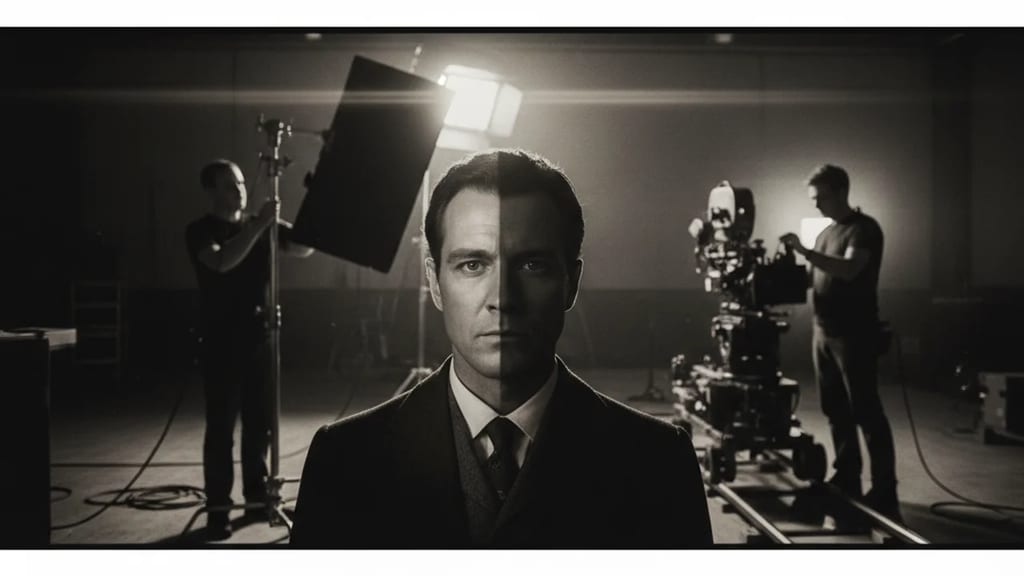
Murnau AI illustration
color temperature flow roll take

Lighting technique with key light positioned exactly 90 degrees to camera, dividing the face into bright and shadow sides. Ratio 8:1 to 16:1, no fill light for dramatic effect.

Technical Details

The key light is positioned exactly 90 degrees to the camera-subject axis, at a height of 0 to a maximum of 15 degrees above eye level. Typical distances are 1.5 to 3 meters when using 2K or 4K tungsten spotlights. A ratio of 8:1 to 16:1 between the illuminated and shadow sides creates the characteristic hard separation. Fresnel lenses or PAR spotlights without diffusion provide the required hard light. Fill light is deliberately minimized or omitted entirely to maintain the dramatic effect.

History & Development

Split lighting evolved in the 1920s from theatrical photography and established itself as a standard technique during the Film Noir era of the 1940s. Cinematographer John Alton perfected the method in films such as "T-Men" (1947) and "He Walked by Night" (1948). The German Expressionism movement influenced this development. Modern LED panels since the 2010s allow for more precise control of shadow gradients through variable color temperature and dimming.

Practical Use in Film

Gordon Willis used split lighting in "The Godfather" (1972) for Marlon Brando's iconic scenes in the dark office. Roger Deakins employed the technique in "Blade Runner 2049" (2017) for interrogation scenes. The method is suitable for characters with inner conflicts, thriller sequences, and scenes with moral ambiguity. Disadvantages include difficulty with continuity shots and limited camera movements, as even small changes in position can disrupt shadow distribution.

Comparison & Alternatives

Split lighting differs from Rembrandt lighting by its exact 50:50 division without the characteristic triangle on the shadow cheek. Unlike loop lighting, it creates hard edges instead of soft transitions. Chiaroscuro lighting uses similar contrasts but distributes them across the entire image. Modern alternatives include LED walls with programmable light gradients or RGB panels for colored split lighting in science fiction productions.

From the crafts

Perspectives

Cinematographer

Ich positioniere das Key Light millimetergenau, da bereits 5 Grad Abweichung die symmetrische Teilung zerstört. Bei Dreharbeiten markiere ich sowohl die Scheinwerferposition als auch die exakte Kopfhaltung des Darstellers, um bei Wiederholungen identische Ergebnisse zu erzielen. Die Herausforderung liegt in der Bewegungsführung – sobald sich der Darsteller zur Kamera dreht, verwandelt sich das Split in ein hartes Seitenlicht.

Director

Ich nutze geteiltes Licht gezielt für Charaktere in moralischen Dilemmas oder Wendepunkten der Handlung. In Verhörszenen verstärkt die harte Lichtteilung die psychologische Spannung zwischen Wahrheit und Lüge. Bei Dialogen kann ich durch die Lichtführung visuell andeuten, welcher Charakter die Oberhand gewinnt, ohne dass die Schauspieler ihre Performance ändern müssen.

Producer

Split Lighting erfordert präzise Kamerafahrten und längere Setup-Zeiten, was durchschnittlich 15-20% mehr Drehzeit für entsprechende Szenen bedeutet. Die Technik limitiert spontane Einstellungsänderungen erheblich, da jede neue Kameraposition eine komplette Licht-Neujustierung erfordert. Dafür entstehen keine zusätzlichen Equipment-Kosten, da die Methode mit Standard-Beleuchtungsausstattung realisierbar ist.

More in the lexikon

Related terms

Test your knowledge

Quiz

1. Zu welchem Department gehört „Geteiltes Licht"?

2. Wie viele verschiedene Fachperspektiven bietet dieser Eintrag?

Report an error
From the Filmfarm ecosystem

Understand visual language, budget productions, connect crew.

The Lexikon is part of the Filmfarm ecosystem — alongside budgeting (FilmBalance), an industry magazine (FilmCircus) and crew networking (FilmCall, CrewMesh). One shared vocabulary for the whole production.

FilmFarm FilmRadarComing soonFilmPulseComing soonFilmNumbersComing soonFilmCapitalComing soonFilmLabComing soonFilmBalanceComing soonFilmCircusComing soon