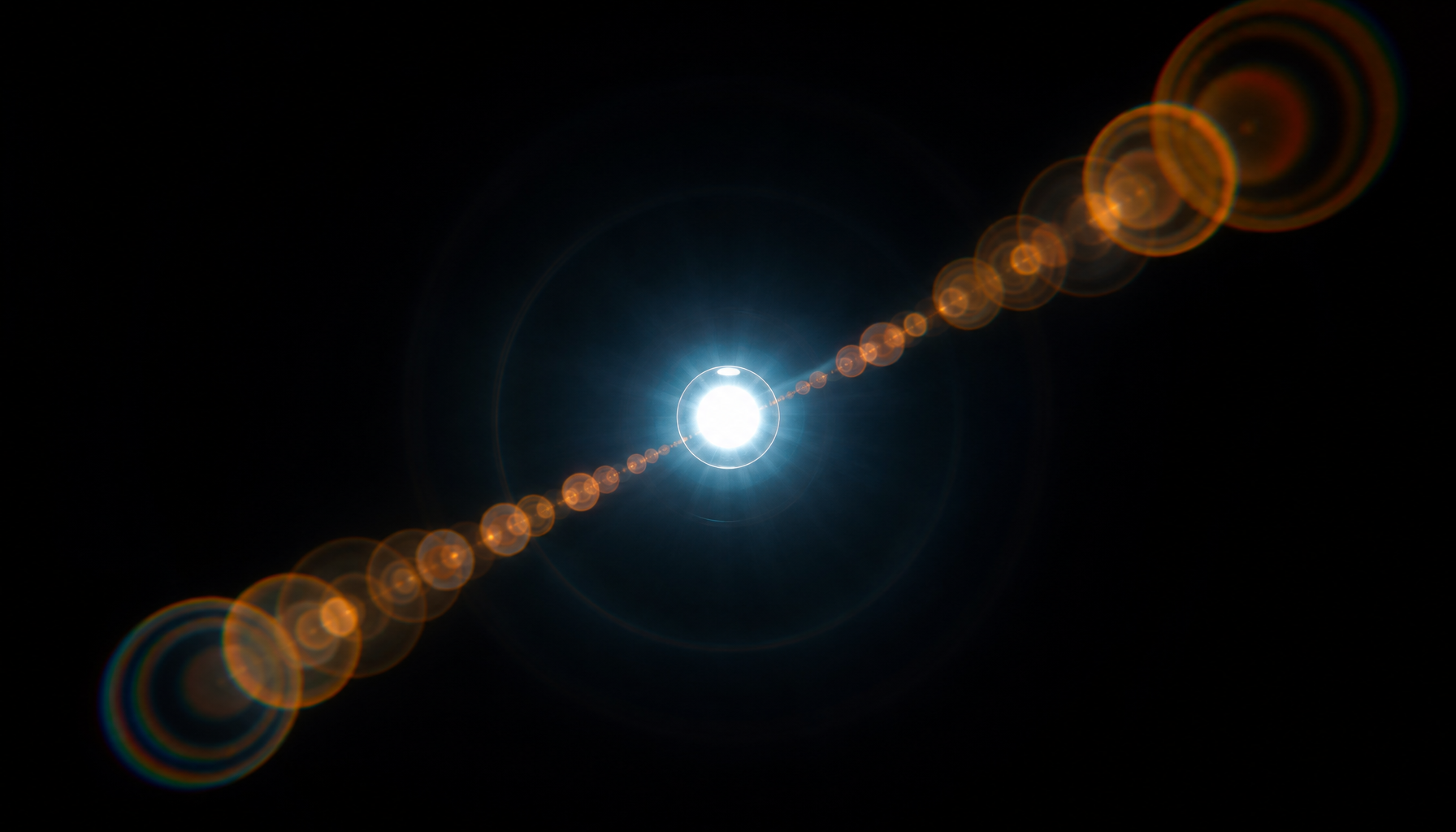
Round ghost reflection of spherical lenses: an image of the aperture appearing as a spot or chain of spots along the axis between light source and image center in backlight.
The Spherical Spot is the basic form of a ghost reflection: a round, more or less sharp image of the aperture, which appears in the frame with backlight – individually or as a chain lined up on the line between the light source and the center of the image. Each air-to-glass surface in the lens can contribute such a reflection; the more lens groups, the longer the possible chain. The shape reveals the aperture: when wide open, the spot remains round; when stopped down, it shows the polygon of the aperture blades.
Why the Term Appears in Flare Tests
In flare libraries, the Spherical Spot serves as a reference category: it describes how disciplined or wild a spherical lens renders its ghosts. Modern, highly coated optics produce few, low-contrast spots; vintage glass throws entire chains with strong color fringing. When compared to anamorphic glass, it is the round counterpart to the Anamorphic Spot, which is elliptically compressed by the cylindrical elements.
On-Set Usage
The spot can be controlled by three levers: the position of the light source (out of the reflection angle), the lens hood (eyebrow or French flag against sources just outside the frame), and the aperture (opening wider makes spots larger and softer, stopping down makes them sharper and more defined). Those who use it as a stylistic device deliberately place the source in the frame and guide the chain through calm areas of the image.
Practical Tips
- The number of aperture blades is listed in the datasheet – even numbers of blades produce spots with an equal number of corners, odd numbers twice as many rays in the ghost's surrounding area.
- A spot directly on a face is expensive in post-production. On set, check for a slight shift of an inch before taking the first shot.
- Zoom lenses reposition the chain when changing focal length – during zoom shots, traverse the entire range and observe.
Related terms
Quiz
1. Was beschreibt „Sphärischer Spot" am besten?
2. Zu welchem Department gehört „Sphärischer Spot"?