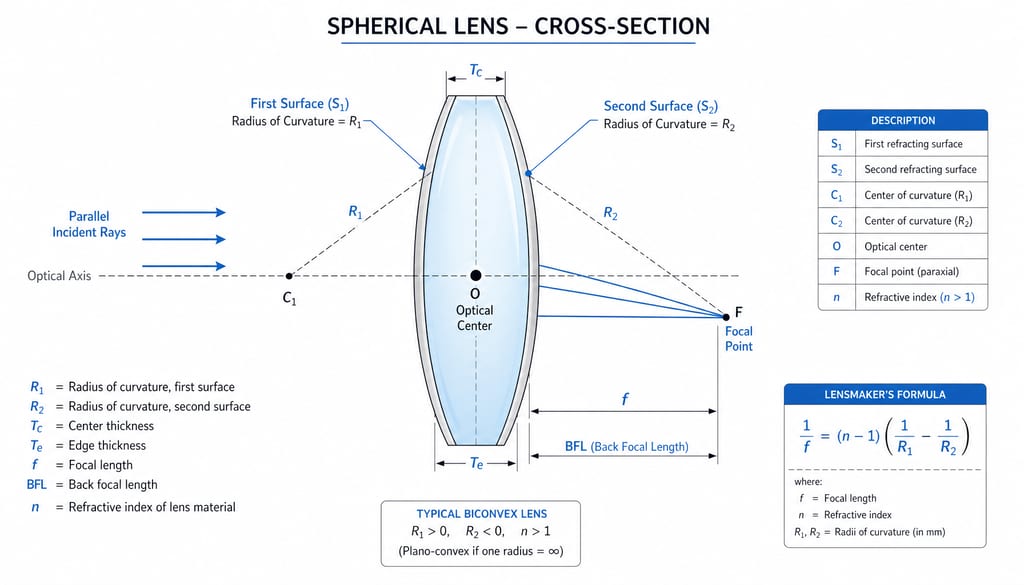
Standard lens system with round glass elements — circular bokeh, no squeeze distortion.
Spherical lenses — meaning all "normal" lenses — use round-ground glass elements and project an undistorted image onto the sensor. 95% of all films are shot with spherical glass. The look is more neutral than with anamorphic lenses: round bokeh, no horizontal flares, uniform sharpness across the image.
Advantages over Anamorphic
Faster aperture (T1.3 instead of T2), more compact, lighter, cheaper, less breathing. Often the better choice for documentary work, Steadicam, and gimbals.
Widescreen with Spherical Glass
Widescreen formats like 2.39:1 can also be achieved spherically — by cropping the sensor. This sacrifices resolution but is significantly cheaper and more flexible than true anamorphic lenses.
News
Spherical optics remain the standard for the majority of film production. While anamorphic lenses are valued for special aesthetic effects, spherical systems offer more flexibility and are more cost-effective. Many productions consciously use spherical lenses and later crop to the Cinemascope format 2.39:1 to combine the advantages of both worlds.
Related terms
Quiz
1. Was beschreibt „Sphärische Optik" am besten?
2. Zu welchem Department gehört „Sphärische Optik"?