Filmlexikon.
Support
Spidercam
Camera · Terms

Spidercam

Murnau AI illustration
flow para roll take

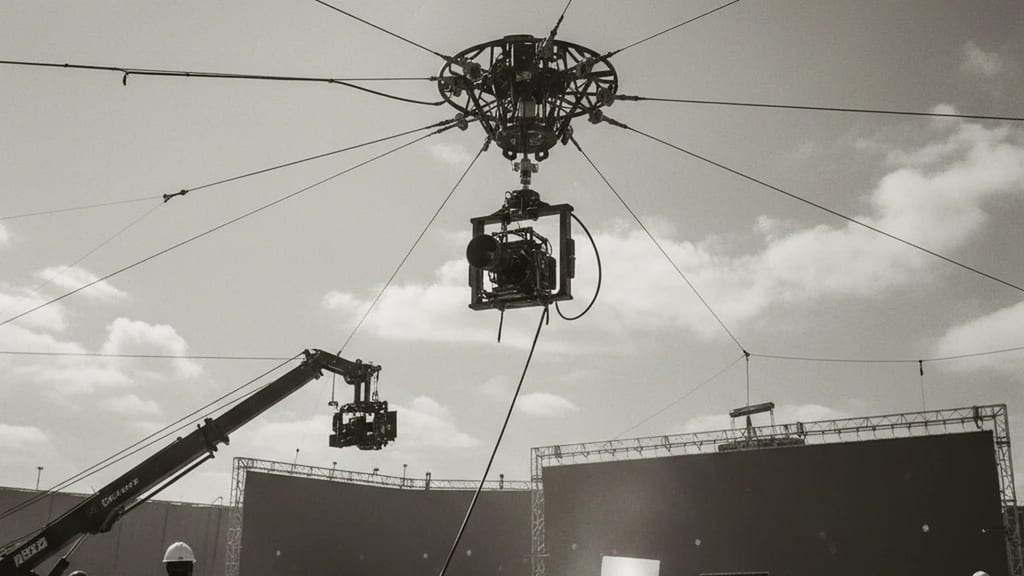
Camera system with four motorized winches and GPS control for three-dimensional camera moves supporting up to 7 kg payload with ±10 cm accuracy.

Technical Details

The Spidercam system consists of four motorized winches installed at elevated points, carrying a camera dolly via 2-3mm thick Dyneema ropes. Positioning is achieved using GPS and encoder systems with an accuracy of ±10 cm. The camera rig weighs approximately 8 kg and can carry cameras up to 7 kg. Control is managed via a radio remote control system with a range of up to 2 km. Modern variants like the Spidercam 3D use vectoring algorithms for smooth movements and can reach speeds from 0.1 m/s to 8.3 m/s.

History & Development

The Spidercam was developed in 1996 by Volker Hacker and first used at the European Football Championship in England. In 2000, it saw its first film application in "Mission: Impossible II" for spectacular chase scenes. The second generation (Spidercam V2) was launched in 2008 with improved stabilization and higher payload capacity. In 2015, the Spidercam 3D was introduced, enabling precise 3D coordinate movements and is now considered an industry standard.

Practical Application in Film

In "The Matrix Reloaded" (2003), the Spidercam facilitated the famous 360-degree camera move around the fighting characters. In "Fast & Furious 6" (2013), the system tracked vehicles on highways and through tunnels. The camera can execute complex movements from static positions that would be impossible with conventional cranes or Steadicams. Disadvantages include an elaborate rigging time of 4-6 hours and limitations in winds exceeding 25 km/h.

Comparison & Alternatives

Unlike camera cranes, the Spidercam offers unlimited freedom of movement within a defined space without visible support structures in the frame. Drones have lower payload capacities (mostly under 3 kg) and shorter flight times but are more flexible in positioning. Cable cam systems like SkyCam operate similarly but are usually limited to linear or restricted movement patterns. For large-scale exterior shots requiring precise repeatable movements, the Spidercam remains unrivaled, while for spontaneous shots or confined spaces, drones or gimbal systems are more practical.

From the crafts

Perspectives

Cinematographer

Die Spidercam gibt mir völlige Gestaltungsfreiheit in drei Dimensionen – ich kann fließende Bewegungen von Bodennähe bis 30 Meter Höhe fahren, ohne dass Stative oder Schienen ins Bild ragen. Die präzise Wiederholbarkeit der Fahrten ist perfekt für VFX-Shots, aber die 8kg schwere Aufhängung schränkt mich bei der Objektivwahl ein. Wind über 20 km/h macht das System unbrauchbar, und die vier Stahlseile begrenzen den nutzbaren Bildausschnitt.

Director

Mit der Spidercam kann ich impossible shots kreieren, die das Publikum emotional aus der gewohnten Perspektive reißen – etwa eine Verfolgungsjagd aus Vogelperspektive, die nahtlos in Augenhöhe übergeht. Das System ermöglicht mir, Räume dreidimensional zu erkunden und Charaktere in ihrer Umgebung zu isolieren oder zu kontextualisieren. Die Bewegungen müssen jedoch präzise geplant sein, da spontane Änderungen während des Drehs schwierig umsetzbar sind.

Producer

Eine Spidercam kostet 8.000-15.000 Euro Tagesmiete plus vier Stunden Setup-Zeit und ein vierköpfiges Spezialistenteam. Für komplexe Fahrten brauche ich zusätzlich zwei Drehtage für Tests und Programmierung. Das System rentiert sich nur bei spektakulären Key-Shots, nicht für Standard-Coverage. Die Versicherungssumme liegt bei 2 Millionen Euro, da herabstürzende Komponenten existenzgefährdend sind.

More in the lexikon

Related terms

Test your knowledge

Quiz

1. Zu welchem Department gehört „Spidercam"?

2. Wie viele verschiedene Fachperspektiven bietet dieser Eintrag?

Report an error
From the Filmfarm ecosystem

Understand visual language, budget productions, connect crew.

The Lexikon is part of the Filmfarm ecosystem — alongside budgeting (FilmBalance), an industry magazine (FilmCircus) and crew networking (FilmCall, CrewMesh). One shared vocabulary for the whole production.

FilmFarm FilmRadarComing soonFilmPulseComing soonFilmNumbersComing soonFilmCapitalComing soonFilmLabComing soonFilmBalanceComing soonFilmCircusComing soon