Filmlexikon.
Support
Speed Clamp
Grip · Equipment

Speed Clamp

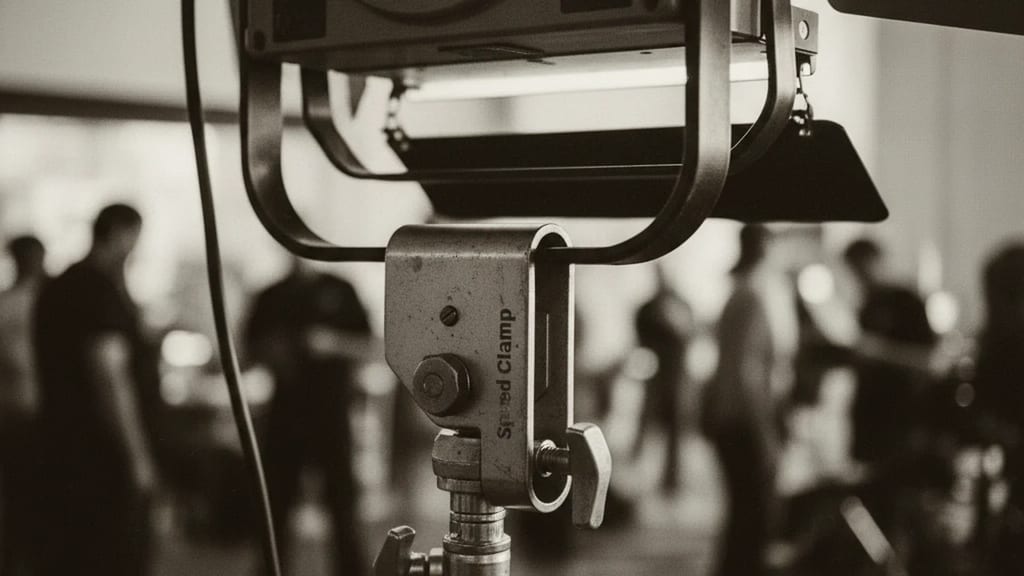
Murnau AI illustration
clamp color temperature flow roll speed take

Quick-clamp with lever mechanism for tool-free mounting of lights and equipment on set. Clamping range 16–35 mm, load capacity up to 25 kg, setup time 15–30 seconds.

Technical Details

Standard speed clamps feature a clamping opening of 16-35 mm diameter and generate a clamping force of 800-2000 N. The lever mechanism operates with a gear ratio of 1:8 to 1:12, making a hand force of 15-20 N sufficient. Structurally, they are made of anodized aluminum or chrome-plated steel with a weight of 180-450 g. Common variants include the Baby Speed Clamp (⅝" spud), Junior Speed Clamp (1⅛" spud), and the Senior Speed Clamp (1⅝" spud).

History & Development

Matthews Studio Equipment developed the first film-ready speed clamp in 1962 as an alternative to screw connections. Lowel-Light Manufacturing perfected the design in 1968 with the Tota-Clamp, which became an industry standard. In 1975, Manfrotto introduced the first speed clamp with an integrated safety screw. Modern variants from Kupo or American Grip have offered carbon fiber elements since 2010, achieving weight reductions of up to 40%.

Practical Use in Film

In "Blade Runner 2049" (2017), DoP Roger Deakins used speed clamps for the precise positioning of LED panels on irregular set constructions. The technology allows for quick repositioning of lights between takes – setup times of 15-30 seconds per unit are typical. Especially for handheld shots, lightweight speed clamps prove useful for attaching on-camera lights to camera rigs. A disadvantage is their limited load capacity compared to screwed connections and their susceptibility to vibrations with heavy tungsten lights.

Comparison & Alternatives

Unlike C-clamps, speed clamps require no tools but are less vibration-resistant. Magnetic clamps offer even faster mounting but are limited to ferromagnetic surfaces. For loads exceeding 25 kg, screwed clamps are still used. Modern twist-lock systems from Arri or Dedolight combine the speed of a speed clamp with higher security but cost three times as much.
From the crafts

Perspectives

Cinematographer

Ich verwende Schnellklemmen hauptsächlich für schnelle Lichtkorrekturen während des Drehs – wenn ich merke, dass eine Stirnleuchte zwei Grad nach links muss, kann mein Gaffer das in Sekunden anpassen. Bei komplexen Kamerafahrten befestige ich kleine LED-Panels direkt am Dolly-Arm, die Schnellklemmen halten auch bei ruckartigen Bewegungen zuverlässig.

Director

Für mich bedeuten Schnellklemmen dramaturgische Flexibilität – wenn ich spontan entscheide, eine Szene intimer zu gestalten, kann mein Team die harten Spots binnen Minuten gegen weiche Flächenleuchten austauschen. Bei Dialogszenen nutze ich diese Geschwindigkeit, um die Lichtrichtung je nach emotionaler Intensität zu variieren, ohne den Schauspielern die Konzentration zu rauben.

Producer

Schnellklemmen reduzieren meine Rüstzeiten um durchschnittlich 20%, was bei einem 30-Drehtag-Schedule etwa einen halben Drehtag spart. Die Anschaffungskosten von 45-120€ pro Stück amortisieren sich bereits nach drei Produktionen durch eingesparte Arbeitszeit, außerdem verringert sich das Verletzungsrisiko der Crew erheblich.

More in the lexikon

Related terms

Test your knowledge

Quiz

1. Was beschreibt „Schnellklemme" am besten?

2. Zu welchem Department gehört „Schnellklemme"?

3. Wie viele verschiedene Fachperspektiven bietet dieser Eintrag?

Report an error
From the Filmfarm ecosystem

Understand visual language, budget productions, connect crew.

The Lexikon is part of the Filmfarm ecosystem — alongside budgeting (FilmBalance), an industry magazine (FilmCircus) and crew networking (FilmCall, CrewMesh). One shared vocabulary for the whole production.

FilmFarm FilmRadarComing soonFilmPulseComing soonFilmNumbersComing soonFilmCapitalComing soonFilmLabComing soonFilmBalanceComing soonFilmCircusComing soon