Technical Details
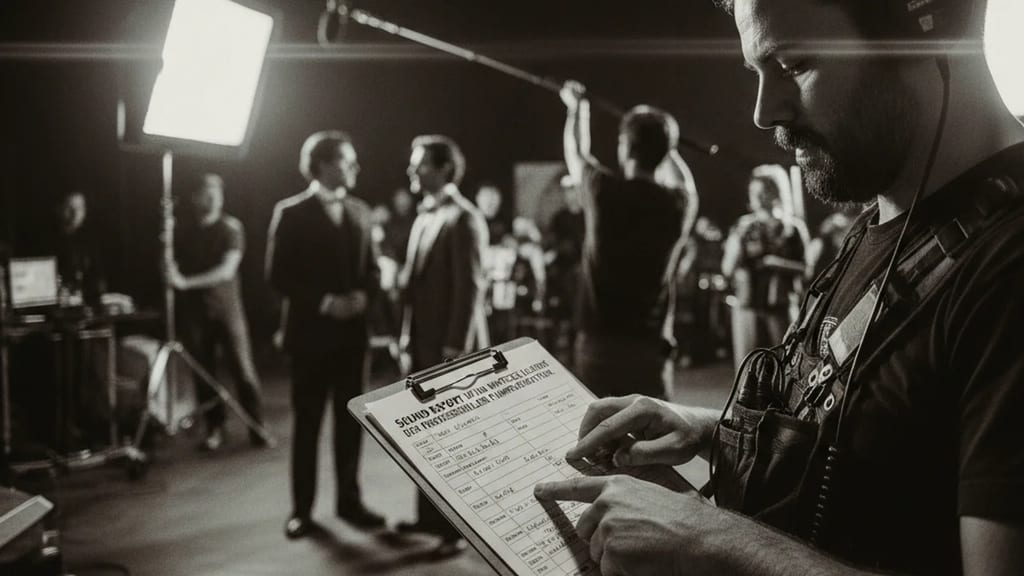
A complete sound report lists every take with start and end timecode (format: HH:MM:SS:FF at 25fps), average and maximum sound pressure levels in dB SPL, and the microphone configuration used. Standard fields include scene and take number, slate information, sampling rate (usually 48kHz/24bit), channels used (up to 32 tracks on modern recorders like Sound Devices 833), wind conditions (Beaufort scale 0-12), and disruptive ambient noise with their approximate frequency spectrum. Digital versions integrate metadata directly into the audio files via BWF (Broadcast Wave Format) headers.
History & Development
Sound reports originated in 1929 with the introduction of synchronized sound, as handwritten lists on pre-printed Western Electric forms. Standardization occurred in 1934 by the Academy of Motion Picture Arts and Sciences with the first uniform Sound Report Sheet. In 1970, Nagra introduced magnetic reference tones, enabling precise synchronization. Since 1995, digital metadata has supplemented paper-based documentation, and from 2010, cloud-based systems like MovieSlate have allowed direct upload to post-production.
Practical Application in Film
On "Mad Max: Fury Road" (2015), sound mixer Ben Osmo created 847 individual entries daily for vehicle engines, with each engine take documented by exact RPM and transmission load. Christopher Nolan's "Dunkirk" (2017) used over 2,400 sound report entries solely for aircraft noise, categorized by aircraft type, altitude, and engine load. The workflow involves: recording with immediate evaluation (A-take/B-take/NG), transfer to the Script Supervisor, a copy to the 1st Assistant Director for continuity, and the original to post-production.
Comparison & Alternatives
The sound report differs from the camera report through its focused audio documentation without image parameters. Modern alternatives like Ambient Recording Lockit systems generate automatic reports via GPS timestamps and slate recognition. SetKeeper and similar apps are increasingly replacing paper forms, but offer identical data structures. On low-budget productions, the camera assistant often handles sound report creation, which, however, leads to incomplete technical documentation.