Definition
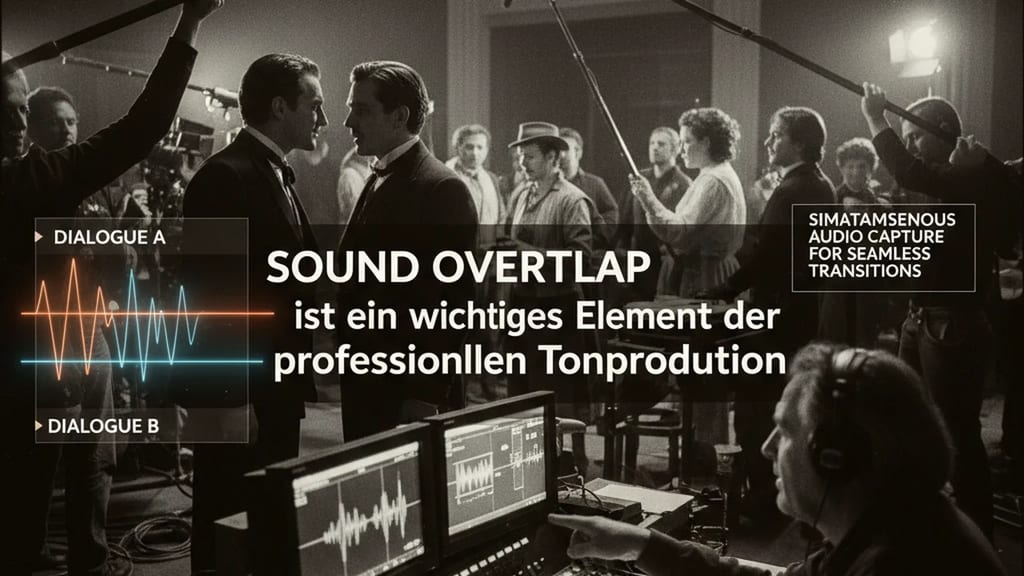
Sound overlap refers to the seamless transition of audio signals between two consecutive shots, where the audio from the first shot extends into the second shot beyond the visual cut, or vice versa. This technique creates acoustic continuity across visual cuts and avoids abrupt sound jumps. The term became established in the 1930s with the further development of multi-track audio technology.
Technical Details
In sound overlap, audio tracks are typically extended by 2-8 frames beyond the visual cut, which corresponds to 83-333 milliseconds at 24fps. In digital post-production, this is achieved through cross-fades with logarithmic or exponential curve profiles. Standard crossfade times range from 12-24 samples at 48kHz for hard cuts and up to 2 seconds for soft transitions. A distinction is made between J-cuts (audio starts before the picture) and L-cuts (audio ends after the picture), as well as symmetrical overlaps with simultaneous fade-in and fade-out.
History & Development
The first documented application occurred in 1927 in "The Jazz Singer" by Vitaphone technicians. In 1932, RCA developed the first mechanical mixing consoles with crossfader functions. The breakthrough came in 1935 with Bell Labs' Multi-Track Recorders, which enabled precise frame accuracy for the first time. Digital Audio Workstations revolutionized the technique starting in 1989 – Pro Tools introduced sample-accurate editing. Modern AI-powered systems like iZotope RX have been automatically analyzing optimal overlap points based on frequency spectra since 2019.
Practical Application in Film
In "Apocalypse Now" (1979), Walter Murch used 3-4 second sound overlaps between combat and quiet scenes. "Mad Max: Fury Road" (2015) utilized 200ms overlaps in action sequences for seamless tempo changes. Dialogue scenes typically use J-cuts with a 4-6 frame lead to maintain natural conversation rhythms. In music films, sound overlaps are synchronized rhythmically with bar changes. The technique reduces the need for additional ambient sounds by an average of 30% of the originally planned recording time.
Comparison & Alternatives
In contrast to a hard cut, sound overlap does not involve an abrupt audio separation. Crossfading differs by simultaneously fading out and fading in two audio tracks. Audio ducking selectively lowers frequency ranges without complete overlap. Match cuts use identical audio content without overlap. Modern alternatives include spectral morphing techniques and psychoacoustically optimized algorithms that exploit the masking effects of human hearing.