Filmlexikon.
Support
Sound Designer
Sound · Roles

Sound Designer

Murnau AI illustration
15lb sandbag 20 c stand 216 diffusion 250 diffusion 251 diffusion 25lb sandbag 35lb sandbag 40 c stand

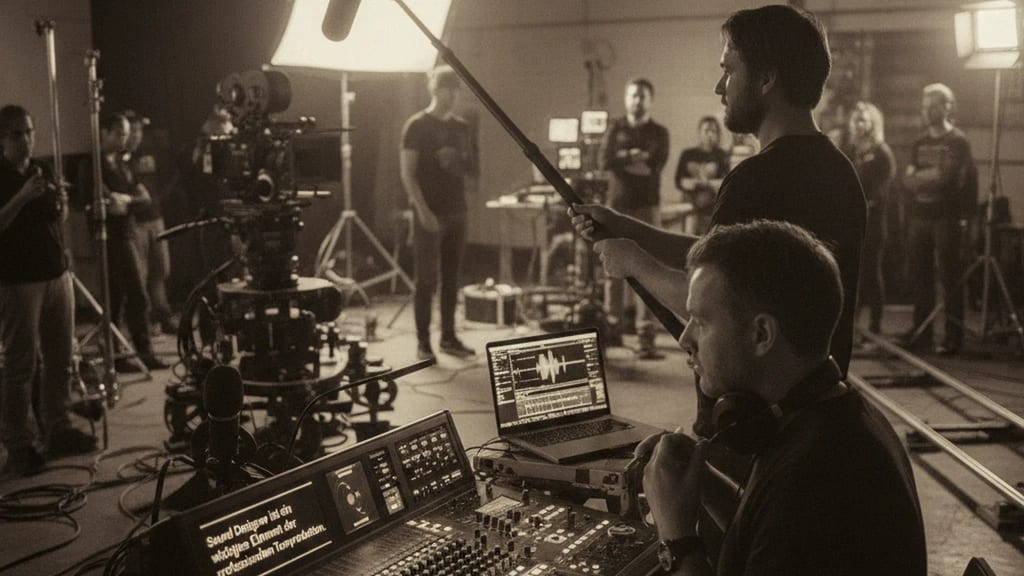
Creates and edits sound effects for film using Digital Audio Workstations like Pro Tools, often by layering and manipulating recorded audio to craft new sonic textures.

Technical Details

Sound Designers work with Digital Audio Workstations (DAWs) such as Pro Tools HDX systems with up to 256 simultaneous audio tracks at latency times below 2ms. They use spectral analysis software for frequency processing between 20 Hz and 20 kHz and employ convolution reverbs with impulse responses of real spaces. Modern systems process surround formats up to Dolby Atmos with 128 simultaneous audio objects. Field recording is done with directional microphones at signal-to-noise ratios of at least 80 dB.

History & Development

In 1971, Walter Murch introduced the term for "THX 1138," but only established it in 1979 with "Apocalypse Now." Ben Burtt revolutionized sound design in 1977 with "Star Wars" by creating iconic laser weapon and lightsaber sounds. Gary Rydstrom developed digital workflows at Skywalker Sound starting in the 1990s. The introduction of Pro Tools in 1991 democratized the industry. Since 2012, object-based audio formats like Dolby Atmos have enabled three-dimensional sound positioning.

Practical Application in Film

For "Jurassic Park" (1993), Gary Rydstrom mixed elephant, walrus, and alligator sounds for the T-Rex roar. Michel Gondry used exclusively diegetic sounds without post-production effects for "Eternal Sunshine" (2004). Denis Villeneuve had a unique alien language with 100 distinct vocalizations developed for "Arrival" (2016). The workflow includes spotting sessions, ADR recording, Foley recording, and the final pre-mix with up to 300 separate audio tracks per reel.

Comparison & Alternatives

Sound Designers differ from Sound Engineers in their creative re-creation rather than pure recording, and from Foley Artists through computer-based workflows rather than live performance. Sound Supervisors coordinate all audio departments, while Sound Designers specifically create effects. Re-recording mixers perform the final mixing console balancing. In low-budget productions, one person often takes on multiple roles; in blockbusters, specialized teams with up to 15 sound designers work in parallel.
From the crafts

Perspectives

Cinematographer

Ich stimme meine Kamerabewegungen mit dem Sound Designer ab, besonders bei Action-Sequenzen wo jeder Schwenk und Schnitt die Wucht der Soundeffekte verstärken muss. Bei Dialogszenen in hallenden Locations wie Kathedralen plane ich die Bildkomposition so, dass die räumliche Akustik visuell nachvollziehbar wird. Die Bildfrequenz beeinflusst direkt die Sync-Präzision - bei 24fps haben wir 41,67ms pro Frame für exaktes Audio-Timing.

Director

Ich entwickle mit dem Sound Designer bereits im Drehbuch konkrete akustische Motive für Charaktere und verwende Soundscapes als unsichtbare Erzählebene. Bei "Blade Runner 2049" definierte ich mit dem Team 47 verschiedene Regen-Variationen als emotionale Grundstimmung für verschiedene Szenen. Sound Design wird bei mir zur zweiten Bildebene - ein metallisches Knarren kann mehr Spannung erzeugen als jeder Dialogsatz.

Producer

Sound Designer kosten zwischen 800-2500 Euro pro Drehtag in der Post-Production, wobei komplexe Sci-Fi-Produktionen bis zu 180 Arbeitstage benötigen. Ich kalkuliere 8-12% des Gesamtbudgets für die komplette Tonpost und plane mindestens 16 Wochen zwischen Picture Lock und Endmischung ein. Die Lizenzierung von Soundbibliotheken wie der 25.000-Sample-starken "Boom Library" kostet zusätzlich 15.000-45.000 Euro je nach Projektumfang.

More in the lexikon

Related terms

Test your knowledge

Quiz

1. Was beschreibt „Sound Designer" am besten?

2. Zu welchem Department gehört „Sound Designer"?

3. Wie viele verschiedene Fachperspektiven bietet dieser Eintrag?

Report an error
From the Filmfarm ecosystem

Understand visual language, budget productions, connect crew.

The Lexikon is part of the Filmfarm ecosystem — alongside budgeting (FilmBalance), an industry magazine (FilmCircus) and crew networking (FilmCall, CrewMesh). One shared vocabulary for the whole production.

FilmFarm FilmRadarComing soonFilmPulseComing soonFilmNumbersComing soonFilmCapitalComing soonFilmLabComing soonFilmBalanceComing soonFilmCircusComing soon