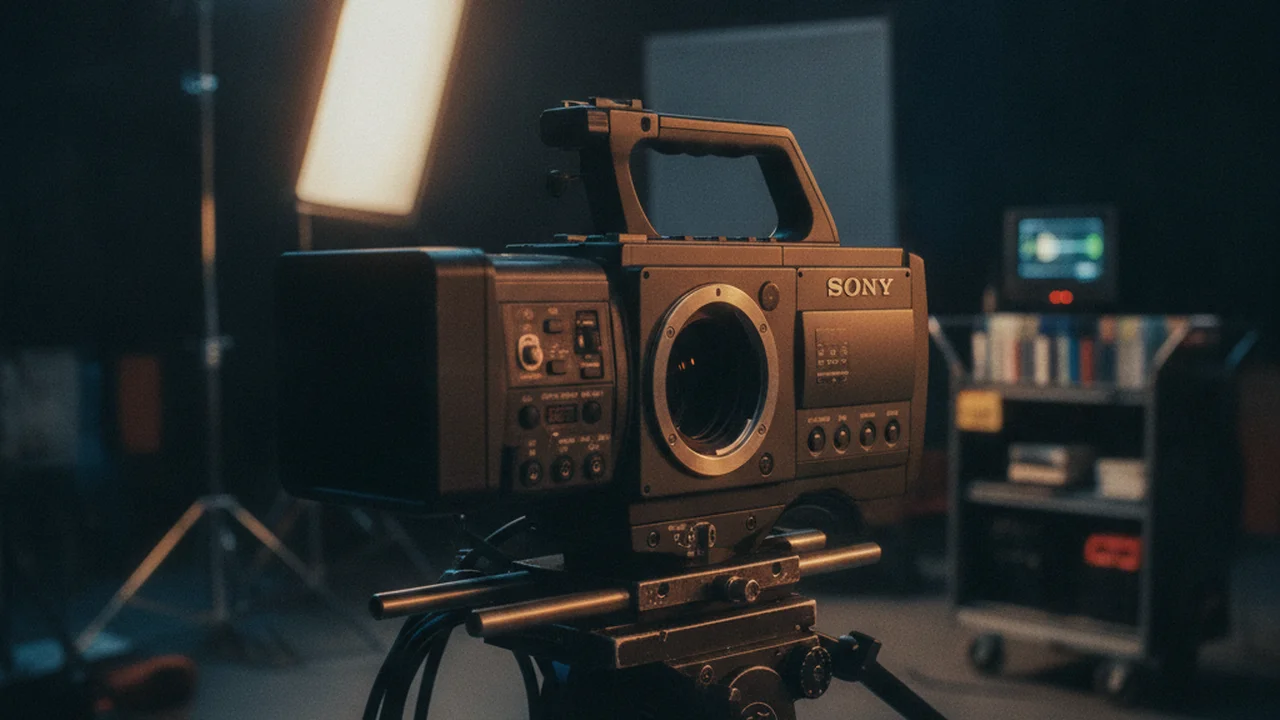
Sony broadcast camera head from 1996 with three 2/3-inch Power HAD CCDs and 850 TV lines. No built-in recorder — it becomes a camcorder only once a deck is docked.
The DXC-D30 is a camera without recording capabilities. This sounds like a deficiency and is at the core of its concept: in the nineties, Sony built the camera head and the drive as separate units that could be connected. The same head could then be used with Betacam SP, Betacam SX, DVCAM, or Hi8 – depending on what was attached to the back.
The Sensor
Three 2/3-inch Interline Transfer CCDs of the Power HAD generation, behind an F1.4 prism. 768 x 494 effective pixels, sensor area 8.8 x 6.6mm. Sony specifies 850 TV lines horizontally, signal-to-noise ratio 63 decibels, sensitivity F11 at 2000 Lux. The signal is NTSC, 525 lines, 2:1 interlaced, 60 fields – the PAL variant is called DXC-D30P. Anyone buying such a camera today should pay attention to the letter designation.
Camera Head and Dock
Two interfaces: the analog Pro 50-pin and a digital Pro 76-pin with 4:2:2 at 10-bit. Among others, the PVV-3 for Betacam SP was docked – this combination was then called PVW-D30 – the BVV-5 via the CA-511 adapter, the BVW-50, the DNV-5 for Betacam SX, and the DSR-1 for DVCAM, which ran as the DSR-130. This is why lens lists often only state 'DXC-D30 Betacam': it refers to the camera plus the drive, not a camera model named Betacam.
Why it Reappears in 2026
Because it delivers an image quality that cannot be replicated. Three separate CCDs produce a different color separation than a Bayer sensor with interpolation. Interlacing creates different motion than progressive scan with a 180-degree shutter. And the 2/3-inch image circle flattens the depth-of-field gradation that arises almost automatically from modern footage. All three characteristics combined result in something that a grade cannot produce.
What to Plan For
The mount is B4, meaning 2/3 inch – modern cine lenses won't fit and cannot be adapted because the prism is in the way. Recording requires tapes and a functioning machine for transfer – both are collector's items. And the camera has no internal log or latitude that saves post-production: what is not properly exposed on set cannot be properly corrected afterward.
Related terms
Quiz
1. Was beschreibt „SONY DXC-D30" am besten?
2. Zu welchem Department gehört „SONY DXC-D30"?