Filmlexikon.
Support
Sony BVM
Camera · Terms

Sony BVM

Murnau AI illustration
flow para roll take

Sony professional reference monitors using CRT or OLED technology for precise color correction and monitoring in film production.

Technical Details

CRT models like the BVM-D20F1U achieved a resolution of 800 TVL (TV Lines) on a 20-inch screen and supported SD and HD-SDI inputs. Modern OLED variants such as the BVM-X300 offer 4K resolution (3840×2160), 1000 cd/m² peak brightness, and a contrast ratio of 1,000,000:1. The monitors feature hardware LUTs with 12-bit processing, integrated vectorscopes and waveform displays, as well as calibratable gamma curves for various production standards.

History & Development

Sony introduced the first BVM monitor in 1985, based on high-resolution Trinitron CRT tubes. The BVM-D24E1WU from 2003 became the industry standard for HD post-production and cost around 25,000 Euros. In 2016, Sony ceased CRT production and focused on OLED technology. The BVM-HX310, introduced in 2017, marked the transition to HDR-capable monitors with up to 4000 cd/m² peak brightness.

Practical Use in Film

In the color grading of films like "Mad Max: Fury Road" (2015), BVM monitors were used as master references to precisely adjust the characteristic orange-blue color palette. DIT (Digital Imaging Technician) setups utilize portable BVM models for live grading on set. The monitors serve as the final reference for deliverables, as their calibration adheres to broadcast standards. Streaming providers like Netflix specify BVM-X300 monitors for the acceptance of their original productions.

Comparison & Alternatives

BVM monitors differ from consumer displays through factory calibration and reproducible color rendition. Flanders Scientific Monitor (FSI) and EIZO ColorEdge offer comparable alternatives but do not achieve Sony's market penetration. Modern 4K OLED models cost between 15,000-35,000 Euros, while specialized HDR variants reach up to 60,000 Euros. For budget productions, calibrated LG OLED TVs are increasingly replacing BVM monitors, but they do not offer hardware LUTs or professional inputs.
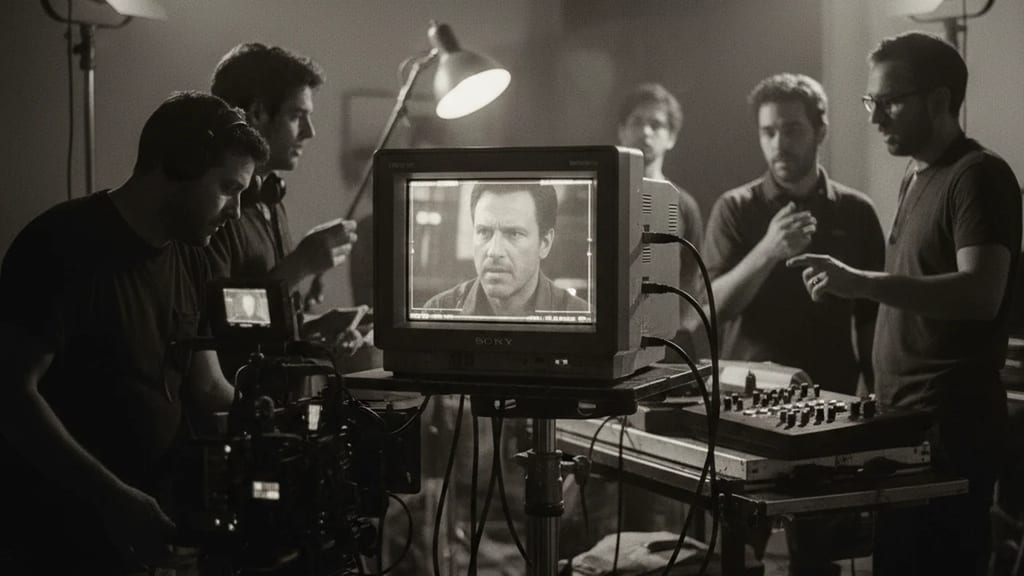
From the crafts

Perspectives

Cinematographer

Ich verlasse mich auf den BVM als absolute Referenz für meine Belichtung und Farbtemperatur, besonders bei kritischen Hauttonabstimmungen. Die eingebauten Scopes zeigen mir sofort, ob ich im legalen Broadcast-Bereich arbeite, ohne externe Messgeräte zu benötigen. Bei HDR-Produktionen ist der präzise Weißpunkt des Monitors entscheidend für meine Lichtsetzung.

Director

Der BVM ermöglicht mir eine präzise Vorschau der finalen Bildästhetik bereits am Set, wodurch ich kreative Entscheidungen direkt treffen kann. Ich sehe genau, wie sich meine gewünschte Farbdramaturgie auf verschiedenen Zielgeräten verhalten wird. Die konsistente Farbwiedergabe hilft mir, die emotionale Wirkung einzelner Szenen visuell zu kontrollieren.

Producer

Ein BVM-Monitor kostet 25.000-60.000 Euro, amortisiert sich aber durch eingesparte Korrekturschleifen in der Postproduktion. Die Investition reduziert Risiken bei internationalen Auslieferungen, da Farbabweichungen bereits in der Produktion eliminiert werden. Für kleinere Budgets miete ich BVM-Monitore tageweise für kritische Farbkorrektursitzungen, was etwa 200-400 Euro pro Tag kostet.

More in the lexikon

Related terms

Test your knowledge

Quiz

1. Zu welchem Department gehört „Sony BVM"?

2. Wie viele verschiedene Fachperspektiven bietet dieser Eintrag?

Report an error
From the Filmfarm ecosystem

Understand visual language, budget productions, connect crew.

The Lexikon is part of the Filmfarm ecosystem — alongside budgeting (FilmBalance), an industry magazine (FilmCircus) and crew networking (FilmCall, CrewMesh). One shared vocabulary for the whole production.

FilmFarm FilmRadarComing soonFilmPulseComing soonFilmNumbersComing soonFilmCapitalComing soonFilmLabComing soonFilmBalanceComing soonFilmCircusComing soon