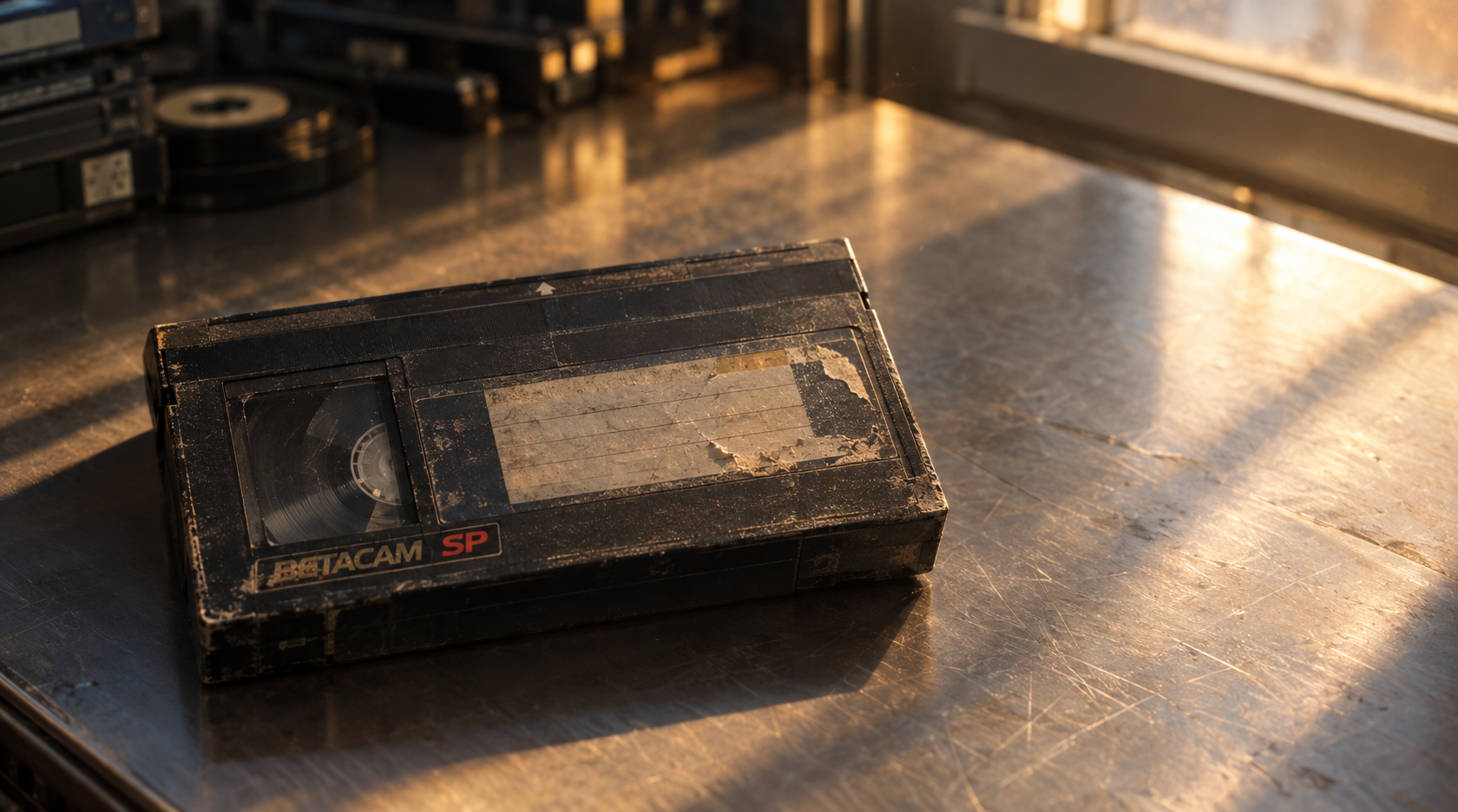
Sony's family of professional half-inch videotape formats — from analogue Betacam in 1982 through Betacam SP to Digital Betacam. The broadcast production standard for two decades.
Betacam is not a single format but a family that has grown over twenty years. What unites them: half-inch tape in a cassette, professional component recording, and a market share that practically dominated television production from 1982 well into the 2000s. Anyone entering an archive today is very likely to pass a Betacam shelf.
Betacam, 1982
Introduced on August 7, 1982, as the successor to U-matic. The decisive step was component recording: brightness and color recorded separately instead of being combined into a composite signal. Sony achieved this via CTDM, a time-division multiplexing method that sequentially writes the two color difference signals compressed onto the same track. Resolution was around 300 lines for luma, 120 lines for chroma. This was a leap for news operations, and for anything involving post-production – component signals can be cut and mixed without color degradation.
Betacam SP, 1986
The version that took the market. SP stands for Superior Performance and essentially refers to the tape coating: metal particles instead of ferrite oxide. This increased the horizontal resolution to about 340 lines, and the L-cassette held 90 minutes. From the late eighties to the late nineties, Betacam SP was what nobody has today – a true industry standard that every broadcaster, post-production house, and rental company aligned with. Sony ceased production in 2001.
Digital Betacam, 1993
Introduced in Montreux in June 1993. Digital recording: 10-bit, 4:2:2, DCT-compressed with a mild ratio of 2.34:1, 90 megabits per second. In addition, four uncompressed audio tracks at 48 kilohertz and 20-bit. For standard definition, this was the limit of what tape technology could sensibly achieve, and Digital Betacam is therefore still the format in which SD archive holdings are most frequently found in usable quality today.
The Sidelines
Betacam SX arrived in 1996 with MPEG-2 compression at 18 megabits per second – cheaper, intended for news. MPEG IMX followed in 2000 with 30, 40, or 50 megabits. For HD, Sony built HDCAM (1997, 1440 x 1080, 144 megabits) and HDCAM SR (2003, up to 880 megabits). All use the same half-inch cassette format, but none are playback compatible with the others – a point that is regularly underestimated in archive work.
Why This Is Still Practical Today
Two reasons. The first is archive work: anyone digitizing material from the eighties to the two-thousands needs to know which format is on the tape, because it determines which machine is needed and what can be retrieved at all. The second is aesthetic. Betacam SP has a look – limited resolution, soft color separation, a certain noise – that cannot be replicated by a filter because it originates from the tape mechanics. There are therefore productions that shoot on Betacam in 2026, using functioning technology from the nineties.
Related terms
Quiz
1. Was beschreibt „Betacam" am besten?
2. Zu welchem Department gehört „Betacam"?