Filmlexikon.
Support
Skew
Camera · Terms

Skew

Murnau AI illustration
flow para roll take

Geometric image distortion caused by shear angle where parallel lines appear skewed, resulting from film slip, sensor misalignment, or camera vibration during motion.

Technical Details

Skew distortions are quantified by the shear angle α (Shear Angle), where even 2-3° can produce visible distortions. In analog film projection, typical skew values between 0.5° and 1.5° arise from film slippage or warped film paths. Digitally, skew manifests as pixel shifts, measurable as the shear factor s = tan(α). Modern image stabilization systems automatically correct skews up to 5°, while extreme values up to 15° remain correctable in post-production software like Nuke or After Effects.

History & Development

Skew effects plagued early cinematographers as early as 1895, when uneven film transport created characteristic trapezoidal distortions. In 1923, the Mitchell Camera Corporation developed precision-engineered film guides that reduced skews below 0.3°. With the transition to digital workflows in the 1990s, the problem shifted from mechanical causes to sensor misalignments and rolling shutter artifacts. Modern gimbal systems like the MōVI Pro (2013) integrate real-time skew correction through IMU-based compensation.

Practical Application in Film

Unintended skew frequently occurs in helicopter or vehicle shots when camera mounts yield under vibration. Directors like Christopher Nolan consciously use controlled skew for disorientation effects, for example, in the limbo sequences of "Inception" (2010). In "Battlefield Earth" (2000), notorious skew distortions resulted from extreme camera angles without correction. VFX supervisors routinely compensate for skew using corner-pin techniques, where tracking markers enable precise corrections down to the sub-pixel level.

Comparison & Alternatives

Skew differs from keystone distortion by preserving parallelism, whereas keystone creates trapezoidal deformations. Rolling shutter produces time-based skew effects with moving objects, as opposed to purely geometric skew. Modern alternatives include real-time warp processors in high-end cameras like the ARRI Alexa LF, which replace mechanical corrections with optical sensor compensation. Software solutions such as REVisionFX RE:Flex offer automatic skew detection with sub-frame precision.
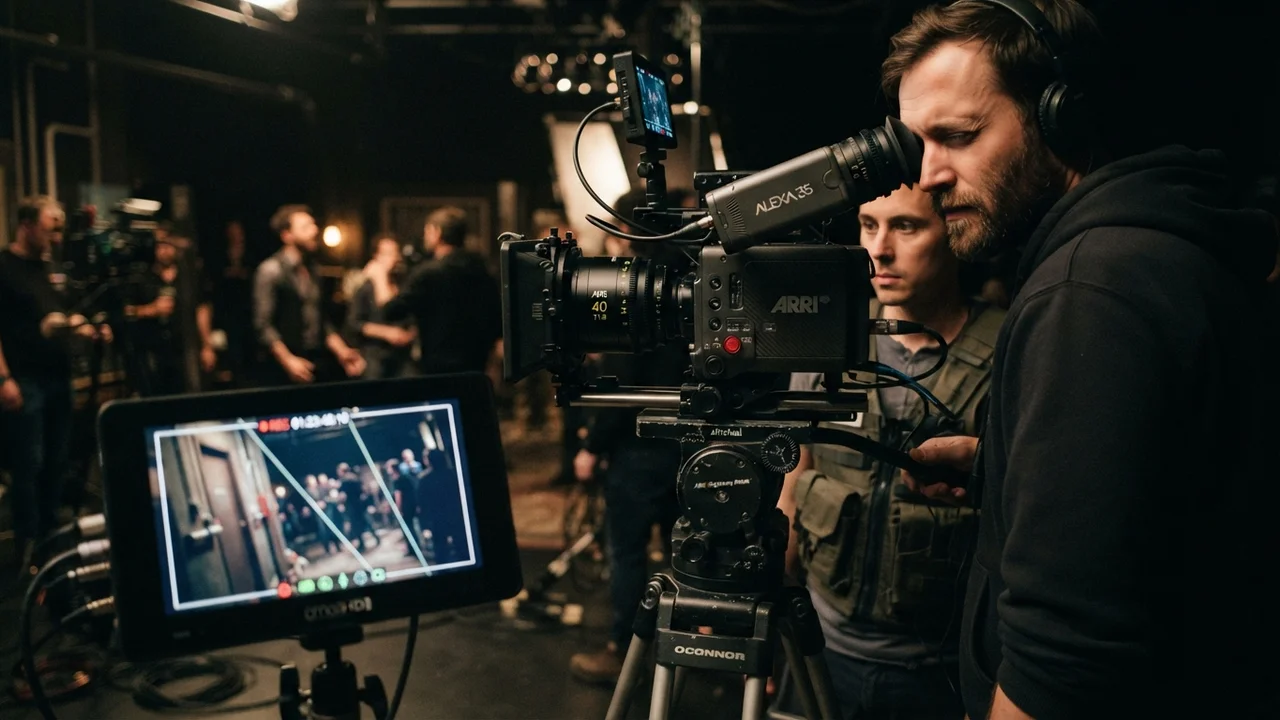
From the crafts

Perspectives

Cinematographer

Ich überwache Scherung kontinuierlich über Zebra-Pattern auf meinem Monitor, besonders bei Steadicam-Fahrten oder wenn ich mit längeren Brennweiten arbeite. Selbst minimale Scherung von 1° zerstört die Bildkomposition und erfordert sofortige Anpassung des Kameramounts oder der Sensorausrichtung. Bei kritischen Szenen setze ich zusätzliche Referenzlinien im Sucher, um auch kleinste Verzerrungen sofort zu erkennen.

Director

Ich nutze kontrollierte Scherung gezielt, um Desorientierung oder psychologische Instabilität visuell zu vermitteln - ein leicht geschertes Bild erzeugt beim Zuschauer unbewusstes Unbehagen. Während der Drehbuchentwicklung plane ich bereits, welche Szenen von subtiler Scherung profitieren könnten, ohne dass es wie ein technischer Fehler wirkt. Bei Dialogszenen vermeide ich jede Scherung, da sie die emotionale Verbindung zum Charakter untergräbt.

Producer

Scherungskorrektur in der Post kostet mich durchschnittlich 800€ pro Drehtag bei einem Standard-Spielfilm, weshalb ich in präzise Kameraausrüstung investiere. Versicherungen decken Nachdreh-Kosten durch Scherungsfehler nur bei nachweisbaren Equipment-Defekten, nicht bei Bedienungsfehlern. Ich kalkuliere 3-5% des VFX-Budgets für geometrische Korrekturen ein, da selbst bei sorgfältigster Planung Scherungsartefakte auftreten können.

More in the lexikon

Related terms

Test your knowledge

Quiz

1. Zu welchem Department gehört „Scherung"?

2. Wie viele verschiedene Fachperspektiven bietet dieser Eintrag?

Report an error
From the Filmfarm ecosystem

Understand visual language, budget productions, connect crew.

The Lexikon is part of the Filmfarm ecosystem — alongside budgeting (FilmBalance), an industry magazine (FilmCircus) and crew networking (FilmCall, CrewMesh). One shared vocabulary for the whole production.

FilmFarm FilmRadarComing soonFilmPulseComing soonFilmNumbersComing soonFilmCapitalComing soonFilmLabComing soonFilmBalanceComing soonFilmCircusComing soon