Filmlexikon.
Support
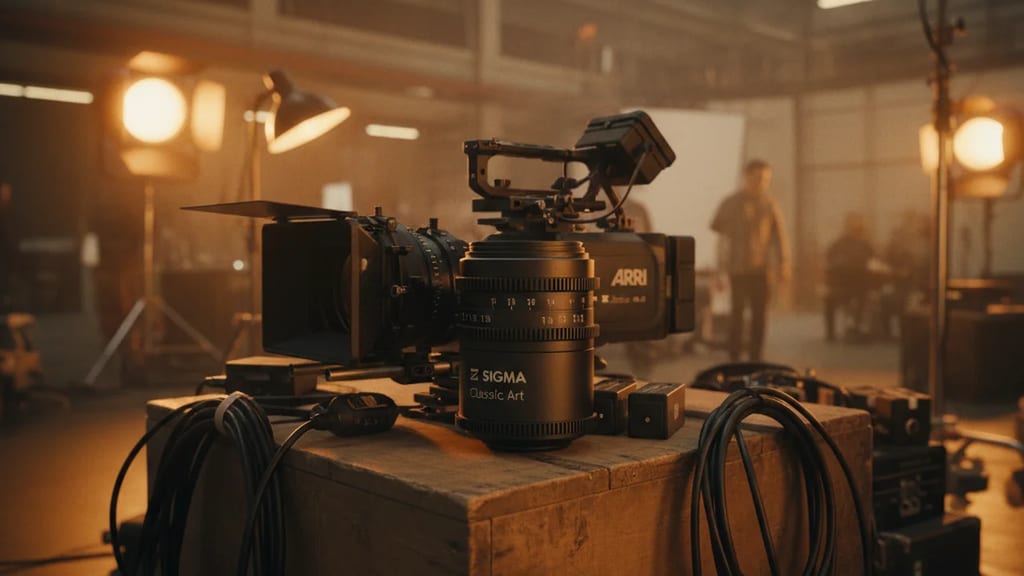
Sigma Classic Art
Camera · Equipment

Sigma Classic Art

Murnau AI illustration
sigma cine ssi flow para roll take

Sigma Classic Art lens series (1994) with eight prime focal lengths (20–135mm, f/2.8), ED glass and ELD coating. Manual focus only; 40–60% cheaper than Zeiss/Leica equivalents; distinctive rendering.

Technical Details

The series comprised eight prime lenses: 20mm, 24mm, 28mm, 35mm, 50mm, 85mm, 105mm, and 135mm, all with an f/2.8 aperture. The lenses utilized ED (Extra-low Dispersion) glass to minimize chromatic aberrations and a special ELD (Electron Beam Coating) for reduced reflections. The filter thread was consistently 62mm, and the weight ranged from 285g (35mm) to 520g (135mm). All models featured an aperture ring with 1/2-stop clicks and a minimum focusing distance between 0.2m (50mm) and 1.5m (135mm).

History & Development

Sigma introduced the Classic Art series in 1994 in response to the growing demand for high-quality third-party lenses. Development took four years and cost $12 million USD. A revision in 2002 brought improved coatings and optimized mechanics. With the introduction of the Art series in 2012, Sigma ceased Classic Art production after approximately 180,000 units had been sold.

Practical Use in Film

Cinematographer Roger Deakins used the 50mm Classic Art for close-ups in "The Man Who Wasn't There" (2001), as it produced a characteristic image rendering with smooth bokeh transitions. The series was favored for low-budget productions, being 40-60% cheaper than comparable Zeiss or Leica lenses. Due to their purely manual operation, they were particularly suitable for follow focus systems and precise focus pulls.

Comparison & Alternatives

In contrast to Sigma's contemporary EX series, Classic Art lenses deliberately omitted autofocus and image stabilization in favor of more robust mechanics. Modern alternatives include the Sigma Art series (from 2012) or Zeiss Classic lenses, which are, however, 200-300% more expensive. While current lenses are optimized for digital sensors, Classic Art lenses exhibit their characteristic image aesthetic with increased micro-contrast on 16mm and 35mm film.
From the crafts

Perspectives

Cinematographer

Ich schätze bei Classic Art-Objektiven die konstante Farbwiedergabe über alle Brennweiten – das erspart mir zeitaufwändige Korrekturen in der Post. Das einheitliche 62mm-Filtergewinde beschleunigt den Objektivwechsel erheblich, und die präzise Fokussierung über 270° Drehwinkel gibt mir absolute Kontrolle bei kritischen Einstellungen.

Director

Mit Classic Art-Objektiven kann ich bewusst eine nostalgische Bildsprache schaffen, da sie Film-Look auch bei digitalen Kameras erzeugen. Die leichte Vignettierung bei Offenblende nutze ich für intime Porträts, während die charakteristische Unschärfe-Qualität emotionale Szenen verstärkt und den Zuschauer näher an die Figuren bringt.

Producer

Classic Art-Objektive kaufe ich gebraucht für 300-800 Euro pro Stück – ein kompletter Satz kostet mich weniger als ein neues Zeiss-Objektiv. Die robuste Mechanik übersteht problemlos 200+ Drehtage ohne Wartung, und durch das einheitliche Zubehör spare ich bei Filtern und Mattboxen erhebliche Kosten.

More in the lexikon

Related terms

Test your knowledge

Quiz

1. Was beschreibt „Sigma Classic Art" am besten?

2. Zu welchem Department gehört „Sigma Classic Art"?

3. Wie viele verschiedene Fachperspektiven bietet dieser Eintrag?

Report an error
From the Filmfarm ecosystem

Understand visual language, budget productions, connect crew.

The Lexikon is part of the Filmfarm ecosystem — alongside budgeting (FilmBalance), an industry magazine (FilmCircus) and crew networking (FilmCall, CrewMesh). One shared vocabulary for the whole production.

FilmFarm FilmRadarComing soonFilmPulseComing soonFilmNumbersComing soonFilmCapitalComing soonFilmLabComing soonFilmBalanceComing soonFilmCircusComing soon