Filmlexikon.
Support
Serene Arm
Camera · Terms

Serene Arm

Murnau AI illustration
gimbal steadicam m 1 steadicam m 2 steadicam operator steadicam volt steadicam tiffen steadicam dji ronin 2

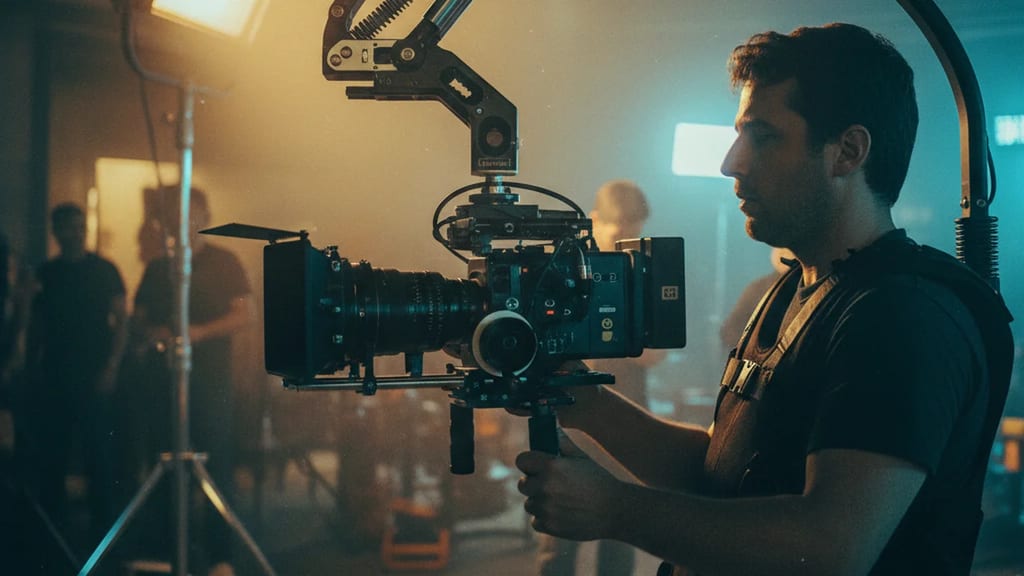
Hydraulically damped camera stabilizer arm by Chapman-Leonard/Panasonic, carbon fiber construction, 360° pan capability, three payload variants (8–35 kg).

Technical Details

The core element is a two-part carbon fiber construction with a base weight of 3.8 kg. The hydraulic damping system uses SAE 10W-30 viscosity silicone oil and operates at temperatures ranging from -10°C to +45°C. The arm offers 360° horizontal and 180° vertical panning with continuously adjustable friction. Three standard variants exist: Serene Arm Compact (max. 8 kg), Standard (max. 18 kg), and Heavy Duty (max. 35 kg).

History & Development

Developed in 2007 by the British company Chapman-Leonard Studios as an alternative to conventional jib arms. Its first commercial application was in 2008 during the filming of "The Dark Knight" for Batmobile chase sequences. In 2012, its acquisition by Panasonic led to a digitized version with electronic damping control. Since 2018, Serene Arms have been available with an integrated motion control interface.

Practical Use in Film

Christopher Nolan extensively used the Serene Arm in "Inception" (2010) for the rotating hotel corridor sequences, as the system remains functional even at a 90° tilt. In "Mad Max: Fury Road" (2015), the combination of the Serene Arm and Alexa Mini enabled the characteristic low-angle shots between vehicles. The typical workflow includes a 15-minute calibration phase and requires two technicians for setup and operation.

Comparison & Alternatives

Unlike static jib arms, the Serene Arm offers continuous stabilization during movement. Compared to Steadicam systems, it excels with higher payload capacity and less physical effort for the operator. Modern alternatives like the DJI Ronin 4D achieve comparable stabilization with lower weight, but with limited reach. For outdoor shots in winds above Beaufort force 4, the Serene Arm remains superior due to its mechanical damping.

From the crafts

Perspectives

Cinematographer

Ich setze den Serene Arm primär für komplexe Kamerabewegungen ein, wo Steadicam an Grenzen stößt – besonders bei schweren Optiken wie dem Angenieux 24-290mm. Die hydraulische Dämpfung gibt mir eine organische Bewegungsqualität, die elektronische Gimbals nicht erreichen, und ich kann auch bei längeren Takes ohne Ermüdung arbeiten.

Director

Der Serene Arm erlaubt mir fließende Übergänge zwischen verschiedenen Bildebenen ohne sichtbare Schnitte – perfekt für lange Plansequenzen oder um emotionale Intensität durch kontinuierliche Annäherung zu steigern. Besonders bei Dialogszenen nutze ich die sanfte Bewegungscharakteristik, um subtile psychologische Spannungen visuell zu verstärken, ohne dass die Technik vom Inhalt ablenkt.

Producer

Mit 280 Euro Tagesmiete plus zwei Technikern liegt der Serene Arm 40% über Standard-Jib-Kosten, spart aber durch reduzierte Take-Anzahl Zeit im Drehplan. Setup-Zeit von 45 Minuten erfordert präzise Zeitplanung, besonders bei Location-Wechseln. Das System amortisiert sich ab vier Drehtagen gegenüber Post-Stabilisierung und rechtfertigt die Mehrkosten durch die Bildqualität.

More in the lexikon

Related terms

Test your knowledge

Quiz

1. Was beschreibt „Serene Arm" am besten?

2. Zu welchem Department gehört „Serene Arm"?

3. Wie viele verschiedene Fachperspektiven bietet dieser Eintrag?

Report an error
From the Filmfarm ecosystem

Understand visual language, budget productions, connect crew.

The Lexikon is part of the Filmfarm ecosystem — alongside budgeting (FilmBalance), an industry magazine (FilmCircus) and crew networking (FilmCall, CrewMesh). One shared vocabulary for the whole production.

FilmFarm FilmRadarComing soonFilmPulseComing soonFilmNumbersComing soonFilmCapitalComing soonFilmLabComing soonFilmBalanceComing soonFilmCircusComing soon