Filmlexikon.
Support
Second Unit
Production · Terms

Second Unit

Murnau AI illustration
15lb sandbag 20 c stand 216 diffusion 250 diffusion 251 diffusion 25lb sandbag 35lb sandbag 40 c stand

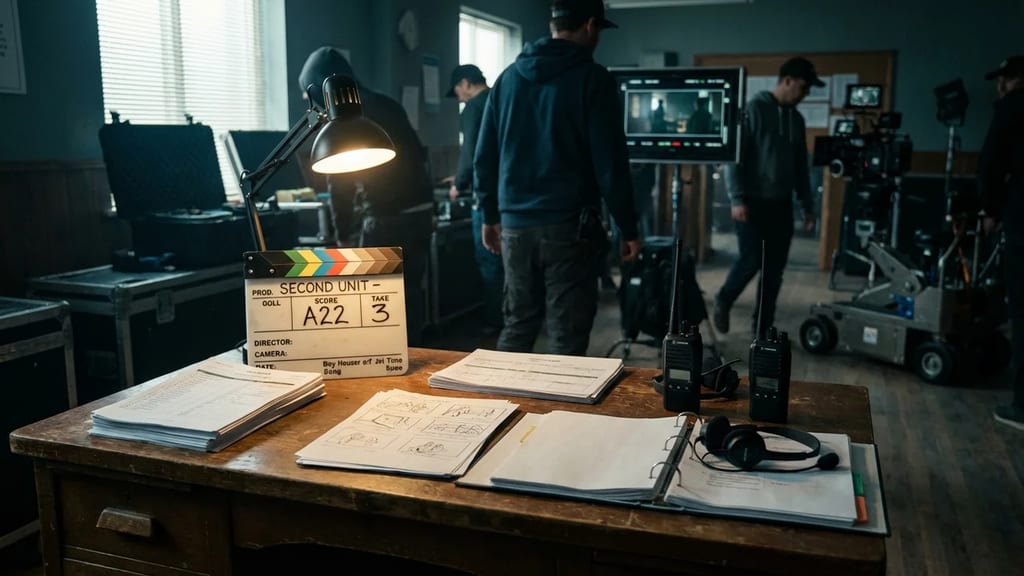
Smaller film crew of 15–40 personnel shooting action sequences, stunts, and establishing shots in parallel with main production, typically without principal actors.

Technical Details

A Second Unit consists of 15-40 crew members – significantly fewer than the 80-150 people of the Main Unit. The core cast includes the Second Unit Director, their own cinematographer (usually referred to as the Director of Photography of the Second Unit), gaffer, script supervisor, and stunt coordinator. In action films, the team can grow to up to 60 people when special effects teams and additional camera operators for multi-camera setups are added. The Second Unit uses identical camera technology to the Main Unit to ensure seamless editing sequences.

History & Development

MGM systematically established the Second Unit system in 1925 for the epic film "Ben Hur" to shoot crowd scenes parallel to dialogue sequences. Starting in the 1930s, Yakima Canutt revolutionized action sequences in Westerns as a Second Unit Director, setting standards for stunt choreography. In the 1960s, directors like Vic Armstrong specialized in Second Unit work for blockbuster productions. Today, Second Units often work months before or after the main production, shooting up to 30% of the final film material.

Practical Application in Film

"Mad Max: Fury Road" shot 80% of its action sequences with Second Units under Guy Norris's direction over an 18-month period. James Bond productions routinely employ 2-3 Second Units in parallel – one for stunts, one for establishing shots of various countries. Marvel productions like "Avengers: Endgame" coordinated up to five Second Units simultaneously across different continents. The Second Unit shoots without the expensive main actors, allowing for longer takes for complex action choreographies that would be impossible for the Main Unit due to time and financial constraints.

Comparison & Alternatives

Unlike a Splinter Unit, which captures specific shots retroactively over just a few days, the Second Unit works independently for weeks or months. Visual Effects Units have partially replaced the classic Second Unit in fantasy and sci-fi productions, as green screen shoots require the Main Unit's presence. Pickup Units work post-production for reshoots, while Second Units operate in parallel to the main production. For low-budget productions under $10 million, producers usually forgo Second Units and integrate their tasks into the Main Unit.
From the crafts

Perspectives

Cinematographer

Ich muss als Second Unit DoP die visuelle Sprache der Main Unit exakt reproduzieren – gleiche Brennweiten, Belichtung und Farbtemperatur sind essentiell für seamless editing. Bei Actionsequenzen verwende ich bis zu acht Kameras gleichzeitig, um jede Explosion oder jeden Stunt vollständig abzudecken, da Wiederholungen meist unmöglich oder zu teuer sind. Die Herausforderung liegt darin, spektakuläre Bilder zu schaffen, die sich nahtlos in die narrative Bildsprache des Hauptkameramanns einfügen.

Director

Second Units ermöglichen mir, die emotionalen Kern-Szenen mit den Hauptdarstellern zu fokussieren, während parallel die visuellen Höhepunkte entstehen. Ich erstelle detaillierte Shotlists und Storyboards für den Second Unit Director, da diese Sequenzen oft das Publikum am stärksten beeindrucken und meine Vision transportieren müssen. Der kreative Dialog mit dem Second Unit Team ist entscheidend – ihre Aufnahmen können meine ursprüngliche Konzeption durch spektakuläre Bilder sogar übertreffen.

Producer

Second Units reduzieren meine Hauptproduktionszeit um durchschnittlich 25%, was bei Tagessätzen von 200.000 Euro erhebliche Einsparungen bedeutet. Ich kann teure Hauptdarsteller früher freigeben und gleichzeitig aufwendige Actionsequenzen realisieren, die sonst das Budget sprengen würden. Die Koordination mehrerer Units erfordert präzise Logistik, spart aber bei Blockbuster-Produktionen oft 5-15 Millionen Euro gegenüber sequentieller Drehweise.

More in the lexikon

Related terms

Test your knowledge

Quiz

1. Was beschreibt „Second Unit" am besten?

2. Zu welchem Department gehört „Second Unit"?

3. Wie viele verschiedene Fachperspektiven bietet dieser Eintrag?

Report an error
From the Filmfarm ecosystem

Understand visual language, budget productions, connect crew.

The Lexikon is part of the Filmfarm ecosystem — alongside budgeting (FilmBalance), an industry magazine (FilmCircus) and crew networking (FilmCall, CrewMesh). One shared vocabulary for the whole production.

FilmFarm FilmRadarComing soonFilmPulseComing soonFilmNumbersComing soonFilmCapitalComing soonFilmLabComing soonFilmBalanceComing soonFilmCircusComing soon