Overview
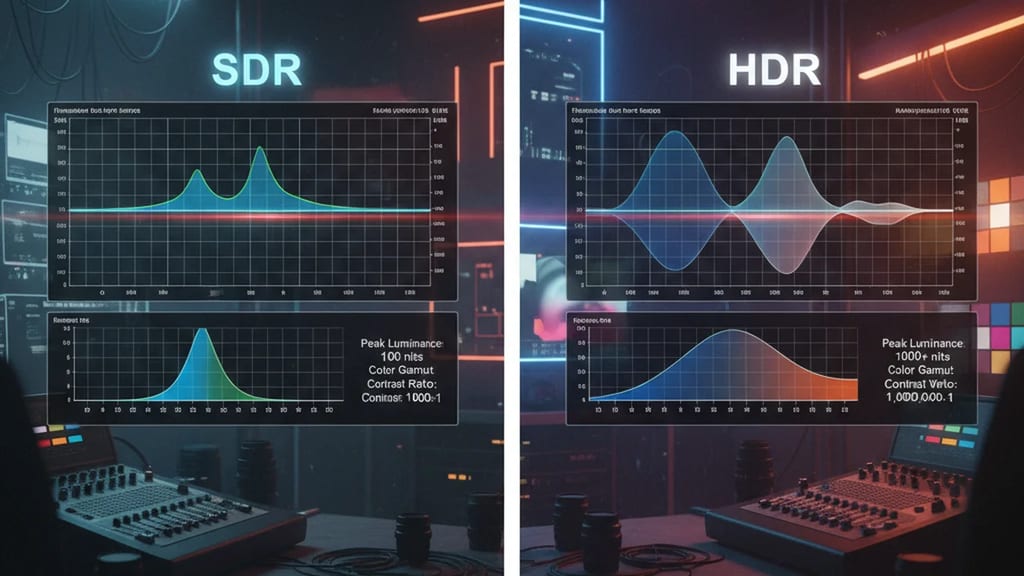
SDR stands for Standard Dynamic Range and refers to the classic brightness, contrast, and color range of video, which has been oriented towards the characteristics of CRT monitors for decades. SDR is not a lighting or grip device, but an imaging standard that determines how images are captured, mastered, and displayed. The term itself only emerged in the 2010s to distinguish established playback from the newer High Dynamic Range (HDR).
On set and in post-production, SDR continues to be the reference for classic broadcast and web deliveries, while HDR workflows (HDR10, Dolby Vision, HLG) are increasingly used in higher-end productions and streaming.
Technical Specifications
SDR is defined by several ITU recommendations that complement each other: Rec.709 specifies color primaries and image parameters, while BT.1886 describes the display curve (EOTF).
| Parameter | SDR (Reference) |
|---|
| Peak Brightness | approx. 100 cd/m² (nits) |
| Black Level | approx. 0.1 cd/m² |
| Color Space | Rec.709 / sRGB |
| Display Curve (EOTF) | ITU-R BT.1886, Gamma ≈ 2.4 |
| Color Depth | mostly 8-bit (professionally also 10-bit) |
| Dynamic Range | approx. 6 stops (8-bit), up to approx. 10 stops (10-bit) |
The EOTF recommendation BT.1886 was standardized by the ITU in March 2011 and approximates the behavior of a CRT screen.
Significance for Set and Post-Production
For lighting, the low peak brightness and limited dynamic range of SDR are relevant: very bright highlights tend to be "clipped," and deep shadows "crushed" if the exposure is not kept cleanly within the SDR range. Gaffers and DoPs must therefore control the contrast range of a scene more carefully than with HDR, where more tonal information is preserved in highlights and shadows.
- Monitoring: SDR reference monitors are typically calibrated to around 100 cd/m² in a darkened environment and Gamma 2.4.
- Color Space: Outputs for classic HDTV and many web platforms are in Rec.709; a lighting setup aligned with SDR must appear consistent within this narrower color space.
- Workflow: For parallel HDR/SDR deliveries, a separate SDR "trim" or mastering step is created so that the image also works within the smaller dynamic range.