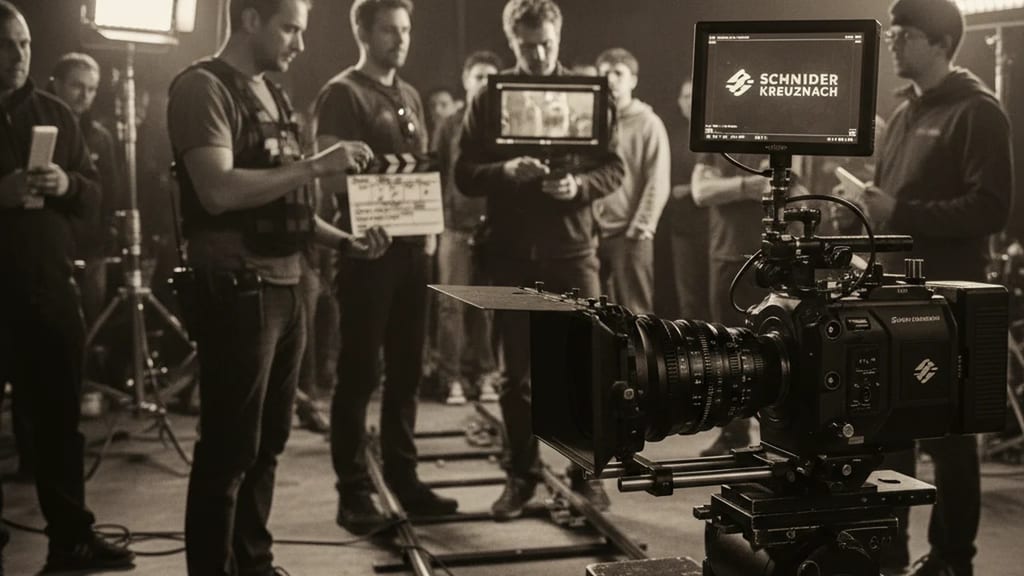
Technical Details
Schneider lenses utilize proprietary glass formulations and multi-layer coatings with up to 18 individual layers per lens surface. The Cine-Xenon series offers consistent T1.4 wide-open apertures with minimal color shift between different focal lengths. Mechanically, the lenses feature 300° focus rings and standardized 0.8 module gears. The company manufactures lenses in PL, LPL, and bayonet mounts for 16mm, 35mm, and digital formats up to 8K resolution.
History & Development
Josef Schneider founded the company in 1913, and the first cinema lens, the Xenon f/2, followed in 1920. The breakthrough came in 1931 with the Xenon f/1.5, which enabled night shots without additional lighting for the first time. After World War II, Schneider established itself as the standard in German film studios with the Variogon zoom series. In 1999, it was acquired by the Schneider Group, and in 2012, a partnership was formed with ARRI for joint lens development.
Practical Use in Film
Wim Wenders consistently used Schneider lenses for "Paris, Texas" (1984) to achieve its characteristic color saturation and soft contrast gradation. The Variogon zooms defined television in the 1970s and 80s, while modern Cine-Xenon lenses were appreciated in productions like "Victoria" (2015) for their consistent light output. The lenses are particularly suitable for available light situations and naturalistic color grading.
Comparison & Alternatives
Schneider lenses are positioned between the clinical Zeiss optics and the characterful Cooke lenses. While Zeiss focuses on maximum sharpness and Cooke on the "Cooke Look," Schneider offers balanced optics without a dominant image characteristic. Modern alternatives include ARRI Signature Primes or Sony CineAlta lenses, but these do not achieve the mechanical longevity of German manufacturing. For low-budget productions, Canon CN-E or Sigma Cine lenses compete at a more affordable price point.