Technical Details
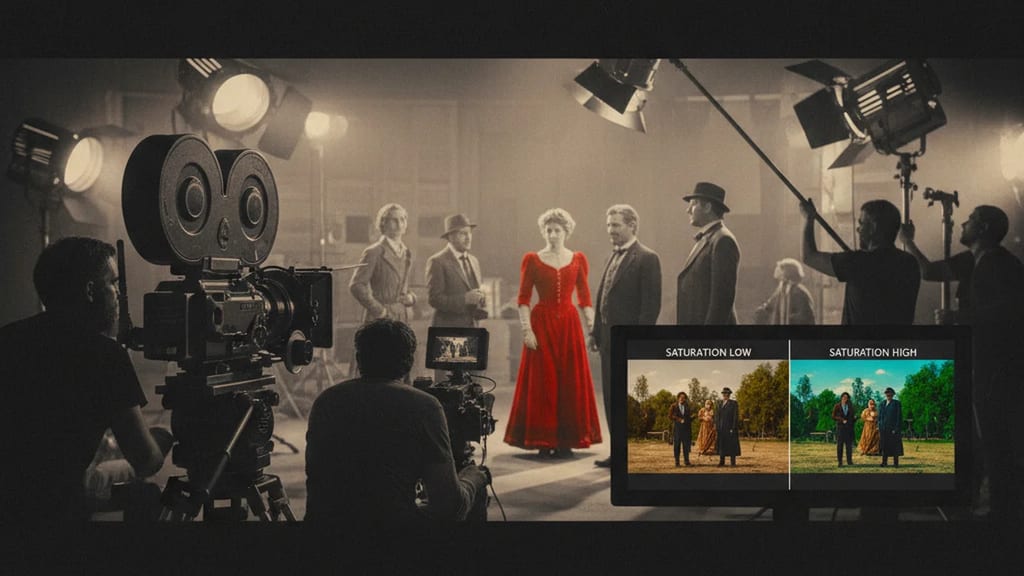
In digital systems, saturation is controlled via various color spaces: In the Rec. 709 HDTV standard, the color gamut covers 35.9% of the CIE 1931 color space, while Rec. 2020 for 4K/8K productions covers 75.8%. DaVinci Resolve operates with saturation controls from -100 to +100, with typical corrections ranging between ±25. The vectorscope displays saturation as radial distance from the center – broadcast-legal limits are 75% for Rec. 709 and 100% for Rec. 2020. HDR workflows in Dolby Vision achieve saturation values up to 4000 nits peak brightness with increased color saturation.
History & Development
Conscious saturation manipulation began in 1935 with Technicolor's three-strip process, which produced oversaturated, artificial colors. In 1950, Kodak introduced Eastmancolor, enabling more natural saturation. Digital Intermediate (DI) from 2000 onwards revolutionized saturation control – "O Brother, Where Art Thou?" was the first fully digitally colorized film in 2000. In 2009, "Avatar" established HDR workflows with extended saturation ranges. In 2016, Netflix standardized the P3-D65 color space with specific saturation guidelines for streaming content.
Practical Application in Film
Ridley Scott's "Mad Max: Fury Road" (2015) uses orange-blue saturation with +40 values for desert scenes and -30 for night sequences. "Her" (2013) works with selective red-orange saturation at +60, while other colors are at -20. Steven Soderbergh's "Traffic" distinguishes plotlines through saturation levels: Mexico at +35 (warm), USA at -15 (cool). Horror productions like "Suspiria" (2018) oversaturate red tones to +80 for visual impact. Streaming formats require 10-15% reduced saturation compared to cinema versions due to compression artifacts.
Comparison & Alternatives
Saturation differs from contrast (luminance differences) and vibrance (selective saturation of weakly saturated areas). While saturation uniformly enhances all colors, vibrance only affects already weakly saturated tones. Color grading offers more precise control than in-camera saturation – RED cameras deliver LOG footage with 12-16 bit color depth for post-processing. ARRI Alexa uses LogC gamma with reduced saturation for maximum dynamic range. HDR10+ and Dolby Vision enable dynamic saturation metadata that adjusts scene by scene.