Definition
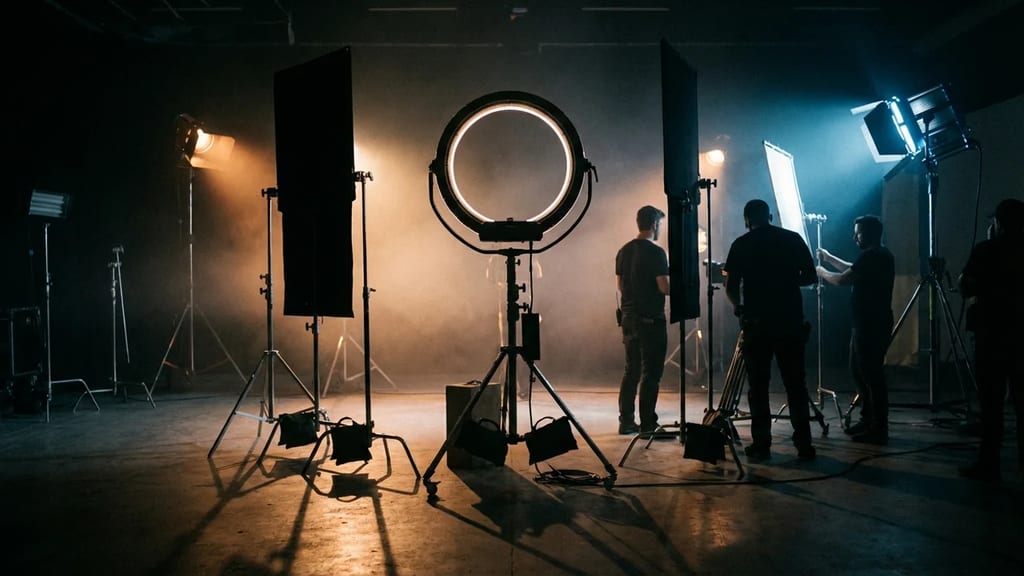
The Ring Light Setup refers to a circular light source with a central opening for the camera lens, which creates uniform, shadow-free illumination of the subject. Standard sizes range from 12 inches (30 cm) to 24 inches (61 cm) in outer diameter, with LED arrays of 240 to 480 individual diodes at color temperatures between 3200K and 5600K. The term derives from its characteristic ring shape, first developed in macro photography for uniform object illumination.
Technical Details
Professional film ring lights use bi-color LED strips with a power consumption of 65-95 watts, achieving illuminance levels of 3000-6000 lux at one meter. The central opening typically measures 6-8 inches (15-20 cm) and allows mounting of lenses up to 85mm without vignetting. High-quality models offer DMX control, 0-100% dimming, and CRI values above 95. Variable color temperature systems combine 3200K and 5600K LEDs with individual control.
History & Development
The ring light prototype originated in 1952 at Kodak for dental photography, developed by Lester Dine for shadowless documentation. In 1962, the military adapted the technology for forensic imaging. The ring light achieved its breakthrough in film in 1968 in Stanley Kubrick's "2001: A Space Odyssey" for the characteristic facial illumination of the astronauts. LED-based systems became established from 2010 onwards, with companies like Kino Flo and ARRI developing professional film versions from 2015.
Practical Application in Film
Ring lights create the characteristic circular catchlight in the eyes and completely eliminate nasolabial fold shadows. In "Blade Runner 2049" (2017), Roger Deakins used 18-inch ring lights for the replicant interrogation scenes. Horror and science fiction productions use ring lights for an "artificial" look – the uniform illumination appears unnatural and disturbing. Their small footprint makes them ideal for cockpit scenes or tight interiors where conventional lights cannot be positioned.
Comparison & Alternatives
Compared to softboxes, ring lights offer harder contrast while simultaneously providing shadow-free illumination. LED panels achieve higher light output but create side shadows. China balls deliver softer light but require greater distances. Modern tube light arrays simulate ring light effects with greater flexibility – four 2-foot tubes arranged in a square provide similar illumination characteristics with double the light output. For beauty shots, ring lights remain unrivaled; for dramatic scenes, DoPs prefer controlled single sources.