Technical Details
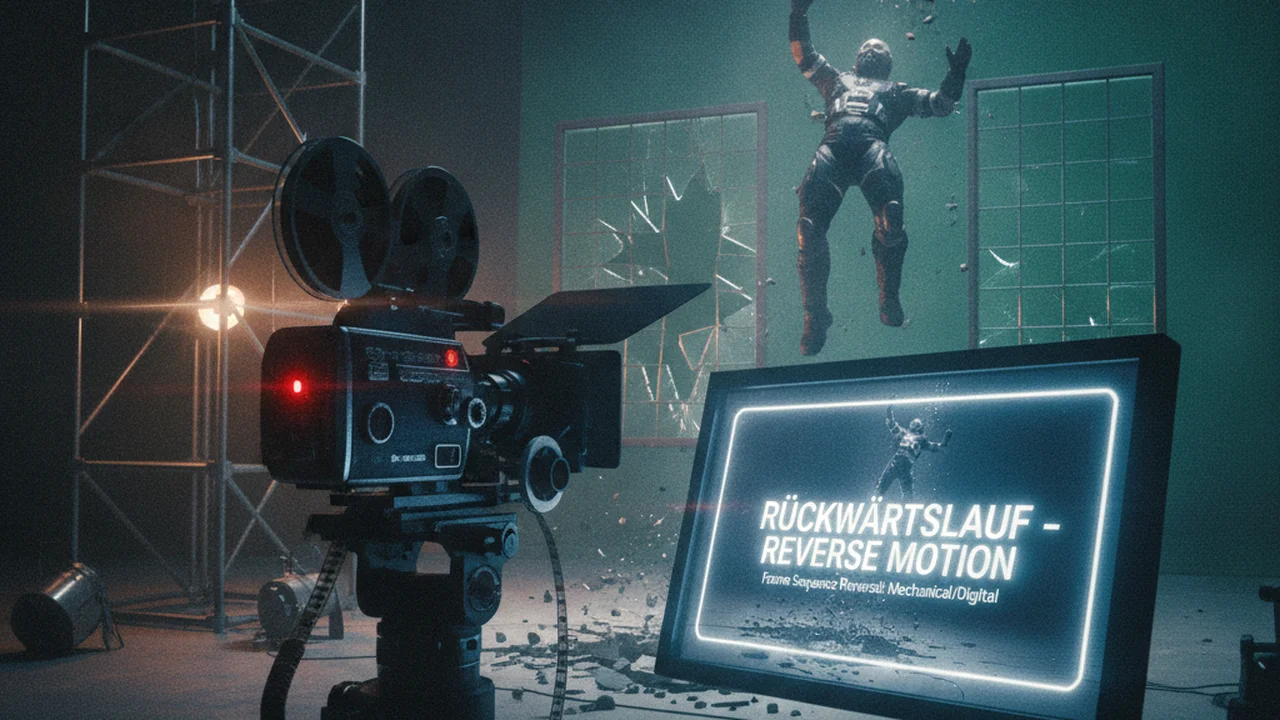
Analog implementation was achieved through mechanical reversal of the transport direction in the camera or projector, with the film's perforations ensuring exact 4.75mm spacing between frames. Digitally, reverse motion is realized by algorithmic reversal of the frame sequence – for example, frames 2880, 2879, 2878 are played back from a 120fps recording instead of 1, 2, 3. Modern systems interpolate additional intermediate frames using motion blur compensation. Variants include speed ramping (variable speed change), time remapping, and selective reverse motion for individual image elements through masking.
History & Development
Georges Méliès already experimented with manual reverse projection in "Le Manoir du Diable" in 1896. The first mechanical reverse function was developed by the French company Pathé in 1908 for their studio cameras. In 1920, Bell & Howell introduced the first projector with a precise reverse mechanism. Digitally, Avid revolutionized the technique in 1992 with non-linear editing, followed by real-time reverse playback by Final Cut Pro (1999) and Adobe Premiere Pro (2003). Modern AI-based motion interpolation since 2018 enables smoother transitions between normal and reverse playback.
Practical Application in Film
Christopher Nolan uses practical reverse motion in "Tenet" (2020) through synchronized forward and backward performance on set, combined with digital frame reversal. Stanley Kubrick realized the hotel sequence in "The Shining" (1980) through mechanical camera reverse motion. The workflow involves shooting at an increased frame rate (48-120fps), post-production reversal, and audio resyncing. Advantages: naturalistic depiction of impossible movements. Disadvantages: complex audio synchronization, increased rendering effort for high-resolution formats (4K: approx. 300% longer render time).
Comparison & Alternatives
Distinction from slow motion: Reverse motion reverses the direction of movement, while slow motion slows down the normal direction. Time remapping allows for variable speed changes, including reverse phases within a sequence. Motion graphics are increasingly replacing mechanical reverse motion with CGI-based movement reversal. Speed ramping combines both techniques for dynamic transitions. Practical reverse motion on set versus digital post-production: the physical method for authentic performer action, the digital method for precise technical control and combination with forward movements.