Filmlexikon.
Support
Reverse Grad ND
Camera · Terms

Reverse Grad ND

Murnau AI illustration
15lb sandbag 20 c stand 216 diffusion 250 diffusion 251 diffusion 25lb sandbag 35lb sandbag 40 c stand

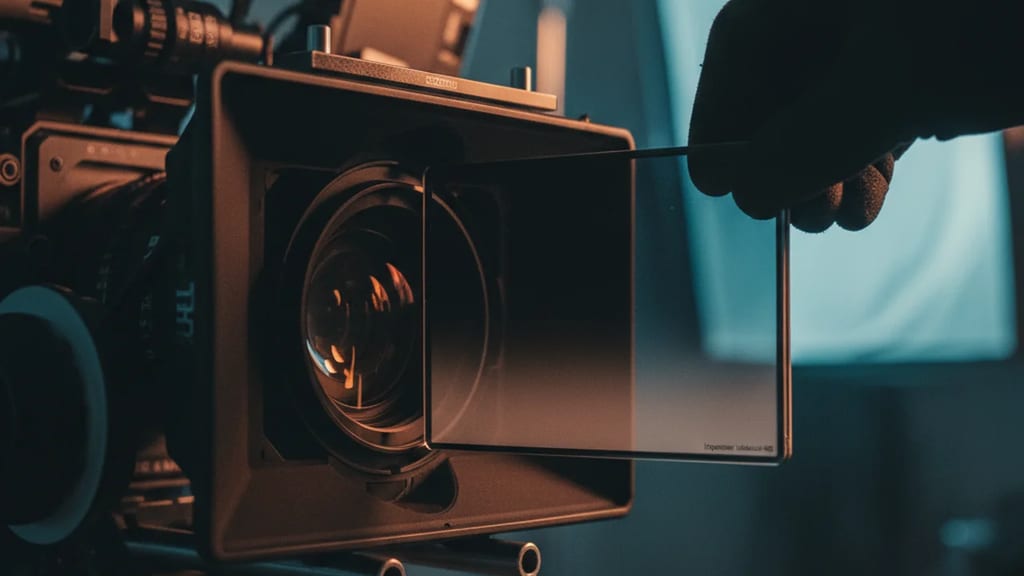
Reverse graduated ND filter with inverted density curve – maximum darkening at image bottom, less at top. For sunsets with bright sun at horizon and dark foreground.

Technical Details

The filter is made of optical glass with gradually vapor-deposited metal oxide layers. Standard dimensions include 100x150mm and 150x170mm for matte box systems. The transition zones range from 25-40mm with soft or hard gradients. Lee Filters produces Reverse ND filters with a maximum density of 0.6/0.9/1.2, while Formatt-Hitech offers up to 1.5. Spectral transmission remains consistently neutral over 400-700nm with less than 1% color shift. Magnetic filter frames allow precise positioning during shooting.

History & Development

The Reverse Grad ND was developed in 2009 by Lee Filters in collaboration with landscape photographers for extreme backlight situations. Cinematographer Roger Deakins popularized its use from 2011 onwards for exterior shots with significant brightness differences. In 2015, Formatt-Hitech introduced harder transitions, followed by magnetic systems from NiSi in 2018. Modern versions utilize ion beam sputtering for more uniform coatings and longer durability.

Practical Application in Film

Roger Deakins used Reverse ND filters in "Blade Runner 2049" (2017) for sunsets in Las Vegas to capture the orange-red sun and dark city ruins in detail. In "1917" (2019), the filter enabled simultaneous exposure of trenches and dramatic sky at dawn. The filter is primarily used during Golden Hour and Blue Hour when the sun is near the horizon. Workflow: Position the maximum density on foreground elements, the horizon in the weakest zone, and moderate sky darkening in the upper image area.

Comparison & Alternatives

It differs from the standard Graduated ND by its inverse density curve – while the latter gradually decreases from the top edge to the middle, the Reverse ND concentrates maximum darkening in the lower image area. Hard-edge versions are suitable for defined horizon lines, soft-edge for irregular contours. Digital blending of multiple exposures offers more flexible post-processing but requires a tripod and static subjects. Variable ND filters can reduce brightness differences but cannot selectively address different image zones.

From the crafts

Perspectives

Cinematographer

Ich positioniere den Reverse-ND so, dass die stärkste Dichte genau auf dem Vordergrund liegt – bei Sonnenuntergängen meist Felsen oder Gebäude im unteren Bilddrittel. Die schwächste Zone muss exakt auf die Sonne treffen, sonst wirkt sie überbelichtet oder unnatürlich gedämpft. Durch Live-View und Zebra-Anzeige kontrolliere ich die Belichtungsverteilung in Echtzeit.

Director

Der Reverse-ND ermöglicht mir dramatische Sonnenuntergänge ohne den Verlust von Vordergrund-Details – perfekt für emotionale Höhepunkte oder Wendepunkte der Handlung. Statt zwischen überbelichteten Himmeln oder schwarzen Silhouetten wählen zu müssen, kann ich beide Bildebenen für die Erzählung nutzen. Die natürliche Lichtverteilung unterstützt die Glaubwürdigkeit der Szene ohne offensichtliche digitale Nachbearbeitung.

Producer

Ein Reverse-ND-Set kostet etwa 800-1.200 Euro, spart aber teure VFX-Arbeit bei Gegenlicht-Aufnahmen und reduziert Drehtage durch effizientere Golden-Hour-Nutzung. Statt mehrere Setups für verschiedene Belichtungen brauchen wir nur eine Kameraposition, was bei Zeitdruck in der Magic Hour entscheidend ist. Die Filter sind robust und halten jahrelang, amortisieren sich schnell gegenüber digitalen Lösungen.

More in the lexikon

Related terms

Test your knowledge

Quiz

1. Was beschreibt „Umgekehrter Verlaufs-ND" am besten?

2. Zu welchem Department gehört „Umgekehrter Verlaufs-ND"?

3. Wie viele verschiedene Fachperspektiven bietet dieser Eintrag?

Report an error
From the Filmfarm ecosystem

Understand visual language, budget productions, connect crew.

The Lexikon is part of the Filmfarm ecosystem — alongside budgeting (FilmBalance), an industry magazine (FilmCircus) and crew networking (FilmCall, CrewMesh). One shared vocabulary for the whole production.

FilmFarm FilmRadarComing soonFilmPulseComing soonFilmNumbersComing soonFilmCapitalComing soonFilmLabComing soonFilmBalanceComing soonFilmCircusComing soon