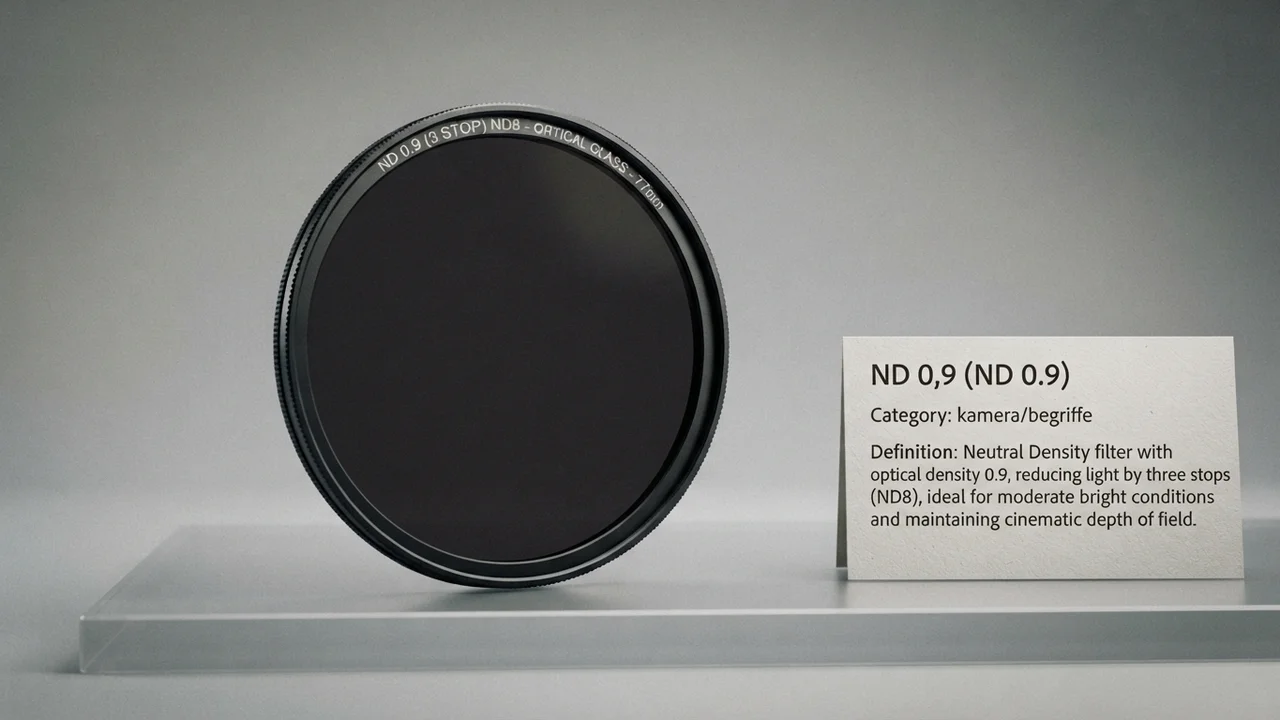
Optical Density and Aperture Value
The ND 0.9 filter (also known as ND8) has an optical density of 0.9 and reduces incoming light by three stops. This means the amount of light is reduced to one-eighth.
The ND8 designation system indicates: ND8 means light is divided by 8. This corresponds to a reduction of 3 stops (3 x halving = eighth).
Typical Applications
Moderate to Bright Lighting Conditions
The ND 0.9 is ideal for transitional lighting situations between ND 0.6 and ND 1.2. On bright, overcast days or in scenes with mixed lighting, this filter offers the right balance.
Combinability for Extended Reduction
The ND 0.9 can be combined with the ND 0.3 or ND 0.6. ND 0.3 + ND 0.9 = ND 1.2 (4 stops), ND 0.6 + ND 0.9 = ND 1.5 (5 stops). This makes the system very flexible.
Professional Exterior Shots
Many productions use a set of ND 0.3, ND 0.6, and ND 0.9 – this is more cost-effective and flexible than variable filters, with better optical quality.
Difference from Variable ND Filters
Variable ND filters can cover the ND 0.9 range but have:
- Cross-polarization effects: Visible patterns at wide angles
- Color shifts: Magenta or green at strong settings
- Lower optical quality: Multiple internal layers
- Greater weight and size: Variable filters are often thicker
The fixed ND 0.9 is lighter, more precise, and cheaper when combining multiple filters.
Relation to the 180-Degree Shutter Rule
Along with the ND 0.6, the ND 0.9 is part of a professional filter system. While the ND 0.6 is perfect at f/2.8, the ND 0.9 allows for the same shutter speed of 1/50 second (at 25p) at smaller apertures like f/4 or f/5.6.
The ND 0.9 reduction makes sense when:
- The light is stronger than needed for ND 0.6
- You want to work at f/4 instead of f/2.8
- You need to stack multiple filters for flexible options
Specifications
- Optical Density: 0.9
- Light Loss: 3 stops
- Multiplier: ND8
- Typical Transmission Rate: 12.5%
- Usage Range: Bright to very bright daylight
- Combinations: Often stacked with ND 0.3 or ND 0.6
Practical Application Examples
- Switching between lighting situations: Flexible without filter changes
- Systems with fixed filters: Combinable instead of variable filters
- Documentary: Quick transitions between interior and exterior shots
- Music videos: Consistent visual language in changing weather