Technical Details
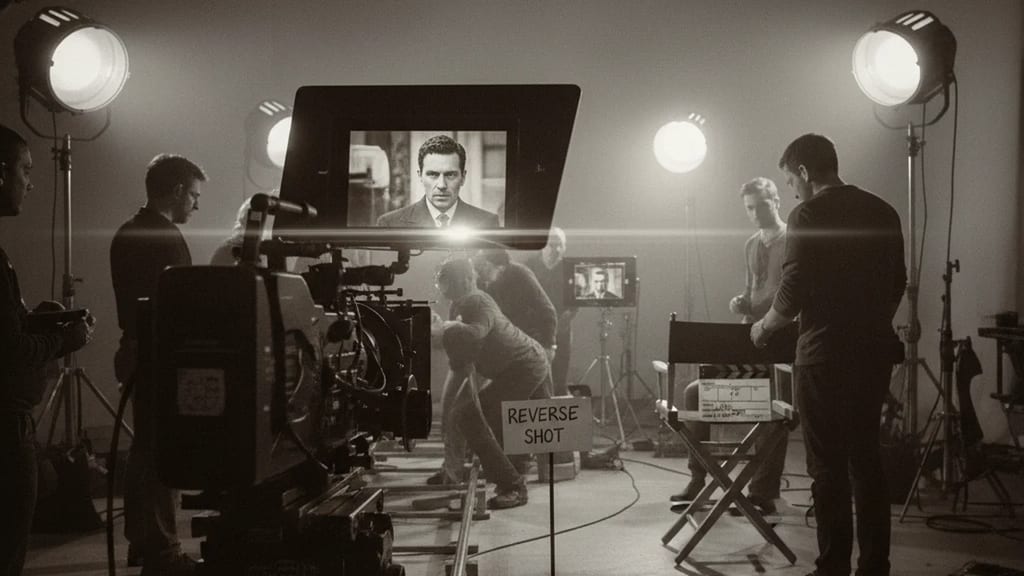
Standard reverse shots typically use focal lengths between 35mm and 85mm on full-frame sensors to ensure natural proportions. Shot and reverse shot stay on one side of an imaginary line defined by the characters' eyelines or directions of movement — the axis of action; crossing it means crossing the line. In dialogue scenes, the camera is typically positioned at a 30°-45° angle to the actors' facial lines. Over-the-shoulder (OTS) shots, as a variant of the reverse shot, show 20-30% of the other person's shoulder in the frame to create spatial orientation. Clean singles omit this reference and isolate the actor completely.
History & Development
Shot/reverse shot became the foundation of classical Hollywood cinema in the 1910s; D.W. Griffith's "The Lonely Villa" (1909), by contrast, stands for parallel editing. Edwin S. Porter had already experimented with perspective cuts in 1903 in "The Great Train Robbery," but without systematic application of the 180° rule. John Ford perfected the technique in the 1930s through precise axis adherence and emotional weighting of shot sizes. The Nouvelle Vague, around Jean-Luc Godard, deliberately broke with these conventions starting in 1960, using jump cuts as an alternative to the classic reverse shot principle.
Practical Use in Film
Starting with "Seven Samurai," Akira Kurosawa shot with several cameras running simultaneously on long lenses — an alternative to breaking a scene down into individual shots and reverse shots.
Comparison & Alternatives
Insert shots interrupt the shot-reverse-shot schema with close-ups of objects or hands, while cutaways switch to entirely different locations. Master shots with camera movements have increasingly replaced static reverse shot sequences since the 1990s – for example, through Steadicam orbits or gimbal choreography. Since 2016, 360° cameras in VR productions enable simultaneous capture of all viewing angles, rendering the classic reverse shot obsolete. Deep focus photography à la Gregg Toland shows both conversation partners in sharp focus within a single frame, completely avoiding cuts.