Technical Details
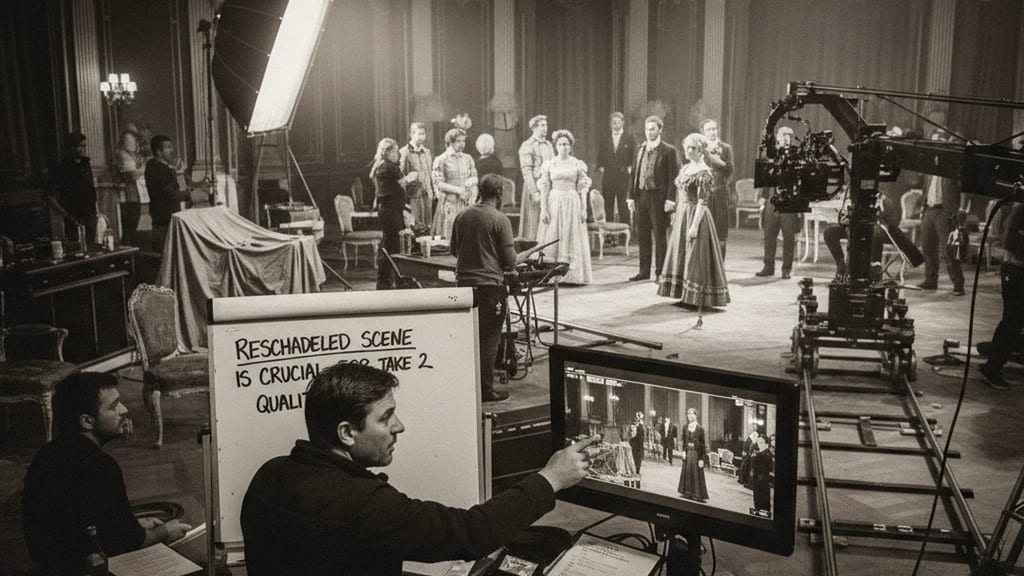
Reshoots require exact continuity documentation of the original footage: camera settings (focal lengths, apertures, filter types), lighting setups (color temperature, light direction, intensity values), and costume/makeup details must be reproduced with millimeter precision. Script supervisors document these parameters in detailed continuity reports. For studio films, complete lighting plots and camera reports are archived to ensure identical image characteristics. Digital color correction compensates for minimal deviations, with modern DI systems easily handling tolerances of ±0.5 f-stops.
History & Development
Systematic reshoots became established in the 1930s with Hollywood's studio system. MGM was the first studio to introduce mandatory test screenings in 1934, which regularly resulted in reshoots. The term "reshoot" first appeared in Variety in 1947. In the 1970s, studios standardized preview processes: after the first rough cut, test screenings followed, with audience reactions determining reshoots. With digital post-production from the 1990s onwards, the technical hurdles for seamless integration of reshot scenes decreased significantly.
Practical Application in Film
"Blade Runner" (1982) went through three different final versions via reshoots over 18 months. Marvel Studios structurally plan reshoots: "Avengers: Endgame" (2019) involved 22 days of reshoots for alternative plotlines. "World War Z" (2013) replaced the entire third act with 40 days of reshoots, costing $40 million. Typical workflow: Rough cut → Test screening → Audience analysis → Reshoot planning → Integration → Final cut. Reshoots usually occur 3-6 months after principal photography to allow actors scheduling buffers.
Comparison & Alternatives
Pick-ups exclusively cover supplementary details (inserts, reaction shots) without principal actors and last a maximum of 1-5 days. Additional photography refers to planned supplementary shoots for already conceived scenes. Reshoots, on the other hand, arise reactively due to identified narrative problems. Second unit shoots film action- or landscape-heavy sequences parallel to the main production without the main cast. In low-budget productions, ADR sessions (Automated Dialogue Replacement) and digital compositing solutions often replace costly reshoots. Streaming providers are increasingly tending towards extensive reshoots, as they can evaluate direct viewer metrics.