Filmlexikon.
Support
Red Streak
Camera · Terms

Red Streak

Murnau AI illustration
flow para roll take

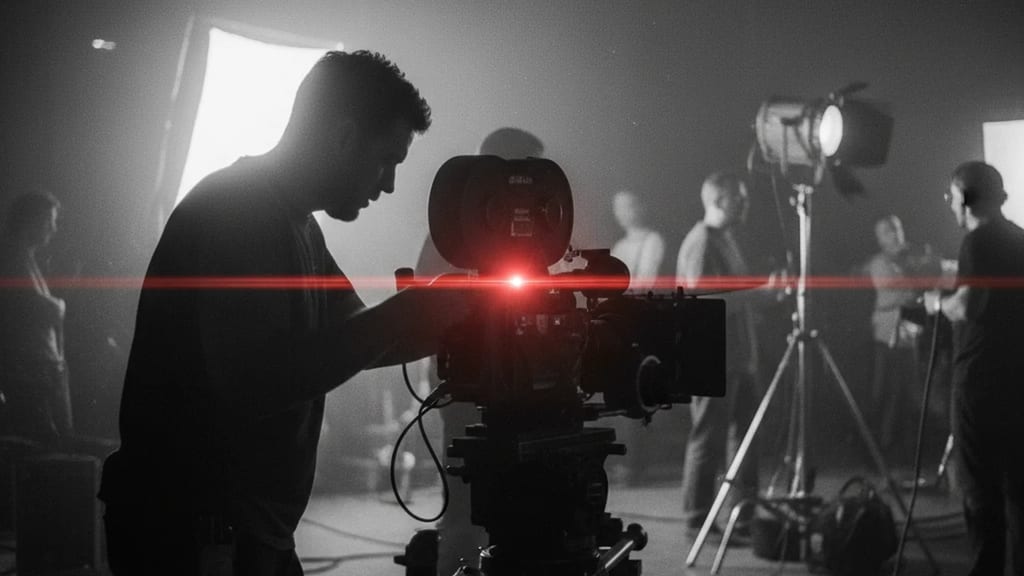
Red streaks on color film caused by light striking the red-sensitive emulsion layer. Run parallel to film edge, typically appearing within 2–3 seconds of unprotected daylight exposure.

Technical Details

Red Streaks primarily manifest in the red-sensitive layer of color film emulsion, showing a characteristic density of 0.3 to 1.8 on the logarithmic scale. With Kodak Vision3 250D (5207), the defect occurs even with daylight exposure of 2-3 seconds on unprotected film. The streaks run parallel to the film edge and mostly affect the perforation area, where mechanical stress causes micro-cracks in the protective layer. Fujifilm Eterna stocks, due to different emulsion compositions, exhibit a slight shift towards orange-red (approximately 620-630nm wavelength).

History & Development

The term Red Streak became established in the 1960s with the introduction of improved color film stocks by Eastman Kodak. Early Technicolor productions of the 1950s occasionally used the defect as a practical effect for explosion or fire scenes. With the introduction of low-light film stocks in the 1980s (ASA 500+), the problem intensified due to increased light sensitivity. Modern film stocks since 2010 integrate improved anti-halation layers, which have reduced Red Streaks by approximately 40%.

Practical Use in Film

Camera assistants routinely identify Red Streaks during magazine loading under red light conditions. In "Saving Private Ryan" (1998), Janusz Kamiński deliberately used prepared film rolls with controlled Red Streaks for combat sequences. In post-production, Red Streaks require extensive digital retouching using frame-by-frame painting or automated dust-busting tools like Revival or PFClean. Correction time is approximately 8-12 hours per affected film roll for professional restoration.

Comparison & Alternatives

Red Streaks differ from Blue Streaks due to their wavelength specificity and from Purple Fringing by their continuous linearity. Static Marks show irregular zigzag patterns, while Cinch Marks create circular artifacts. Modern digital workflows eliminate the problem entirely, yet filmmakers like Christopher Nolan consciously prefer 65mm film despite potential Red Streak risks. Preventive measures include light-tight magazine sealing and temperature control at 13-18°C during transport and storage.
From the crafts

Perspectives

Cinematographer

Ich prüfe jedes Magazin unter Rotlicht auf bereits sichtbare Red Streaks, bevor ich es in die Kamera einsetze. Bei kritischen Szenen verwende ich doppelte Light-Seals und achte darauf, dass die Filmrollen nie länger als 20 Minuten direktem Sonnenlicht beim Location-Wechsel ausgesetzt sind. Falls Red Streaks auftreten, dokumentiere ich deren Position genau für die Post-Produktion und informiere sofort den Produzenten über mögliche Re-Shoot-Notwendigkeiten.

Director

Red Streaks können meine Vision komplett zerstören, besonders in emotionalen Close-Ups oder wichtigen Establishing Shots. Ich arbeite eng mit dem Kameramann zusammen, um bei verdächtigen Takes sofort einen zweiten Take zu drehen, auch wenn das den Zeitplan belastet. In wenigen Fällen nutze ich bewusst kontrollierte Red Streaks als Stilmittel für Trauma- oder Erinnerungssequenzen, dann aber immer geplant und mit entsprechender Budgetplanung für die aufwendige Postproduktion.

Producer

Red Streaks bedeuten für mich potentielle Mehrkosten von 15.000-30.000 Euro pro betroffener Szene durch digitale Restauration oder Re-Shoots. Ich kalkuliere daher 2% des Kamera-Budgets als Red-Streak-Reserve ein und bestehe auf professionelle Filmlagerung mit klimatisierten Transportboxen. Bei größeren Produktionen beauftrage ich täglich Rushes-Kontrolle im Labor, um Red Streaks sofort zu identifizieren und schnelle Re-Shoot-Entscheidungen treffen zu können, solange noch Set und Cast verfügbar sind.

More in the lexikon

Related terms

Test your knowledge

Quiz

1. Zu welchem Department gehört „Red Streak"?

2. Wie viele verschiedene Fachperspektiven bietet dieser Eintrag?

Report an error
From the Filmfarm ecosystem

Understand visual language, budget productions, connect crew.

The Lexikon is part of the Filmfarm ecosystem — alongside budgeting (FilmBalance), an industry magazine (FilmCircus) and crew networking (FilmCall, CrewMesh). One shared vocabulary for the whole production.

FilmFarm FilmRadarComing soonFilmPulseComing soonFilmNumbersComing soonFilmCapitalComing soonFilmLabComing soonFilmBalanceComing soonFilmCircusComing soon