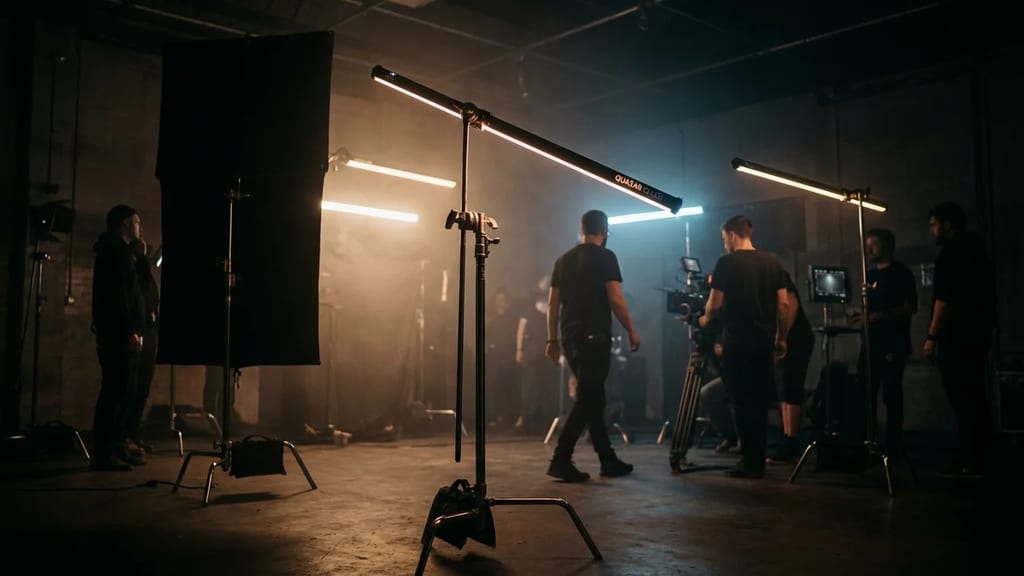
Quasar Science LED tubes (30–240 cm), 2700K–6500K, up to 15,000 lumens. Flicker-free at 25 kHz, DMX control, True Match technology for precise daylight/tungsten color matching.
Technical Details
Quasar Q-LED lights achieve color temperatures from 2700K to 6500K with a power consumption between 25 and 240 watts, depending on the model. The Rainbow series additionally produces saturated colors across the entire RGB spectrum with 16-bit resolution per color channel. The tubes are available in lengths from 1 foot (30cm) to 8 feet (240cm) and achieve a maximum light output of up to 15,000 lumens for the largest models. Control is via DMX512, CRMX, or proprietary apps via Bluetooth. A special feature is the True Match technology, which precisely matches LED spectra to daylight or tungsten.
History & Development
Quasar Science was founded in 2012 by Garrett Brown, the inventor of the Steadicam, and his son Darius. The first Q-LED models were launched in 2014 and quickly established themselves as an alternative to classic cinema fluorescents. In 2016, the Rainbow series with RGB functionality followed, and in 2019, the CrossFade technology for seamless color temperature transitions. The current Q50R series from 2022 integrates wireless DMX and expanded control options via cloud-based apps.
Practical Use in Film
Quasar Q-LEDs have been used in productions such as "The Crown" (Netflix) for uniform illumination of historical interiors and "Stranger Things" for its characteristic 1980s neon aesthetic. Cinematographers appreciate the flicker-free 25,000Hz PWM frequency for slow-motion shots and the precise dimming from 0-100% without color shift. Typical workflow: mounting via standard spigots on C-stands or integration into practical sets as a hidden light source. Disadvantages: higher acquisition costs compared to standard LEDs and dependence on external power supply.
Comparison & Alternatives
Quasar Q-LEDs compete directly with Astera Tubes and Arri's Sky Panel systems. Compared to Astera, they offer better color rendering but are less robust for outdoor shoots. Sky Panels provide more light output but are less versatile in shaping. Modern alternatives include Creamsource Vortex8 for pinpoint lighting or Litepanels Gemini for large-area softlight applications. Quasar is particularly suitable for practical integration and accent lighting, less so for key light tasks on larger sets.