Technical Details
Professional film putty knives feature a blade width of 12-38 mm with a material thickness of 0.3-0.8 mm. The standard version is made of hardened stainless steel (1.4301) with a hardness of 45-50 HRC for optimal flexibility without deformation. The handle measures 80-120 mm and has a non-slip surface texture. Special variants for high-temperature applications (up to 300°C) have ceramic-coated blades, while antistatic versions use conductive polymers. The blade ends are rounded as standard (radius 1-2 mm) to prevent film damage.
History & Development
The systematic use of putty knives in film lighting began in 1943 at MGM Studios when gaffer George Stevens Jr. employed the tool for damage-free mounting of the first Eastman Color filters. In 1958, Lee Filters developed the first specific "Lighting Spatula" with a temperature-resistant coating. The breakthrough came in 1967 with the introduction of Teflon-coated blades by Rosco, which remained usable even with 250°C lamps. Modern CNC-milled variants since 2003 achieve tolerances of ±0.05 mm.
Practical Use in Film
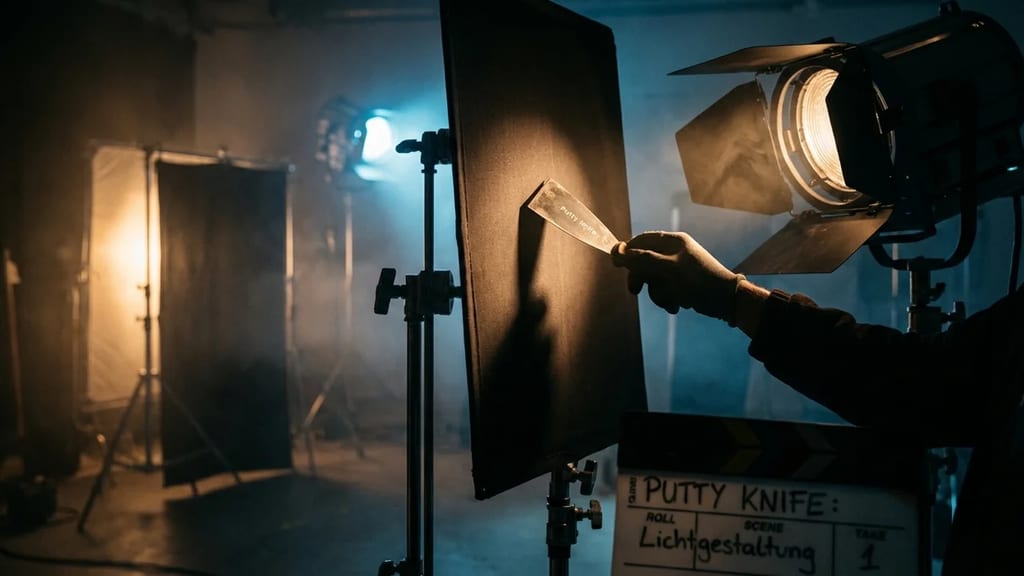
On "Blade Runner 2049" (2017), DoP Roger Deakins used putty knives for millimeter-precise positioning of Amber Drift gels on 18K tungsten lamps for the iconic orange-cyan contrasts. The workflow involves preheating the putty knife to 40-50°C to prevent condensation, followed by circular smoothing movements from the center outwards. Putty knives eliminate 95% of air bubbles between the filter and protective glass, preventing hotspots and uneven color distribution. On LED panels, they enable precise gradient effects through partial gel coverage.
Comparison & Alternatives
Compared to squeegee systems, putty knives offer higher precision with lower material pressure (0.2-0.5 N/cm²), while magnetic holders allow for faster mounting but no fine adjustment. Modern alternatives include ultrasonic smoothing devices (since 2019) and electrostatic positioning tools, which, however, cost 15-20 times more. Digitally controlled filter magazines are increasingly replacing manual putty knife workflows but do not achieve their 0.1mm accuracy for individual adjustments.