Filmlexikon.
Support
Proskar 16
Camera · Terms

Proskar 16

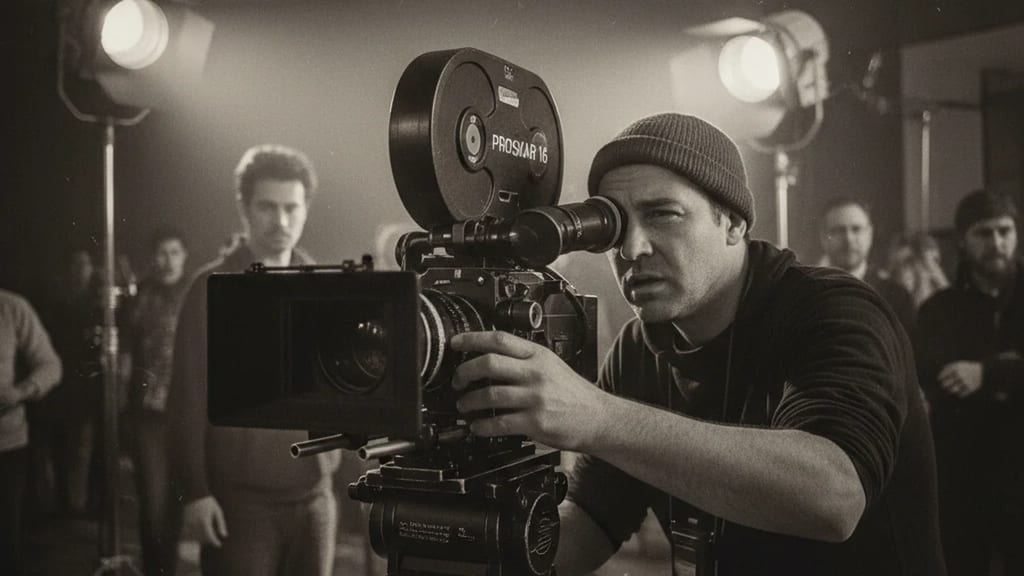
Murnau AI illustration
flow para proskar roll take

Anamorphic attachment lens by Rank/Taylor Hobson for 16mm cameras with 25% horizontal squeeze, developed 1962 to achieve Cinemascope aesthetics on low budgets.

Technical Details

The Proskar 16 system utilizes special anamorphic attachments with focal lengths ranging from 12.5mm to 75mm for standard 16mm cameras. The cylindrical lens elements create a horizontal compression of 25% while maintaining vertical resolution. Typical aperture values range from f/2.8 to f/16, with optimal sharpness performance between f/4 and f/8. The weight of the attachments varies between 280g (12.5mm) and 850g (75mm).

History & Development

Proskar 16 was developed in 1962 by the British Rank Organisation in collaboration with Taylor Hobson to provide low-budget productions with access to Cinemascope aesthetics. Its first commercial application was in the 1963 BBC production "The Monocled Mutineer." In 1968, Panavision expanded the system to include Super-16 compatibility. From 1975 onwards, Proskar 16 gained traction in the American independent film sector but rapidly lost significance with the advent of digitalization from 2005.

Practical Use in Film

George Lucas used Proskar 16 for establishing shots in "American Graffiti" (1973) to reduce production costs. Terrence Malick shot nature scenes in "Badlands" (1973) entirely with the system. The typical workflow requires special projectors with de-squeeze lenses or digital correction in post-processing. Advantage: 40% cost savings compared to 35mm anamorphic. Disadvantage: Visible distortions with rapid camera movements and a reduced light intensity of 1.5 stops.

Comparison & Alternatives

Proskar 16 differs from standard anamorphic lenses by its lower squeeze factor (1.33:1 vs. 2:1) and its 16mm optimization. Modern alternatives include digital anamorphic simulations in DaVinci Resolve or Moment anamorphic smartphone attachments. Hawk V-Lite Anamorphics today offer a similar aesthetic with better optical quality. Proskar 16 remains relevant for authentic vintage looks or extreme budget limitations under 50,000 Euros total budget.

From the crafts

Perspectives

Cinematographer

Ich schätze die charakteristischen horizontalen Lens Flares und das organische Bokeh des Proskar 16, muss aber die reduzierte Schärfentiefe und den Lichtverlust bei Available Light-Situationen einkalkulieren. Die Vorsatzlinsen erfordern präzises Fokussieren, da die anamorphe Verzerrung Unschärfen besonders an den Bildrändern verstärkt.

Director

Proskar 16 verleiht meinen Filmen diese nostalgische 70er-Jahre-Cinemascope-Atmosphäre, die besonders bei Roadmovies und Charakterstudien die emotionale Distanz zwischen Figuren visuell unterstützt. Die horizontalen Verzerrungen bei Gesichtern nutze ich gezielt für psychologische Momente der Entfremdung.

Producer

Mit Proskar 16 reduziere ich Filmkosten um 35-40% gegenüber 35mm-Anamorphic und spare zusätzlich bei Kameramieten, da Standard-16mm-Equipment verfügbar bleibt. Allerdings erfordert die Post-Production spezialisierte Color Grading-Sessions für die De-Squeeze-Bearbeitung, was 2-3 zusätzliche Arbeitstage bedeutet.

More in the lexikon

Related terms

Test your knowledge

Quiz

1. Was beschreibt „Proskar 16" am besten?

2. Zu welchem Department gehört „Proskar 16"?

3. Wie viele verschiedene Fachperspektiven bietet dieser Eintrag?

Report an error
From the Filmfarm ecosystem

Understand visual language, budget productions, connect crew.

The Lexikon is part of the Filmfarm ecosystem — alongside budgeting (FilmBalance), an industry magazine (FilmCircus) and crew networking (FilmCall, CrewMesh). One shared vocabulary for the whole production.

FilmFarm FilmRadarComing soonFilmPulseComing soonFilmNumbersComing soonFilmCapitalComing soonFilmLabComing soonFilmBalanceComing soonFilmCircusComing soon