Technical Details
Analog long takes are limited by magazine capacities: Standard 35mm magazines hold 400 feet (122 meters) for 11 minutes at 24fps, while 1000-foot magazines allow for 28 minutes. Digital cameras like the ARRI Alexa LF theoretically achieve unlimited recording lengths with sufficient storage capacity (512GB CFast 2.0 cards for approximately 40 minutes of 4K ProRes).
Technical variations include static long takes (Fixed Long Take), mobile versions with dollies, Steadicam, or handheld operation, as well as modern drone long takes. Invisible cuts achieved through pans across dark areas or objects extend the apparent recording duration through hidden edits.
History & Development
Early long takes arose from technical necessity: Georges Méliès' "Le Voyage dans la Lune" (1902) utilized theatrical single shots. Orson Welles established the dramaturgically motivated long take with "Citizen Kane" in 1941 (a 3:20-minute opening sequence). Alfred Hitchcock, in 1948 with "Rope," achieved a seemingly uncut 80-minute narrative through ten 8-10-minute long takes.
Modern milestones: Brian De Palma's 4-minute Copacabana sequence ("Goodfellas," 1990), Paul Thomas Anderson's 8-minute disco sequence ("Boogie Nights," 1997). Alejandro González Iñárritu pushed the boundaries with "Birdman" (2014) through 15 seemingly seamless long takes of 6-8 minutes each.
Practical Application in Film
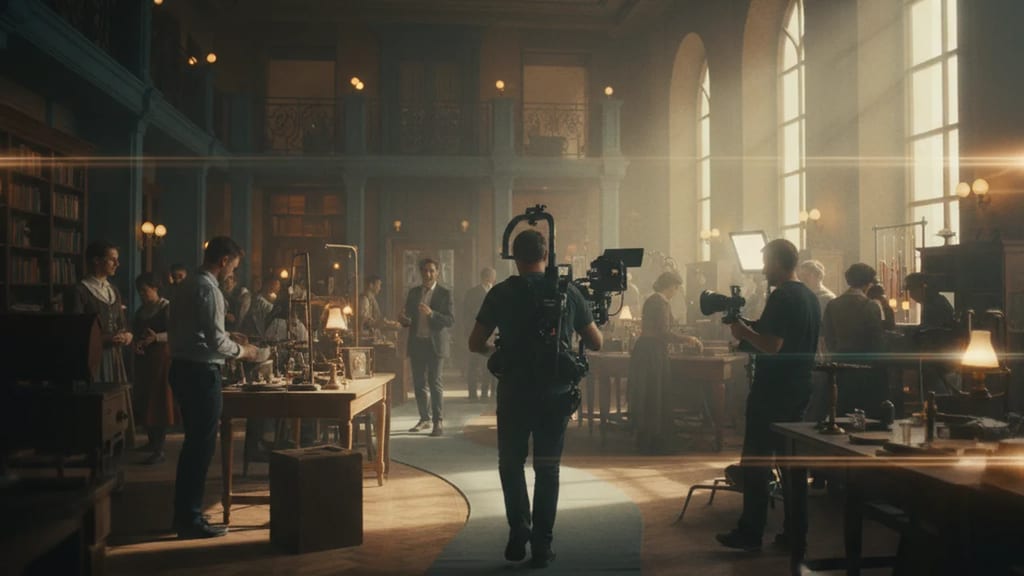
Long takes require precise choreography between actors, camera, and sound. Russell's 6-minute "Copacabana" sequence necessitated eight rehearsals and three takes. Modern productions utilize Technocranes (up to 50-foot booms) or cable cam systems for complex camera movements.
Advantages: Preservation of spatial and temporal continuity, intense actor performances, immersive audience experience. Disadvantages: Costly repetitions in case of errors, limited editing options in post-production, high demands on lighting over extended camera paths.
Comparison & Alternatives
Long takes differ from master shots by their dramaturgical completeness without planned coverage. Pseudo-long takes with invisible cuts (as in "1917," 2019) simulate continuity through digital transitions every 6-8 minutes.
Modern alternatives include stitching techniques (digitally joining multiple takes) and Virtual Production with LED walls, which allow for background changes without location changes. Pre-visualization software like Unreal Engine enables precise long take choreography before principal photography begins.