Cinematographer
Aus DoP-Perspektive ist dieses Element essentiell für die visuelle Gestaltung. Es ermöglicht mir die gewünschte Farbstimmung und das ästhetische Bild konsistent umzusetzen.
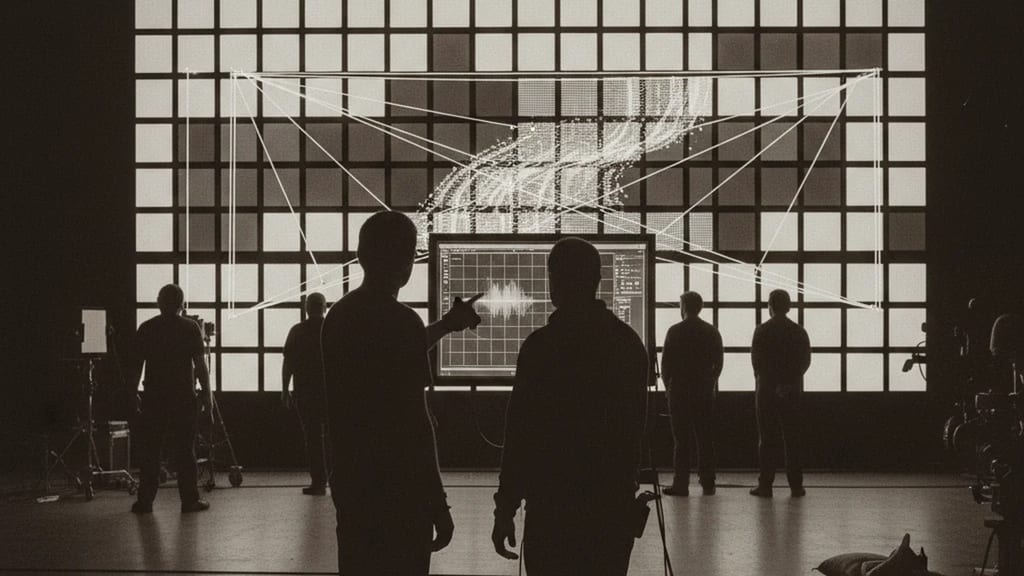
Control technique mapping video signals pixel-by-pixel onto individually addressable LED fixtures, creating a low-resolution display effect.
Pixel Mapping refers to a lighting control technique where an image or video is projected onto an array of individually controllable LED fixtures. Each fixture – or each individually addressable LED segment within a fixture – acts as a pixel, reproducing color and intensity. Collectively, the fixture array behaves like a low-resolution display capable of showing patterns, gradients, or moving content.
This technique originally stems from stage and event lighting and has found its way onto film and TV sets through pixel-addressable LED fixtures. Unlike a conventional lighting setup where each fixture outputs a fixed, uniform value, Pixel Mapping allows each point within a fixture or across multiple fixtures to be animated independently.
Control is typically achieved via DMX512 or, for larger setups, through network-based protocols like Art-Net or sACN, which distribute multiple DMX universes over a network. An RGB unit occupies at least three DMX channels (Red, Green, Blue). For wireless transmission, CRMX is frequently used.
At its core, Pixel Mapping software or a media server requires three pieces of information to correctly map content:
The software calculates which fixture receives which color and brightness value from the input image or video signal. In film applications, the source material (photo/video) is often additionally sampled for hue and intensity, and these values are then sent to the fixtures.
Pixel Mapping can be implemented using lighting consoles with integrated mapping functions, specialized software, or media servers:
| Category | Examples |
|---|---|
| Consoles with Mapping | grandMA, ETC Eos, ChamSys MagicQ, Avolites |
| Specialized Software | Madrix, Resolume Arena (with DMX output) |
| Pixel-Addressable Fixtures | LED tubes and RGB units with segmented pixel groups |
Pixel-addressable fixtures group their LED chips into individually controllable pixel groups. For example, LED tubes can address varying numbers of pixels per unit depending on their length (e.g., 10, 24, or 48 pixels per tube in the Quasar Science Rainbow 2 series).
In film and TV, Pixel Mapping is less often used to display a recognizable image within the frame; the purpose is usually to create dynamic, realistic lighting situations:
When implementing this, careful color management is essential: source material cannot be directly transferred to the fixtures without processing, as the color space and the LEDs' reproduction characteristics must be taken into account.
Aus DoP-Perspektive ist dieses Element essentiell für die visuelle Gestaltung. Es ermöglicht mir die gewünschte Farbstimmung und das ästhetische Bild konsistent umzusetzen.
Diese professionelle Lösung erhöht die Produktionseffizienz und reduziert Post-Production-Anforderungen. Sie ermöglicht flexible, schnelle Anpassungen während des Drehs.
Als Gaffer ist dies ein unverzichtbares Werkzeug meines täglichen Handwerkszeugs. Es ermöglicht mir professionelle Lichtkontrolle und schnelle Anpassungen auf Set, was Zeit spart und Qualität sichert.
1. Zu welchem Department gehört „Pixel Mapping"?
2. Wie viele verschiedene Fachperspektiven bietet dieser Eintrag?
The Lexikon is part of the Filmfarm ecosystem — alongside budgeting (FilmBalance), an industry magazine (FilmCircus) and crew networking (FilmCall, CrewMesh). One shared vocabulary for the whole production.