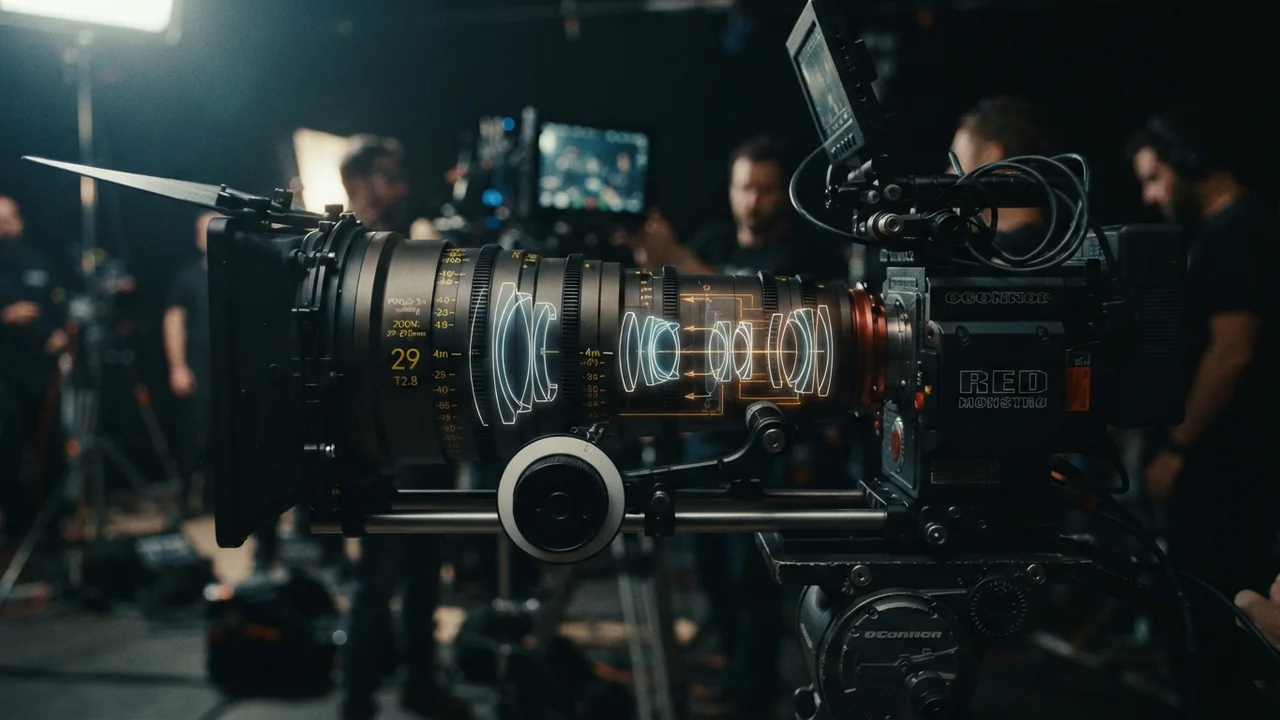
Zoom construction that holds focus across the entire focal range: once focused, the subject stays sharp while zooming. Standard for cine zooms, the exception for stills zooms.
Parfocal means: The focus remains constant across the entire focal length range. If you focus sharply on the eyes at 100mm and then zoom out to 25mm, the sharpness is maintained — and vice versa. The opposite is a varifocal design, where the plane of focus shifts during zooming, requiring refocusing after every focal length change. Technically, parfocality requires a mechanically complex compensation group within the lens that tracks the focus position during the zooming process.
The Classic Workflow on Set
Parfocality is the foundation of an old, reliable technique: zoom in on the detail, focus, zoom out, and frame. The focus puller uses this during rehearsals to verify distances, and during the actual shoot, it allows for zoom movements within a take without the focus drifting. Broadcast and documentary cinematographers rely on this daily — an interview where every focal length correction forces a refocus is practically unworkable.
Why Photo Zooms Are Mostly Varifocal
With photo lenses, autofocus handles readjustment after every zoom anyway, so manufacturers save on the expensive mechanical compensation and instead optimize for weight, size, and price. Some modern photo zooms electronically compensate for focus drift via a motor — this works for stills but fails during a visible zoom movement because the tracking is jerky or lags behind. True cine zooms solve this purely mechanically and maintain focus even during slow, visible movements. The price difference between a photo and a cine zoom is largely due to this mechanism, along with minimized focus breathing and constant aperture.
- Test adapted photo zooms before shooting: zoom in, focus, zoom out — if the focus shifts, any zoom movement within the take is out of the question.
- Even parfocal optics only maintain this with the correct flange focal distance — check after every lens change on unfamiliar bodies.
Related terms
Quiz
1. Was beschreibt „Parfokales Design" am besten?
2. Zu welchem Department gehört „Parfokales Design"?